
Can One RO System Supply a Home and Guest Cottage?
One reverse osmosis system can supply a main home and a detached guest cottage if it's designed for their combined water demand and can deliver enough pressure to both buildings.
RO system capacity is only part of the answer. Storage, pump performance, pipe size, and the distance to the cottage also affect how well a shared system works. Start by deciding which fixtures need treated water, then size the equipment around how both buildings use it.
How a Shared RO System Connects Both Buildings
A shared whole-house RO setup treats water at a central location, then sends it to the main home and cottage through separate plumbing branches. Many systems use a storage tank and a distribution pump because the RO membrane produces treated water gradually.
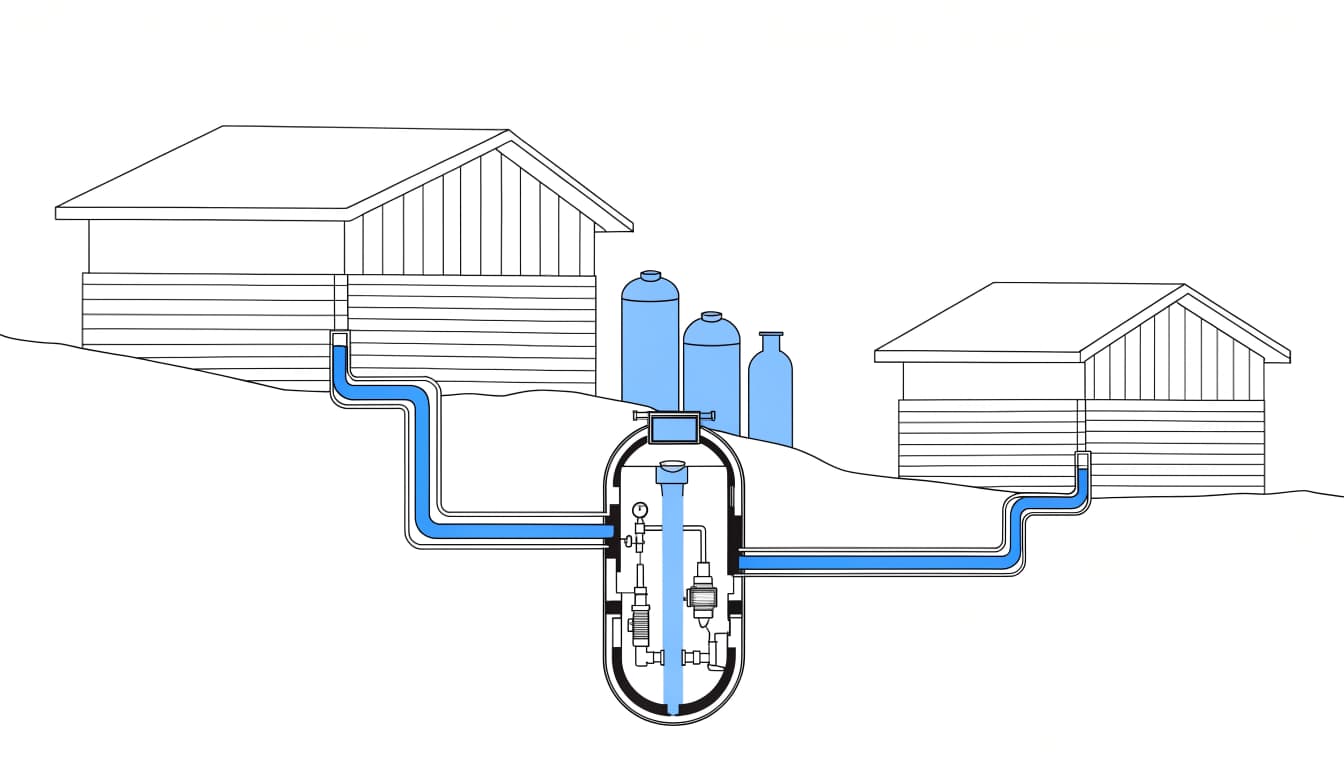
The system might sit near the main home's water entry or in a separate equipment area. The location needs enough room for pretreatment, storage, pumps, controls, electrical connections, drainage, and routine service.
The plumbing layout determines what receives RO water. A cottage connected downstream of the treatment system can receive it throughout the building, while a cottage supplied upstream will not. The same applies to outdoor taps and irrigation lines.
A small under-sink RO unit is a different type of installation. It typically supplies a dedicated drinking-water faucet rather than showers, laundry, and other fixtures across a property. Choosing between these approaches starts with the water problem you're trying to solve.
Estimate Daily Water Demand for Both Homes
Daily demand is the total amount of treated water both buildings use over a day. It tells you whether the RO system can replenish its supply over time.
Account for Cottage Occupancy
Include everyone who normally uses the property and periods when the cottage is occupied. A guest staying for several days may use the shower, kitchen, toilet, and laundry, even if the cottage is empty for much of the year.
Fixtures and habits matter as much as the number of residents. Frequent laundry, long showers, and back-to-back baths can create a much larger load than drinking and cooking alone.
Separate Indoor and Outdoor Uses
Decide whether hose bibs, pool equipment, and irrigation will receive RO water. These uses can add substantial demand, and treating all of that water produces additional concentrate.
Many properties keep irrigation and other high-volume outdoor uses on a separate supply while sending RO water to indoor fixtures. Our whole-house RO storage tank sizing guide covers the household details that affect this decision.
Match RO System Capacity to Actual Production
A membrane's rated output is a starting point, not a promise of the same production under every condition. Feed-water pressure, temperature, water chemistry, pretreatment, and membrane condition can all affect output.
For a shared system, the useful question is how much treated water the equipment can produce under the property's operating conditions. That production must cover the combined daily demand of both buildings and allow the storage tank to refill after busy periods.
Understand Membrane Recovery
In RO design, recovery describes the portion of incoming feed water that becomes treated water. The rest leaves as a concentrate stream containing more dissolved material.
Recovery affects how much feed water the system needs and how much concentrate requires disposal. Higher recovery isn't automatically better for every well. Water chemistry and membrane limits also matter because unsuitable operating conditions can encourage scale.
Allow Time for the Tank to Refill
Refill rate is a separate consideration. A tank may handle a busy morning, but the membrane needs enough time to replace the water before the next period of heavy use.
The well or other source must support treatment production, any pretreatment backwashing, and other connected uses. A storage tank can't compensate indefinitely for a membrane or water source that produces less than the property consumes.
Size Storage and Peak Flow Together
Daily volume doesn't describe the busiest moments on a property. Peak flow is the rate both buildings need when fixtures run at the same time.
Plan for Simultaneous Use
A shower in the main home and a shower in the cottage can overlap with kitchen use or a washing machine. During that period, the delivery pump and piping must move water fast enough to maintain usable pressure.
A tank-based system can draw on stored water during these short peaks. A system designed without a storage reservoir must meet demand as fixtures operate, so its production and delivery equipment need to match that peak directly.
Use Available Storage, Not Tank Size Alone
The nominal size of a tank isn't always the amount of water available at useful pressure. Tank design, controls, and pump operation affect the reserve you can use.
An atmospheric tank generally relies on a pump to pressurize water for the buildings. A pressurized tank works differently, and its usable drawdown is less than its total vessel volume. In either case, storage and pump capacity need to be designed together.
A larger tank can cover a short demand spike, but it won't fix an undersized delivery pump or a membrane that can't replenish the supply.
Account for Distance and Pressure Loss
The cottage's distance matters because moving water through pipe creates friction loss. Longer runs, smaller inside pipe diameters, fittings, and higher flow rates can all reduce pressure at the far end.
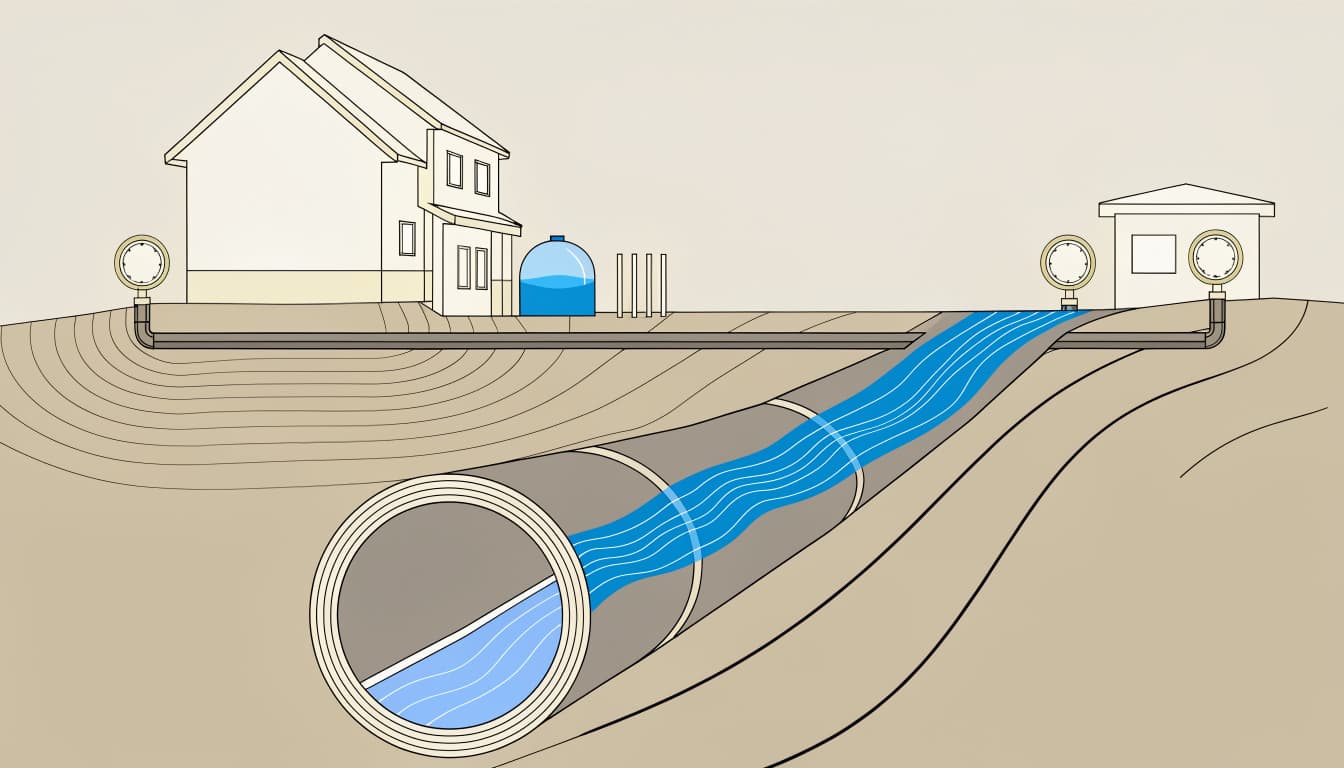
Size the Cottage Supply Line
A line that works for a single faucet may restrict flow when a shower and other fixtures run together. The appropriate pipe size depends on the route, expected flow, elevation changes, and available pump pressure.
The buried route also affects installation. Existing utilities, paving, landscaping, and access between buildings can make a shared line more involved than the distance alone suggests.
Evaluate Pressure Under Demand
Pressure measured with every fixture closed doesn't tell the whole story. The cottage needs enough pressure while water is flowing and while the main home is also using water.
A distribution pump may need to be sized for the combined flow and the losses along the route. A local booster may be an option in some layouts, but adding a pump won't correct every restriction in an undersized pipe.
Plan the Plumbing Connection to Each Building
A shared design should identify the source line, treatment location, tank, pump, and branch serving each building. That plan makes clear which fixtures receive RO water and which remain on a separate supply.
Accessible shutoff valves can allow one building or branch to be isolated without unnecessarily interrupting the other. Service bypasses also need careful design: untreated water should never enter the treated supply through an unintended connection.
A qualified installer can address cross-connection protection, buried piping, electrical needs, drain connections, and applicable plumbing requirements. This is especially important when a property already has separate well, irrigation, or cottage plumbing.
If the cottage is supplied by an existing underground line, its material, condition, and size affect whether it can carry treated water at the needed flow. Older plumbing may also affect water quality after treatment, so the membrane isn't the only part of the system that matters.
Compare a Shared System With Separate Units
The right choice depends on the treatment goal and the cost of connecting the buildings.
| Option | When it may fit | Main trade-off |
|---|---|---|
| Shared whole-house RO | Both buildings need treated water at many fixtures | Requires combined sizing and a suitable connection to the cottage |
| Separate whole-house units | Buildings have independent supplies or are difficult to connect | Adds equipment and separate maintenance |
| Separate point-of-use units | Drinking and cooking water are the main concerns | Treats only the fixtures connected to each unit |
A shared system concentrates equipment and service in one location. However, a treatment failure or service interruption can affect both buildings. Separate systems offer more independence, but they introduce another set of filters, membranes, and service needs.
Compare the complete installed layout rather than the equipment alone. Trenching, pipe work, storage space, electrical access, drainage, and future maintenance all affect the choice.
If hardness is the main concern, RO may not be necessary for every fixture. Our comparison of well-water softeners and whole-house RO explains the different jobs those systems perform.
Test the Water and Plan for Maintenance
Sizing starts with the water source as well as demand. A well-water test can identify conditions that affect treatment selection and membrane protection.
Choose Pretreatment for the Source
Depending on the results, a system may need sediment filtration, softening, iron treatment, or another stage before the RO membrane. Pretreatment helps address problems that can interfere with membrane operation or shorten its service life.
RO also produces concentrate, so the installation needs an appropriate discharge arrangement. The design must account for drainage capacity and any concerns involving septic systems, landscaping, or nearby water.
Maintain the Entire Distribution System
A shared system has one treatment location, but the tank and piping serve both buildings. Filters, membranes, pumps, and controls need routine attention, and storage and distribution components need a suitable sanitation plan.
A guest cottage that sits vacant can have water standing in its plumbing for extended periods. Include that branch in the maintenance plan rather than focusing only on the equipment at the main home. Testing water after treatment helps assess whether the system is addressing the original water-quality concern.
Key Takeaways for a Shared RO System
A shared RO system needs enough production for both buildings' daily use and enough storage, pumping, and pipe capacity for simultaneous demand. The cottage connection matters as much as the treatment equipment.
When only drinking and cooking water need treatment, separate point-of-use units may be a simpler choice. For whole-property treatment, water testing and a complete plumbing plan should guide the design.
Frequently Asked Questions
Can a Shared RO System Supply Two Showers at Once?
It can if the storage, distribution pump, and piping are sized for that combined flow. Membrane production alone doesn't establish how much water the fixtures can receive at one time.
Will an RO Storage Tank Supply Water During a Power Outage?
It depends on the tank and plumbing. An atmospheric tank that relies on an electric distribution pump generally needs power to deliver water at household pressure. A pressurized tank may provide some water, but the available reserve is limited.
Does the Cottage Need Its Own RO Storage Tank?
Not always. Central storage may be sufficient when the pump and supply line can meet the cottage's demand. A separate arrangement may make sense when the buildings have different needs or a difficult connection.
Choose the System Around Both Buildings
One RO system can serve a main home and guest cottage when the entire design supports both. Focus on production, usable storage, peak flow, and delivery pressure rather than the membrane rating alone.
At Trademark Water Systems, we install water treatment systems and build custom RO systems for well-water users in Southwest Florida. We can help you assess the water source and plan a system around the way your property uses water.
Latest posts
Read Our Blog
Tips, guides, industry best practices, and news.


Contact us
Get in touch
Our friendly team is ready to chat.