
Water Testing After Treatment: What to Check Next
New water-treatment equipment can be installed correctly and still need verification. Water testing after treatment shows whether the system is reducing the contaminant it was selected to address, without creating a new problem downstream.
Homeowners and facility managers should test the right water at the right tap, follow the manufacturer's startup instructions, and compare untreated results with treated results. Taste, appearance, and a basic home test kit can raise useful questions, but they can't prove that water is safe.
Why water testing after treatment matters
A filter, softener, reverse osmosis system, carbon unit, or disinfection device has a specific job. Testing confirms whether it is doing that job under actual operating conditions.
A new system can produce disappointing results when the source water changes, the flow rate is too high, cartridges are installed incorrectly, or plumbing still contains untreated water. Testing also gives you a starting point for future maintenance.
Confirm the treatment target
Start with the contaminant or condition identified before installation. A softener should be checked for hardness reduction. An iron filter should be checked for iron and, when relevant, manganese or sulfur. Reverse osmosis testing may include total dissolved solids, conductivity, nitrate, or another contaminant identified in the original laboratory report.
Bacteria, nitrate, and other health-related contaminants require more careful testing than a quick strip test. If the system treats well water, the University of Florida IFAS guidance recommends testing for the specific problem at installation, at regular intervals afterward, and whenever water quality changes.
Create a useful baseline
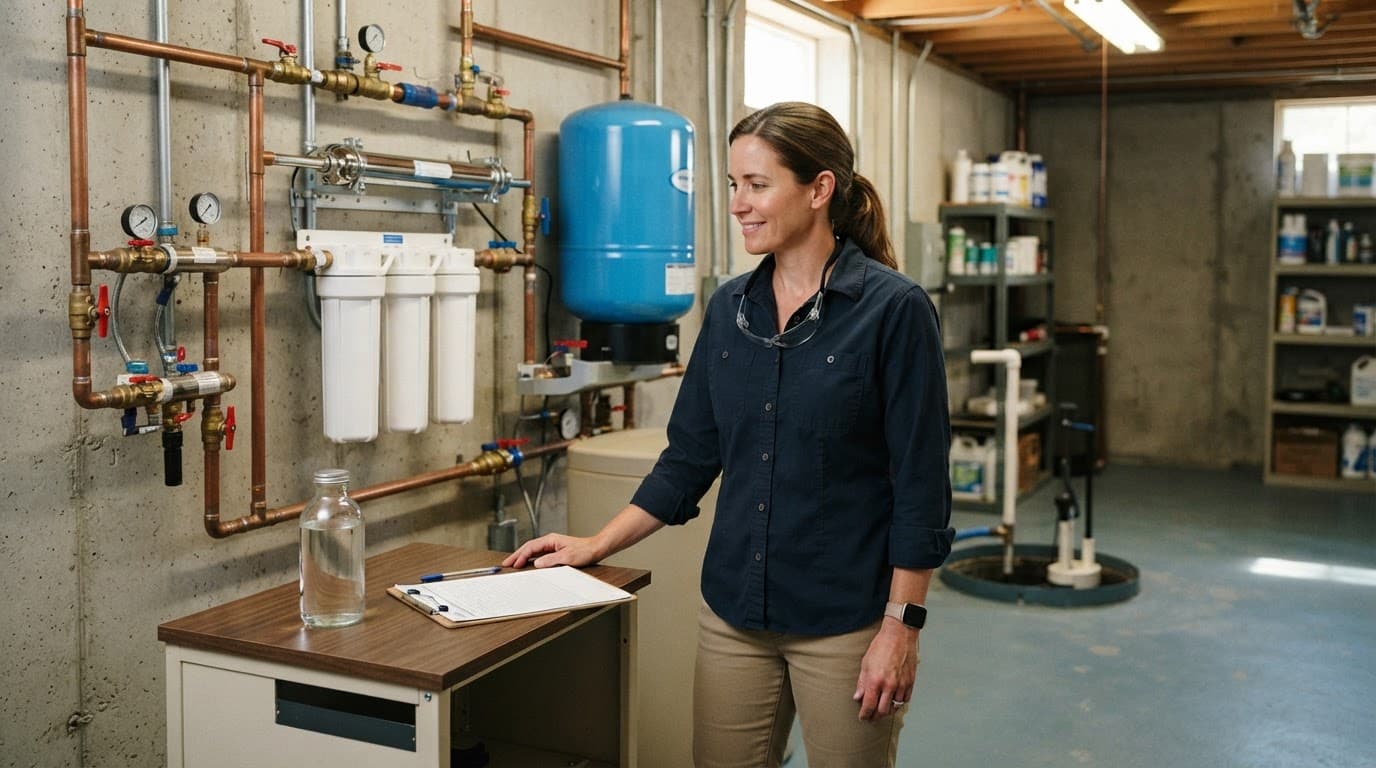
Keep the original water analysis, installation date, equipment model, cartridge information, and post-installation results together. Facility managers should also record the sample location, flush time, operating pressure, and any recent service.
That record helps separate a treatment failure from a source-water change. It also gives a technician useful information when performance declines months later.
Collect representative samples from the correct taps
The sample location affects the result. The U.S. Environmental Protection Agency says the correct location depends on the water source, the contaminant being tested, the purpose of the test, and any applicable requirement.
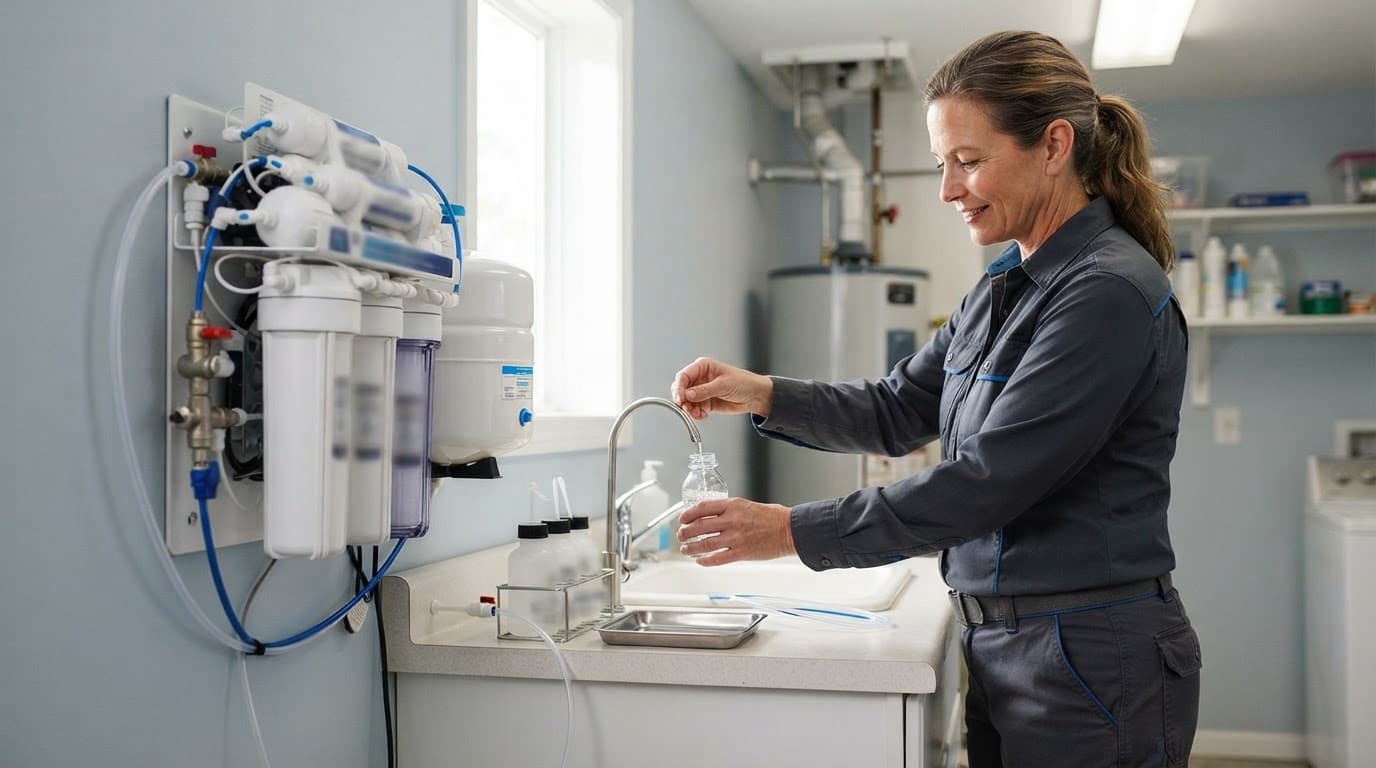
For treatment-performance testing, collect paired samples whenever possible. One sample should represent untreated source water. The second should represent water after treatment.
Take the untreated sample before the equipment
Collect the source sample before water passes through the treatment unit. In a well-water home, this may be a raw-water tap near the pressure tank or before the first filter. In a facility, the sampling point may be at the incoming service line or another approved source location.
Use a cold-water faucet that doesn't have a hose, swivel fitting, aerator, screen, or point-of-use filter attached. Remove those devices unless the laboratory or regulator gives different instructions.
Run the tap long enough to clear standing water. EPA guidance commonly calls for two to three minutes, although an entry-point sample may require longer flushing until the temperature stabilizes. Follow the laboratory's instructions when they specify a different time.
Take the treated sample after the equipment
For most treatment-performance samples, EPA guidance places the post-treatment sample at the entry point before treated water enters the distribution system. This location shows what leaves the treatment equipment before storage tanks, long plumbing runs, or additional fixtures affect the result.
A separate point-of-use sample may be necessary for drinking water. Lead and copper testing is a common example because those metals can enter water from household plumbing. The appropriate sample may need to sit in the pipes overnight and be collected first thing in the morning.
Use the laboratory's bottle, avoid touching the bottle opening to the faucet, and keep hands out of the water stream. Some Florida Department of Health laboratory instructions require at least 100 milliliters, same-day delivery, and delivery at or below 50 degrees Fahrenheit. Your laboratory's instructions take priority.
Flush and sanitize the system before testing
Testing immediately after installation can produce a misleading result. New carbon media may release harmless dust, new plumbing may contain debris, and disinfectant used during installation may remain in the lines.
Read the treatment manufacturer's startup procedure before opening a faucet. The required steps differ by equipment type, media, plumbing design, and water source.
Flush according to the equipment instructions
A new carbon filter often needs extensive flushing before use. Reverse osmosis systems may need a storage tank filled and discarded one or more times. Sediment filters can require flushing until the water runs clear.
Don't shorten the process because the water looks clear. Some substances have no visible color, and a clear sample can still contain nitrate, lead, bacteria, or excessive dissolved solids.
After flushing, allow the system to operate under normal household or facility conditions. Then collect the sample at the designated treated-water tap. If several units work together, test after the final treatment stage as well as between stages when troubleshooting requires it.
Sanitize only when the procedure calls for it
Well systems, storage tanks, ultraviolet units, and certain treatment lines may require disinfection. However, adding bleach or another chemical without a written procedure can damage membranes, media, seals, or equipment.
A newly disinfected well must also be pumped until residual disinfectant is gone before sampling. Florida well-release procedures may require analysis by a Florida State Certified Laboratory, not a home kit. Ask the installer, laboratory, or county health department which steps apply to your system.
Build a testing schedule for the new system
The first post-installation test should match the reason you bought the equipment. Testing unrelated indicators can create confusion and unnecessary expense.
Match each test to the treatment goal
Use this quick guide when planning water testing after treatment.
| What to test | When to test | Warning signs |
|---|---|---|
| Total coliform and E. coli | After well work, disinfection, flooding, or a major plumbing change | Any positive E. coli result, repeated coliform results, or sudden illness concerns |
| Nitrate | During initial testing and at least annually for private wells | A rising result or a result near the laboratory or regulatory limit |
| Hardness | Before and after softener installation, then during service checks | Scale returns, soap fails to lather, or hardness remains close to the raw-water level |
| Iron, manganese, and sulfur | Before and after filtration, plus when staining or odor returns | Orange or black staining, rotten-egg odor, clogged fixtures, or poor filter performance |
| Lead and copper | After plumbing work, when corrosion is suspected, and at recommended intervals | Metallic taste, blue-green deposits, or results above the applicable action level |
| pH, turbidity, TDS, or conductivity | At startup and when performance changes | Cloudiness, pressure loss, a sharp TDS increase, or unstable readings |
| Treatment-specific contaminants | At startup and according to the manufacturer's maintenance schedule | The treated result remains near the untreated result or gets worse |
Florida DOH recommends annual bacteria and nitrate testing for private wells. It also recommends that most homeowners test for lead every three years. Test sooner after flooding, a hurricane, a submerged wellhead, a new pump, or major repairs.
For a broader schedule, review guidance on well water testing frequency and adjust it for your source and treatment equipment.
Screening kits and certified laboratory analysis are different
Home test kits can help you watch for changes. They may be useful for hardness, pH, chlorine, or approximate total dissolved solids when used carefully and consistently.
However, a screening result isn't the same as a certified laboratory analysis. Strip colors are subjective, reagents expire, and low-level contamination can fall outside a kit's range. A home kit also may not detect the contaminant that creates the greatest health risk.
Use home tests for routine observation
A homeowner can use the same kit before and after service to watch for trends. For example, a hardness test may show whether a softener is regenerating properly. A TDS meter may reveal a sudden change in reverse osmosis performance.
Treat these readings as screening information. They can tell you when to investigate, but they shouldn't replace laboratory testing after installation or repair.
Use a certified lab for health and compliance decisions
Choose a laboratory certified for drinking-water analysis, then use its bottles and collection instructions. UF/IFAS recommends certified laboratories for private-well testing, with sterile containers and sterile collection methods for coliform bacteria.
Certified analysis is the right choice after a positive home screening result, a failed disinfection test, a new well, suspected contamination, or a treatment system that supports a regulated facility. Florida county health departments can provide sampling instructions and, in some cases, sample kits or collection services.
Compare untreated and treated results before changing equipment
A treated-water result has meaning only when you know what entered the system. Compare the raw and treated samples for the same analyte, collected close together and under similar operating conditions.
If untreated hardness is high and treated hardness drops sharply, the softener is addressing its assigned problem. If iron remains unchanged after an iron filter, check the flow rate, media, regeneration cycle, and pretreatment before replacing equipment.
A small change in one reading doesn't automatically mean failure. Laboratory reporting limits, sample handling, water temperature, and source-water variation can affect results. Ask the laboratory or a qualified technician to interpret results that are close to a limit.
Watch for signs that need professional help
Contact a qualified water-treatment professional when:
- A certified lab finds E. coli, elevated nitrate, lead, or another health-related contaminant.
- The treated result is nearly the same as the untreated result.
- Water pressure drops after installation or changes sharply during use.
- Odor, staining, cloudiness, or scale returns after initial improvement.
- A UV system lacks its expected alarm or disinfection monitoring.
- A filter, softener, or RO system leaks, bypasses, or fails to regenerate.
- A well has flooded, lost its sanitary seal, or undergone pump or plumbing repairs.
- You need a compliance sample for a facility, rental property, or new well.
Don't drink water after a failed bacteria or E. coli result until the source and treatment have been evaluated. Boiling may address some biological risks, but it doesn't remove nitrate, lead, or many chemical contaminants.
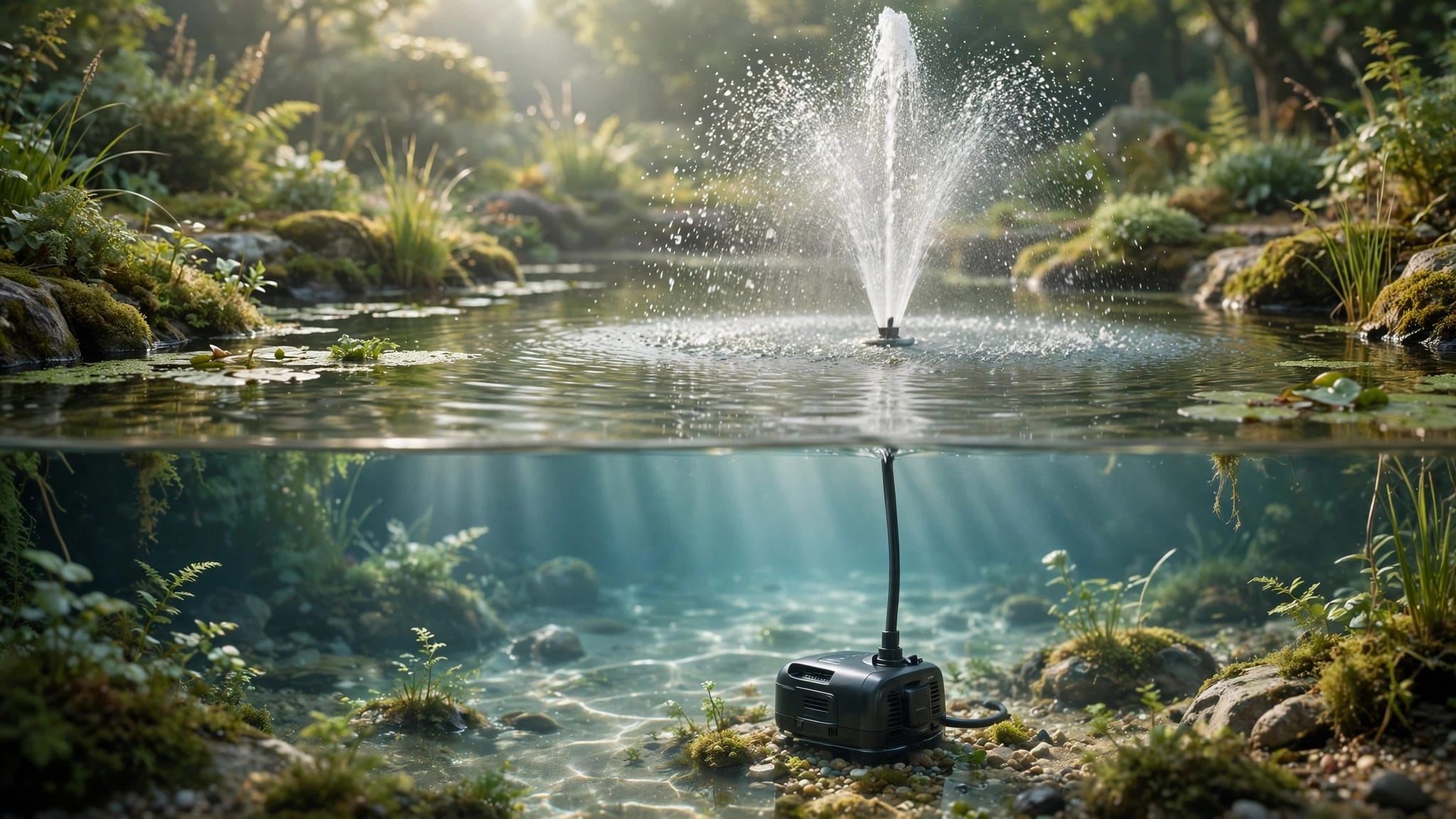
Lake fountain water needs separate handling. A fountain improves circulation and aeration, but it doesn't make lake water suitable for drinking. Property managers should evaluate fountain performance through water level, pump operation, visible algae, odor, and circulation concerns. For equipment problems, use lake fountain installation and repair services rather than treating a fountain as a potable-water system.
Conclusion
Water testing after treatment gives you evidence that a new system works under real conditions. Collect samples from the correct points, flush or sanitize as directed, and compare untreated water with treated water using the same laboratory methods.
A home kit can help spot trends, but certified laboratory analysis belongs in decisions about health, compliance, and suspected contamination. When results don't match the treatment goal, professional diagnosis is safer than guessing or changing equipment blindly.
Latest posts
Read Our Blog
Tips, guides, industry best practices, and news.


Contact us
Get in touch
Our friendly team is ready to chat.