
Whole House RO Storage Tanks: A Homeowner's Sizing Guide
A reverse osmosis membrane can produce exceptionally clean water, but it usually can't make water as quickly as a busy home uses it. Whole house RO storage tanks solve that timing problem by storing treated water before the home needs it.
The tank is only one part of the design. Tank volume, membrane output, pretreatment, pump capacity, household demand, and available space must work together. A properly designed whole house reverse osmosis system typically uses an atmospheric storage tank followed by a repressurization pump, rather than sending every fixture directly through a pressurized membrane system.
Key Takeaways
- A whole-house reverse osmosis water membrane produces supply gradually, while storage allows the home to use water during peak demand.
- An atmospheric water storage tank is usually the right choice for full-home reverse osmosis because it can hold larger volumes without requiring the tank itself to maintain house pressure.
- A repressurization pump is normally needed after atmospheric storage to deliver usable pressure to showers, faucets, appliances, and outdoor fixtures.
- Household size alone doesn't determine tank capacity. Bathrooms, irrigation, laundry, guests, water pressure, and daily habits also matter.
- Correct pretreatment protects the membrane and storage equipment from sediment, hardness, iron, chlorine, and other feed-water problems.
How whole house RO storage tanks work in a full-home system
A whole-house reverse osmosis system generally has several stages. Incoming water first passes through pretreatment, then through the reverse osmosis system membrane. The membrane separates treated water from concentrated reject water. Treated water flows into a storage tank, where it waits until the home calls for water.
When someone opens a faucet, starts a washing machine, or flushes a toilet, a control system detects the demand. A repressurization pump then moves water from the water storage tank into the home's plumbing at the required pressure.
The membrane continues producing water while the tank level is low. Once the tank reaches its operating level, a float switch or control valve stops production. This cycle prevents the membrane from running constantly during periods when the home isn't using water.
A storage tank provides two practical benefits:
- It separates production from use. The membrane can work at a steady rate while the water storage tank handles short periods of higher demand.
- It protects water pressure. The repressurization pump supplies the flow needed by household fixtures, instead of asking the RO membrane to serve every fixture directly.
A small under-sink RO unit uses a pressurized bladder tank because it treats a limited amount of water at one location. Full-home RO is different. A family can use dozens or hundreds of gallons during a busy day, and several fixtures may operate at once.
The tank must also be sanitary and properly connected. Components may include constructed food grade materials and NSF certified parts to maintain water quality. Additional items may include a level sensor, inlet valve, overflow protection, vent, drain connection, booster pump, repressurization pump, check valves, pressure gauges, and a control panel. A poorly matched tank can leave the membrane running too often or cause weak pressure throughout the house.
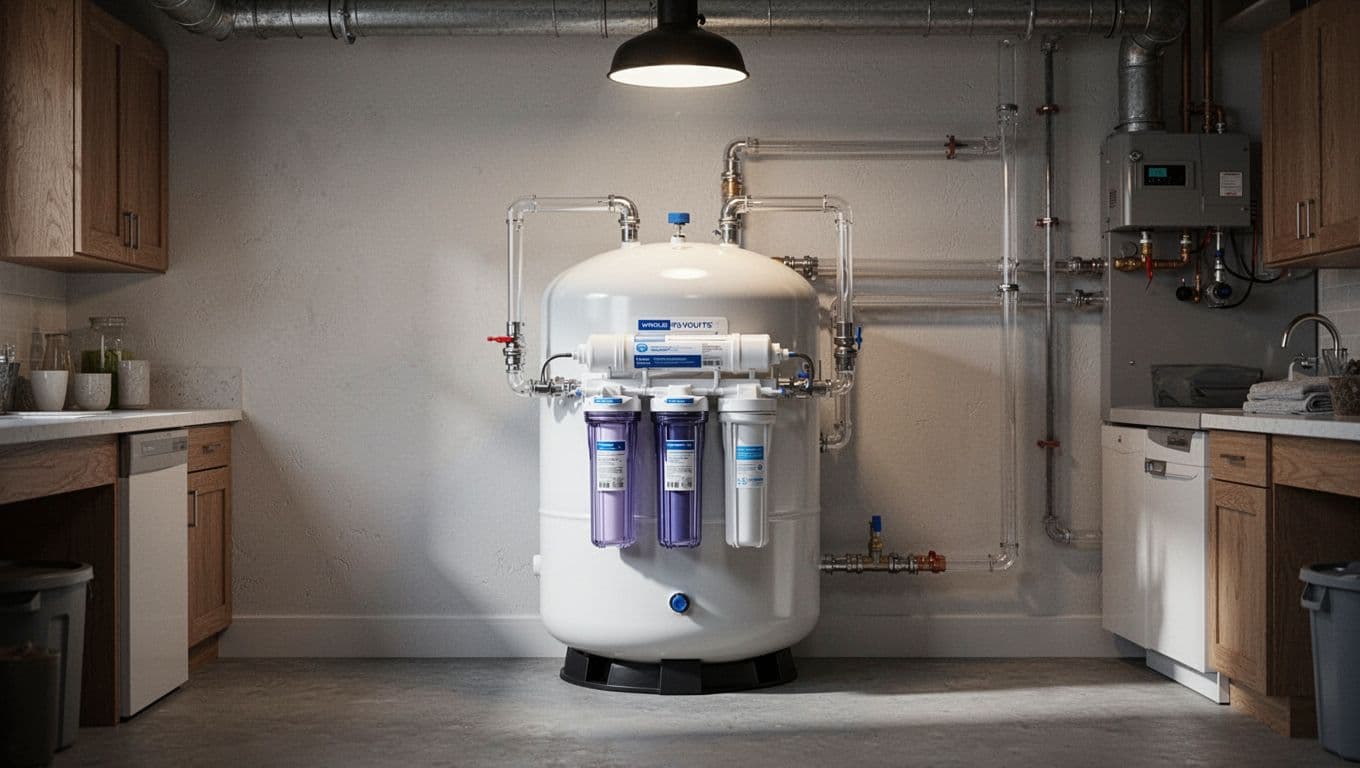
A whole-house RO installation needs room for storage, controls, pumps, and service access.
Atmospheric versus pressurized RO storage
The two main storage approaches are atmospheric and pressurized. They hold treated water in different ways, so they also require different plumbing and pump arrangements.
An atmospheric tank holds water at or near normal air pressure. It doesn't push water into the home's plumbing on its own. A separate repressurization pump draws water from the tank and supplies the pressure required by the home, making atmospheric water storage a reliable choice for larger residences.
A pressurized tank uses an enclosed vessel with an air or nitrogen charge. As water enters, it compresses the air cushion. That pressure pushes water toward the plumbing when a fixture opens. The pressure tank relies on its internal air charge to deliver this flow, but its usable volume depends on its pressure settings, so its actual drawdown is less than its labeled capacity.
| Feature | Atmospheric storage | Pressurized storage |
|---|---|---|
| Typical use | Whole-house RO and high-volume treatment | Point-of-use RO and smaller applications |
| Tank pressure | Near atmospheric pressure | Maintained by an air or gas charge |
| Pump requirement | Usually needs a repressurization pump | May deliver water without a separate pressure pump |
| Storage capacity | Practical for larger volumes | More limited usable drawdown at household scale |
| Space needs | Tank plus pump and controls | Compact vessel, but large capacity increases size |
| Service needs | Float, level controls, pump, and tank inspection | Pressure checks, bladder inspection, and valve service |
| Best fit | Homes with full-house treated water demand | Smaller systems with lower flow demand |
Atmospheric storage is usually the better fit for whole-house RO because it allows the system to store a substantial water storage capacity without placing the entire tank under house pressure. It also works well when the membrane produces water over several hours and the home needs a higher flow rate for short periods.
A large pressurized tank doesn't automatically provide its full labeled capacity. Pressure settings determine how much water the home can draw before the tank needs to refill.
Pressurized storage can still make sense in selected applications. A smaller home may have low demand, limited equipment space, or a treatment design that doesn't require a large reserve. However, a professional should calculate the tank's usable drawdown, not rely on the nominal gallon rating.
Why a repressurization pump matters
An atmospheric tank stores water, but it doesn't provide normal household pressure. That is why a repressurization pump, such as a reliable centrifugal pump, is a standard part of many whole-house RO designs.
Without the pump, water would reach the plumbing through gravity or a weak transfer path. Showers could lose pressure, toilets might refill slowly, and appliances could fail to receive the flow they need. Using a water pressure booster restores pressure after storage and helps the system respond when multiple fixtures operate together.
Pump selection depends on more than the home's static water pressure. The installer should account for:
- Peak gallons-per-minute demand
- Required pressure at the farthest fixture
- Elevation between the tank and the home
- Pipe size and length
- Filter and pretreatment pressure loss
- Pump motor size and control method
- Whether irrigation or other high-use fixtures share the system
A variable-speed pump can adjust output as demand changes. A fixed-speed pump may work well when the design uses a pressure tank, control valve, or other method to limit cycling. The right choice depends on the plumbing layout and the expected demand.
The pump should also have protection against dry running. If the atmospheric tank level drops too low, a level control can stop the pump before it pulls air into the plumbing. A pressure switch, check valve, and properly sized expansion or pressure-control equipment can help prevent short cycling and pressure swings.
Maintenance access matters as much as horsepower. Leave room to inspect gauges, replace filters, service valves, and remove the pump if repairs become necessary. Equipment packed tightly into a corner can make a routine repair expensive.
How to size a whole-house RO storage tank
Tank sizing starts with water demand, not with the size of the RO membrane alone. The membrane determines how quickly the system can produce treated water. The tank covers the difference between that production rate and the home's peak use.
Daily demand provides a useful starting point:
- One or two people: A household may need roughly 100 to 200 gallons per day of treated water, depending on fixtures and habits.
- Three or four people: Daily demand may fall near 200 to 400 gallons per day.
- Five or more people: Demand can reach 400 to 700 gallons per day or more, especially with several bathrooms, frequent laundry, or guests.
Those figures are planning ranges, not automatic tank specifications. A home with efficient fixtures may use less. A property with a large family, high-flow showers, a pool makeup line, or outdoor hose use may need much more, sometimes benefiting from a commercial grade RO setup to handle the load.
For storage, a practical starting point might look like this:
| Household pattern | Example atmospheric tank range | What may change the decision |
|---|---|---|
| One to two people, one or two baths | 120 to 250 gallons | Long gaps between use, low flow fixtures, limited space |
| Three or four people, two to three baths | 250 to 500 gallons | Morning shower demand, laundry, guests, membrane production |
| Five or more people, three or more baths | 500 to 1,000 gallons | Multiple fixtures, large property, high daily demand |
| Vacation or guest home | 150 to 400 gallons | Long vacant periods followed by sudden occupancy |
| Home with high outdoor demand | 500 gallons or more | Irrigation separation, hose use, pool or landscape needs |
The tank should cover the home's peak period, not only the daily average. For example, a four-person home might use much of its water between 6:00 and 9:00 a.m. If the membrane produces water slowly during that window, the tank must provide the reserve.
Start with a whole-house reverse osmosis system sizing guide when comparing membrane output, storage volume, and pump requirements. A complete design should also consider the source-water report and the home's plumbing plan.
Tank size can become excessive if the membrane is too small, or insufficient if peak demand is ignored. The best design balances production, water storage capacity, pressure, and recovery time.
Match storage to the home's water-use pattern
Two homes with the same number of residents can need different RO storage tanks. A household's schedule often matters as much as its head count.
A couple who works away from home may use water in short bursts during the morning and evening. A larger family may create a sharp morning peak when showers, toilets, and kitchen fixtures operate together. A home with teenagers, frequent laundry, or regular guests can empty a tank faster than the daily average suggests. Automated components like float switches help manage tank levels during sudden bursts in demand.
Consider these questions before choosing a tank:
- How many full bathrooms are in the home?
- How many showers may run at the same time?
- Does the home use treated water for toilets, laundry, or every fixture?
- Will outdoor hose bibs receive reverse osmosis water?
- Is irrigation supplied by a separate line?
- Does the property have a pool or spa that needs makeup water?
- How long does the home remain vacant?
- Does the household host guests often?
- What is the water pressure at the service entrance?
- How much room is available for a tank and pump?
Outdoor irrigation usually deserves separate consideration. Treating landscape water with RO can consume a large volume and produce unnecessary reject water. Many installations keep irrigation, pool equipment, and other high-volume uses on a separate line while sending treated water to indoor fixtures.
A vacation home presents a different challenge. It may use little water for weeks, then experience heavy demand when several people arrive. The controls should support safe startup, tank turnover, and stagnation management. The system may also need a flush cycle after extended periods without use.
Water-use patterns can change after installation. A new bathroom, larger family, rental use, or home renovation can increase demand. Choose equipment with enough adjustment range to handle reasonable future changes without assuming every possible expansion.
Pretreatment protects the membrane and tank
Reverse osmosis is not a substitute for a proper pre-treatment system. Sediment, chlorine and chloramine, hardness, iron, manganese, hydrogen sulfide, and bacteria can all affect system performance.
Sediment can clog prefilters and restrict flow. Chlorine can damage many thin-film composite RO membranes. Hardness can create scale on the membrane surface, which reduces production and increases cleaning needs. Effective contaminant reduction through proper filtration prevents iron, heavy metals, and manganese from staining equipment and fouling treatment media.
Private-well water requires extra attention because its quality can vary by property. A laboratory water test should guide the equipment selection. Water softeners may help with hardness, while an iron filter, carbon filter, sediment filter, or other treatment stage may address different problems.
Homeowners comparing treatment types can review this guide to whole-house reverse osmosis versus a water softener. The systems solve different problems. A softener reduces hardness, while RO reduces total dissolved solids and many dissolved contaminants.
Pretreatment also affects tank sizing. If filters clog quickly, the membrane may produce less water than its rated capacity. That shortfall can leave the storage tank below its expected level during peak use.
A practical pretreatment plan may include:
- A sediment filter sized for the incoming flow
- Carbon treatment when chlorine protection is needed
- A softener when hardness creates a scaling risk
- Iron or sulfur treatment for affected well water
- Disinfection or other treatment when testing identifies biological concerns
- Pressure gauges before and after key filters
Filter replacement schedules depend on water quality and usage. A pressure drop across a filter is often a better service signal than a calendar date alone. Still, regular inspections prevent a neglected filter from restricting the entire system.
Installation details homeowners should check
A whole-house RO storage tank needs a suitable installation area. The floor must support the filled tank, which can weigh several hundred pounds or more. The location should also have drainage or overflow protection, enough ventilation, and access to power and plumbing.
The tank should sit on a stable, level surface. Keep it away from direct sunlight, freezing temperatures, excessive heat, and areas where a leak could damage finished walls or electrical equipment.
The plumbing layout should make the water path easy to follow. Common components include:
- Feed-water pretreatment
- RO membrane assembly
- Treated-water line to the storage tank
- Tank level control or float assembly
- Repressurization pump
- Final treatment, optional ultraviolet disinfection, or polishing filter when required
- Pressure control and distribution line to the home
- Drain connection for RO reject water and overflow protection
The installer should protect the tank from overfilling. Using NSF certified plumbing fittings and tank materials ensures structural integrity and safety. A mechanical float, electronic level sensor, shutoff valve, and high-level alarm can provide layers of protection. The exact controls depend on the tank and system design.
Reject water also needs a proper destination. RO creates a concentrated waste stream as it separates dissolved solids from treated water. The drain connection must handle the expected flow and comply with local plumbing requirements. Some systems can recover or reuse reject water, but that decision depends on water chemistry and the available plumbing.
A whole-house system may require changes to the main water line. Make sure the plan identifies which fixtures receive treated water and which remain on untreated or pretreated water. Separating irrigation and other high-volume uses can reduce tank size and operating cost.
Operating costs, maintenance, and service life
Whole-house RO storage tanks need routine attention. The tank itself may require less frequent service than the membrane, filters, pumps, and controls, but routine maintenance ensures the complete system should be inspected as one package.
A maintenance visit may include checking:
- Sediment and carbon filter condition
- Membrane production rate
- Feed and product-water pressure
- Reject-water flow
- Storage tank level controls
- Repressurization pump operation
- Pressure switch or variable-speed controls
- Tank fittings, valves, and overflow protection
- Water quality at selected fixtures
Membranes don't last forever. Their service life depends on feed-water quality, pretreatment, operating pressure, temperature, recovery rate, and maintenance. A performance test can show whether low production comes from a clogged filter, low pressure, scaling, a damaged membrane, or a control problem.
Storage tanks also need sanitary care. A tank that remains nearly full with little turnover can create a different operating pattern than one that cycles daily. The system should be designed and maintained to keep treated water fresh and to limit contamination risks after service work.
Energy use comes mainly from pumps and controls. Water and drain costs depend on membrane recovery, feed-water chemistry, and the amount of treated water used. A smaller, well-matched system can cost less to operate than an oversized design that cycles pumps unnecessarily, which ultimately protects system efficiency over time.
Don't ignore unusual sounds or pressure changes. A pump that starts and stops repeatedly, a tank that never fills, or a membrane that runs continuously can indicate a control, leak, pressure, or sizing problem.
Common storage tank mistakes
Several installation choices can create trouble even when the tank appears large enough.
Choosing by tank label alone is a common error. A 300-gallon tank may not provide 300 gallons of immediately usable water if the design requires a reserve level or if the tank's shape limits practical drawdown.
Skipping a repressurization pump can produce poor fixture pressure. An atmospheric tank needs a pump or another properly engineered pressure system.
Using a small point-of-use pressure tank for full-home demand creates rapid depletion. The membrane may not recover quickly enough after a busy morning.
Treating every fixture with whole house reverse osmosis water can increase capacity needs without improving the most important uses. Irrigation and pool makeup water often belong on a separate line.
Ignoring feed-water chemistry shortens membrane life. A tank cannot compensate for scale, iron, chlorine damage, or clogged pretreatment.
Putting the tank in an inaccessible location makes service harder. Leave enough room for filter changes, pump removal, valve inspection, and safe drainage.
Installing too much storage can also cause problems. A very large tank costs more, occupies more space, and may hold water longer than the household needs. The right target is enough reserve for peak demand with a reasonable recovery cycle.
When to repair, resize, or replace the system
A low water storage tank level doesn't always mean the tank is too small. First check whether a clogged prefilter, low feed pressure, failed level sensor, closed valve, or membrane problem has reduced production. Consistent routine maintenance helps prevent unexpected membrane and component failures that mimic sizing issues.
A tank may need resizing when the home has changed. Common triggers include an added bathroom, a larger household, a new rental arrangement, higher guest use, or a decision to send treated water to more fixtures.
The pump may need attention when the tank reaches a normal level but the home still has weak pressure. Check pump operation, pressure settings, filters, pipe restrictions, and electrical controls before replacing equipment.
Replacement makes sense when a tank has structural damage, persistent leaks, failed fittings, or contamination that cleaning cannot resolve. A bladder-style pressure tank may need replacement when the bladder fails or the air charge won't hold. Atmospheric tanks can also age, especially when exposed to sunlight, heat, chemicals, or physical damage.
Have the system evaluated as a complete design. Replacing only the tank may leave the membrane, pump, controls, and plumbing mismatched. A service professional can measure actual production and demand, then recommend a change based on evidence instead of guesswork.
Choosing a whole-house RO storage plan
Start with a professional water test sent to a certified water testing laboratory and a realistic household demand estimate. Include the number of residents, bathrooms, fixtures, daily schedule, outdoor uses, and future changes that are likely within the next several years.
Next, identify the operating arrangement. For most full-home systems, that means an atmospheric tank, level controls, and a repressurization pump. A pressurized tank may fit a smaller or specialized installation, but its usable capacity and pressure performance require careful calculation.
Ask for the design's membrane production rate, storage capacity, peak flow, pump pressure, reject-water plan, pretreatment stages, and maintenance schedule. These numbers show whether the equipment matches the home.
The installation area should support safe service. A good plan leaves room around the tank, keeps electrical components protected from leaks, and provides clear access to filters, valves, gauges, and controls.
Finally, choose a provider that can maintain the system after installation and offer strong warranty protection on the equipment. Whole-house reverse osmosis needs more than a one-time equipment delivery. Local service matters when a pump loses pressure, a filter blocks flow, or water quality changes after a well or plumbing issue.
Frequently Asked Questions
Why do whole-house reverse osmosis systems need an atmospheric storage tank?
An atmospheric storage tank allows the system to hold large volumes of treated water without placing the tank itself under high house pressure. This setup cleanly separates slow membrane production from the home's rapid peak water demand.
Can I use a small pressurized bladder tank for a whole-home system?
Pressurized bladder tanks are generally too limited in usable drawdown for a full-size home. They work well for small under-sink units, but whole-house demand usually requires an atmospheric tank paired with a repressurization pump.
Do I need a repressurization pump with an atmospheric tank?
Yes, an atmospheric tank stores water at normal air pressure and cannot push it through household plumbing on its own. A repressurization pump is required to deliver adequate water pressure to showers, faucets, and appliances.
Conclusion
A whole-house RO storage tank is a working part of a larger water-treatment system. The membrane produces reverse osmosis water, the tank holds a reserve, and the repressurization pump delivers that water at usable household pressure.
For most full-home installations, atmospheric storage is the practical starting point. Size it around peak demand, source-water conditions, and the fixtures you actually plan to serve. With the right pretreatment, controls, pump, and maintenance plan, the system can provide consistent treated water and maximize system efficiency without forcing the membrane to keep pace with every faucet opening.
Latest posts
Read Our Blog
Tips, guides, industry best practices, and news.

Contact us
Get in touch
Our friendly team is ready to chat.