
Can Whole-House RO Reduce Boron in Well Water?
Whole-house reverse osmosis can reduce boron in private well water, but the amount removed depends on the membrane, water chemistry, and operating conditions. A standard RO system may leave more boron behind than you expect.
The best starting point is a laboratory test of your untreated well water. The result helps you choose a treatment system and measure whether it's meeting your goal.
Key Takeaways
- Whole-house reverse osmosis can reduce boron in well water, but removal depends on the membrane, water chemistry, temperature, and operating conditions. A single pass may not meet a low treatment target.
- Test untreated well water for boron, pH, hardness, iron, manganese, and total dissolved solids before choosing equipment.
- Pretreatment, storage capacity, wastewater disposal, and routine service all affect system design and performance. Test treated water for boron because TDS readings alone can't confirm boron reduction.
- Point-of-use RO may be enough for drinking and cooking, while irrigation needs depend on the crops and the water they receive.
Why boron removal can be difficult
Boron occurs naturally in groundwater, and seawater intrusion can raise salinity in some coastal wells. Seawater contains about 4.6 mg/L of boron, according to Condorchem, though an individual well's concentration can differ.
In water, boron occurs mainly as neutral boric acid and charged borate. Borax is a sodium tetraborate compound, and dissolved forms and water chemistry affect membrane behavior. RO membranes generally reject the charged borate ion more effectively. Because pH affects the balance between the two forms, it also affects boron removal.
Boric acid has a pKa of about 9.2, although the balance between forms also depends on water chemistry. Conventional coagulation and sedimentation don't significantly remove boron, according to the WHO. RO can reduce it, but a single pass may fall short of a low treatment target.
What seawater RO results tell homeowners
Desalination results show how reverse osmosis membranes and operating conditions affect performance. They don't predict exactly how a residential system will perform on your well.
Temperature affects membrane performance
Condorchem reports that standard high-rejection seawater membranes remove about 73% to 90% of boron at pH 8, depending on water temperature. Special high-boron-rejection membranes can reach up to 95% under the reported conditions.
In one example at 30 degrees Celsius, removal fell to 78%. The first-pass treated water, called permeate , still contained 1.15 mg/L. That exceeded the example's 0.5 mg/L target, so further treatment was needed.
A second treatment stage can help
One desalination design sends permeate through a second RO pass after caustic soda raises its pH to 9.5. Another uses RO followed by boron-selective ion exchange. Condorchem reports about 90% reduction at the resin-treatment outlet for the latter process.
These are industrial designs, not guaranteed results for a home. Raising pH also increases scaling risk, so chemical adjustment requires professional design and controls.
Test the well before designing a system
Ask a certified laboratory to measure the well's boron concentration in a sample collected before existing treatment equipment. Test for pH, hardness, iron, manganese, and total dissolved solids too. These results guide water treatment design, including membrane selection and pretreatment.
The WHO's boron fact sheet gives a drinking-water guideline value of 2.4 mg/L. That's a health-based guideline, not a US legal limit for your private well. Your treatment goal may differ if you also use the water for irrigation.
Protect the membrane with pretreatment
Sediment can clog equipment, while iron and manganese can foul membranes. Hardness can cause scale as minerals concentrate during RO treatment. Depending on your results, pretreatment may include sediment filtration, iron treatment, or a softener.
A softener helps control hardness, but it isn't a substitute for a boron-specific treatment plan. Our comparison of whole-house RO and water softeners explains their different jobs.
Plan for household demand
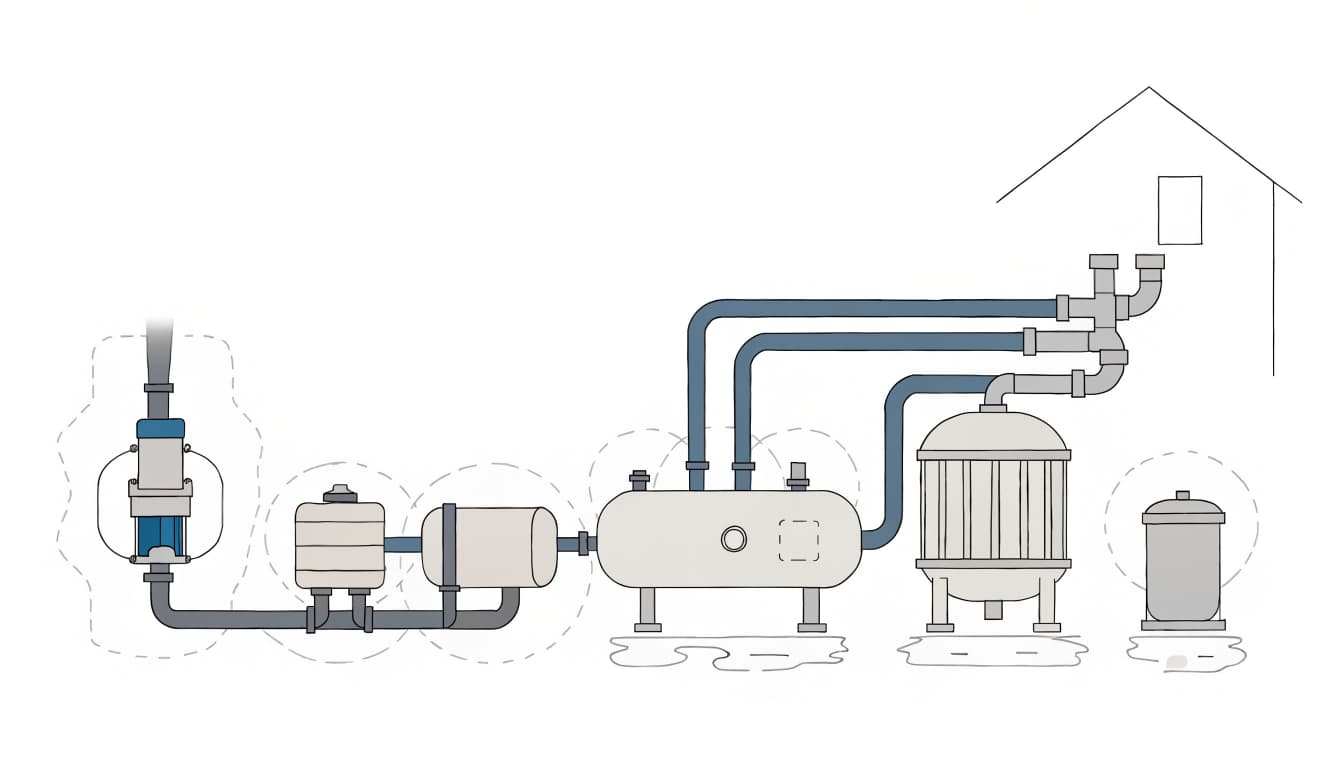
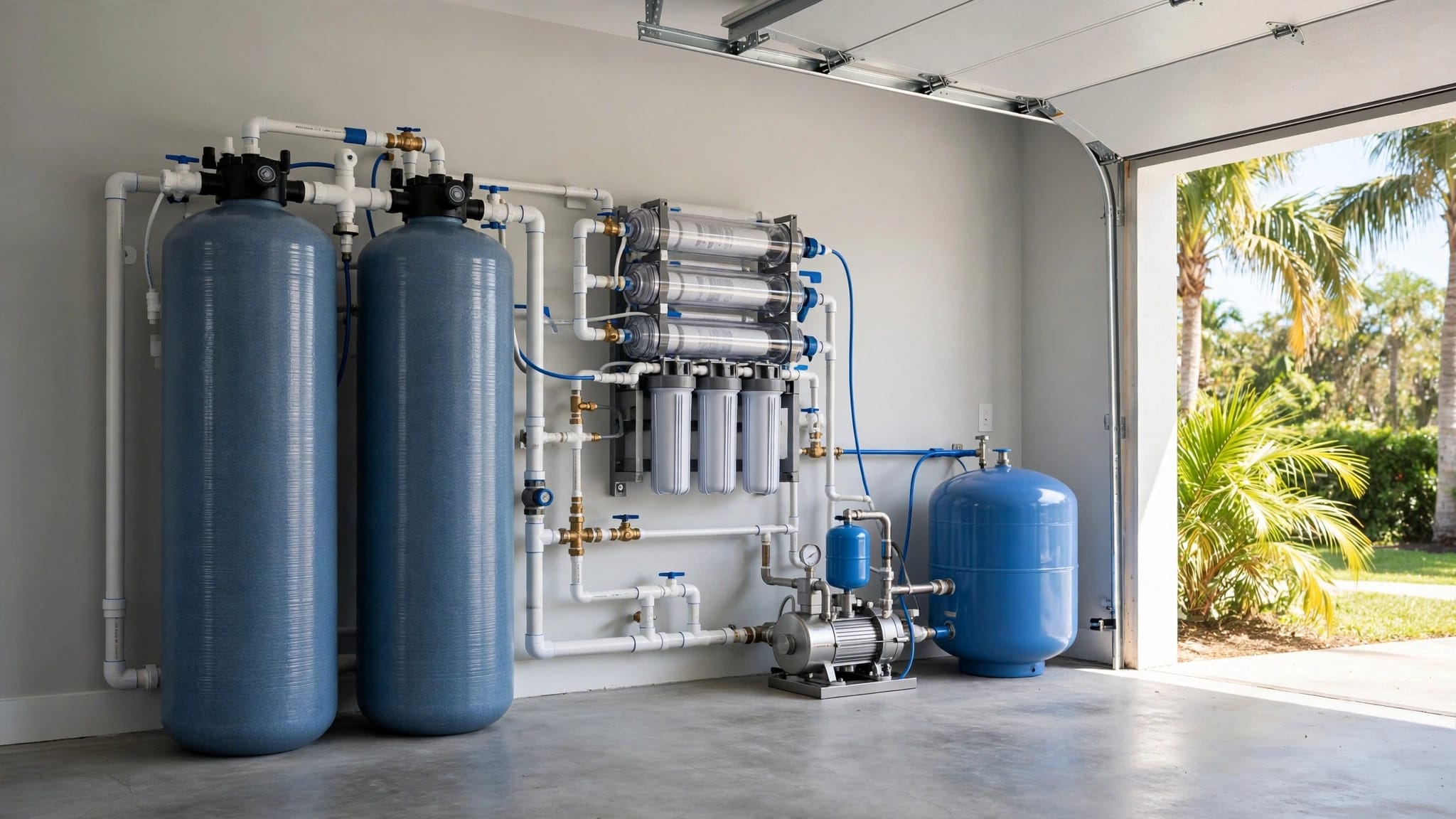
Whole-house RO needs enough production and storage for the home's daily use. A storage tank and delivery pump can supply water during periods when several fixtures run at once. Our guide to sizing an RO storage tank covers those decisions.
Whole-house RO vs. point-of-use treatment
The right location for treatment depends on where you need lower-boron water.
| Option | Where it treats water | Main consideration |
|---|---|---|
| Whole-house RO | Fixtures connected to the treated supply | Requires more space, storage, and wastewater planning |
| Point-of-use RO | Usually a kitchen faucet | Uses less equipment, but doesn't treat other fixtures |
| Boron-selective resin | At a selected treatment point | Needs regeneration and management of chemical waste |
If drinking and cooking are your main concerns, an under-sink system may be sufficient. It still needs boron-specific performance data and a treated-water test. Whole-house treatment usually costs more and uses more water, but it may fit a broader water-quality goal.
How boron-selective resin is regenerated
A boron-selective ion exchange resin captures boron until the bed needs regeneration. Dime Water describes a process that passes hydrochloric acid through the bed to remove retained boron. After a rinse, caustic soda neutralizes the resin, followed by another rinse before the bed returns to service.
A dual-column arrangement can provide continuous treated water while one column regenerates. The process produces boron-bearing waste, so chemical handling and disposal belong in the system design.
Plan for concentrate and ongoing service
RO separates incoming water into treated water and wastewater, an effluent stream containing rejected substances. Whole-house water treatment design needs a suitable discharge route that meets local requirements and accounts for drain capacity and septic-system limitations.
Industrial facilities can use vacuum evaporation to reduce the volume of rejected concentrate for recovery. Handling this effluent with vacuum evaporation is a separate industrial process, not a typical household wastewater disposal option.
After installation, test the treated water for boron and compare it with the untreated result. Repeat testing during routine service and after significant system or well changes. TDS readings alone can't confirm boron reduction.
Replace prefilters on schedule, inspect membrane performance, and maintain storage and pumps. Pressure, temperature, fouling, or worn components can change results over time.
Consider irrigation separately
Plants vary in their susceptibility to boron toxicity by crop. The Australian and New Zealand water-quality guidelines place blackberry below 0.5 mg/L, while peach, cherry, plum, and grape fall in the 0.5 to 1 mg/L range. Asparagus plants are more tolerant, at 6 to 15 mg/L.
These are crop guidelines, not universal limits. Soil, climate, and plant variety also affect tolerance. If irrigation has a separate supply line, identify whether it will receive treated or untreated water.
Frequently Asked Questions
Can whole-house RO remove boron from well water?
Yes, whole-house RO can reduce boron, but the amount depends on the membrane, water chemistry, temperature, and operating conditions. A single pass may leave boron above the treatment target.
Why is boron difficult to remove with RO?
Boron occurs in water mainly as neutral boric acid and charged borate, and RO membranes generally reject the charged form more effectively. pH affects the balance between these forms and can change removal.
What should I test before installing a system?
Ask a certified laboratory to test an untreated well-water sample for boron, pH, hardness, iron, manganese, and total dissolved solids. Use the results to guide system design, then test treated water to measure performance.
Is under-sink RO enough for boron treatment?
It may be sufficient if your main concerns are drinking and cooking, but confirm the system's boron-specific performance and test the treated water. An under-sink system doesn't treat water at other fixtures.
Choose treatment based on your well
Whole-house RO can reduce boron, but a membrane label alone can't tell you the result at your tap. A design based on your well test, operating conditions, and household demand gives you a better basis for choosing equipment.
At Trademark Water Systems, we help Southwest Florida homeowners with custom well-water RO systems. Start with your laboratory results, then use treated-water testing to measure performance after installation.
Latest posts
Read Our Blog
Tips, guides, industry best practices, and news.


Contact us
Get in touch
Our friendly team is ready to chat.
