
What Size Whole-House Reverse Osmosis System Do You Need?
A big house does not always need a big whole house RO system . The better question is how much water your home uses on an average day, and how much it needs at the busiest moment.
Square footage can fool you. A compact home with four people, two showers, and a laundry schedule can need more capacity than a larger house with lighter use. The right size also depends on your water test, your tank space, and how fast the system can refill when everyone turns on a tap at once.
Start with Water Demand, Not Square Footage
Sizing starts with gallons, not floor plans. A whole-house reverse osmosis system has to cover two things at the same time: your daily water use and your peak simultaneous use.
Daily use is the total amount of treated water your home needs in a day. Peak use is the rush hour of your plumbing, when showers, sinks, toilets, and laundry all pull water at once. That second number matters because RO membranes produce water at a steady pace, not instantly.
A family of two may use far less water than a family of five, but habits matter too. Back-to-back showers, a large soaking tub, and frequent laundry all push the system harder. If the system cannot keep up, pressure drops and the house feels short on water.
A whole-house RO system should match how water is used, not how large the floor plan looks.
Here is a simple planning range to start the conversation:
| Household size | Rough daily treated water need | Common setup range |
|---|---|---|
| Small home, 1 to 2 people | 100 to 200 gallons | Smaller membrane capacity, storage tank, booster pump if pressure is low |
| Medium home, 3 to 4 people | 200 to 400 gallons | Mid-size membrane capacity, larger tank, stronger pretreatment |
| Large home, 5 or more people | 400 to 700+ gallons | Higher membrane capacity, bigger tank, repressurization, careful drain planning |
These are planning ranges, not fixed rules. A house with heavy morning use may need a bigger setup than the table suggests. A quiet second home may need less.
The easiest way to think about it is this: the membrane is the engine, but the tank is the fuel reserve. If the reserve is too small, the home runs out of usable water during busy periods.
What Your Water Test Says About the Right Setup
Water quality changes the size and layout of the system. A home with high total dissolved solids, iron, hard water, or a lot of sediment needs more than a standard membrane and a tank.
Start with a recent water analysis. If you do not have one, get one before you choose equipment. A good test tells you what the system has to remove, and that shapes the pretreatment, membrane choice, and maintenance plan. If you want help turning test results into a setup that fits your home, professional water conditioning services can help match the system to the water.
Different problems call for different support ahead of the membrane:
- High TDS means the membrane works harder, and recovery, waste, and storage design matter more.
- Hard water can scale the membrane, so softening or scale control may be needed before RO.
- Iron or manganese can stain fixtures and foul equipment fast, so pretreatment is often part of the package.
- Sediment and chlorine can damage filters and membranes, so pre-filters are not optional.
Well water and city water do not behave the same way. Well water often needs more iron and sediment control. Municipal water may need chlorine removal and careful carbon filtration. In both cases, bad pretreatment shortens membrane life and can make the whole house RO system seem undersized when the real problem is water quality.
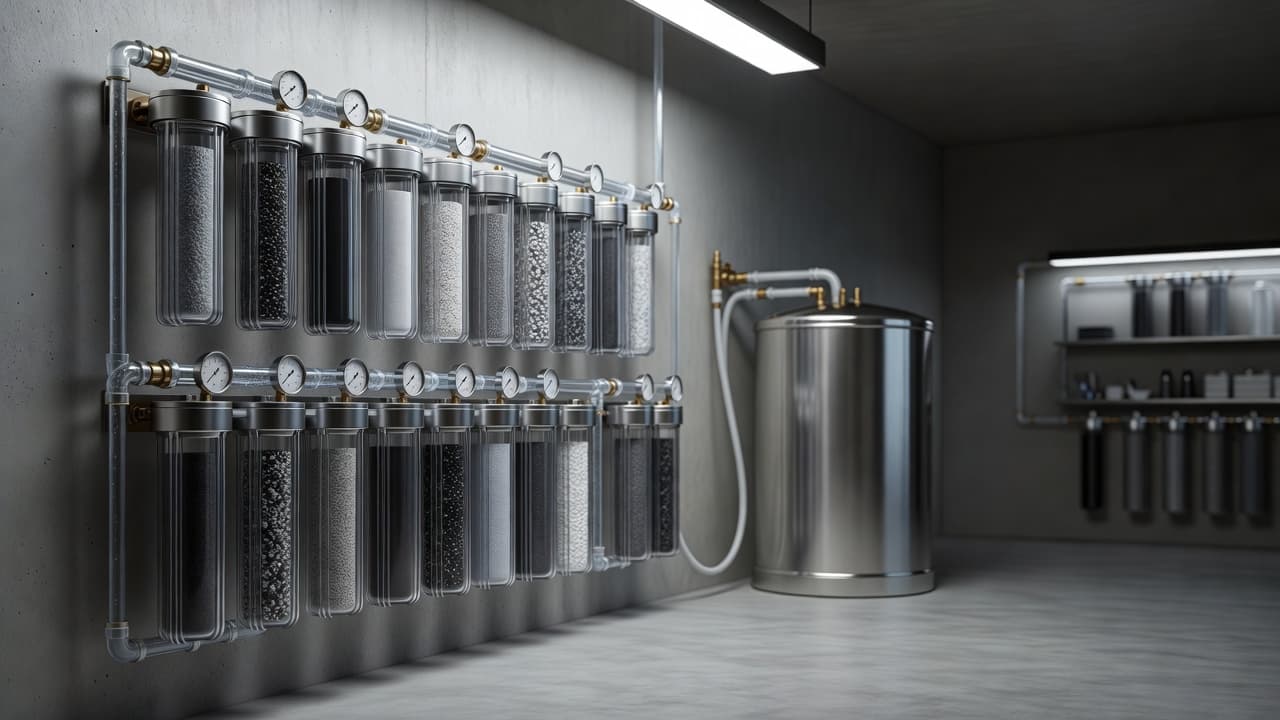
A clean water test helps you avoid guessing. It also helps you avoid buying a bigger membrane when the better fix is better pretreatment.
The Parts That Change the Size You Actually Need
A whole-house RO system is more than the membrane size on the spec sheet. Storage, pressure support, and waste handling all affect how well it works in real life.
The membrane sets production speed. The storage tank holds treated water so the home can use water faster than the membrane can make it. The repressurization pump helps maintain usable pressure after storage. Together, those parts decide whether the system feels smooth or sluggish.
A system with a modest membrane and a well-sized tank can often outperform a larger bare system. That is because homeowners need usable water at the faucet, shower, and laundry room, not just a strong number on a brochure.
Drain and recovery matter too. RO creates concentrate water that has to go somewhere. If the drain line is undersized, poorly placed, or hard to service, the system becomes harder to live with. Homes with septic systems, low-drain capacity, or strict water-use limits need extra care here.
The waste ratio also matters when you plan the right size. A system that rejects more water needs a larger drain path and may use more water overall. A system with better recovery can save water, but it still has to protect the membrane and keep the product water clean.
A good rule is simple: if the tank empties too fast, or the pressure drops when more than one fixture runs, the setup is wrong for the home. That can mean the membrane is too small, the tank is too small, or the pump is not strong enough.
Matching System Size to Small, Medium, and Large Homes
The best way to narrow the choice is to match the system to the household pattern. A smaller home with light use does not need the same setup as a busy family house with multiple bathrooms.
| Home type | What usually works | What to watch |
|---|---|---|
| Small household | Lower membrane capacity, one or two storage tanks if needed, booster pump when inlet pressure is low | Short tank recovery times, low pressure during back-to-back use |
| Medium household | Mid-range membrane capacity, larger storage, repressurization pump, strong pre-filters | Morning peaks, laundry cycles, shower pressure |
| Large household | Higher capacity membrane bank or multi-membrane setup, larger tank, robust pump package | Rapid drawdown, drain load, more frequent maintenance |
For a small household, the goal is steady pressure and reasonable recovery. A compact whole-house RO system can work well if the water quality is moderate and the home does not have heavy demand spikes.
For a medium household, tank size becomes more important. Many families in this range need enough stored water to handle showers and other tasks without making the system run nonstop.
For a large household, the conversation changes. You need enough production for the daily load, but you also need enough storage and pump support for peak use. In plain terms, the system has to keep up when the house is awake.
A home with high TDS or iron may need a larger support package than a larger home with cleaner source water. That is why a water test matters so much. The same floor plan can need a very different setup depending on what is in the water.
A Simple Way to Size the System Before You Buy
You do not need to guess from a catalog. A short sizing check gives you a much clearer answer.
- Count the people in the home and note the busiest times of day.
- Review a water analysis, or get one before choosing equipment.
- Estimate daily treated water use, then add room for peak use.
- Check where the tank, pump, and drain line will go.
- Match pretreatment to the source water, especially if you have iron, hardness, or high TDS.
That last step is where many projects go wrong. Homeowners often focus on the membrane and ignore the filters in front of it. Yet sediment, chlorine, iron, and scale can do more damage than a smaller-rated system ever will.
If you are comparing options, ask one simple question: can this setup supply enough clean water during the busiest hour of the day without straining the membrane or the drain? If the answer is no, the system is not sized right yet.
Conclusion
The right whole-house reverse osmosis system size depends on more than the size of the house. It depends on how much water you use, how many people use it at once, and what your water test shows.
Daily demand, peak simultaneous use, pretreatment, storage, repressurization, and drain planning all shape the final setup. When those pieces line up, the system feels steady, the water quality stays consistent, and the equipment has a better chance of lasting.
If you are choosing between two sizes, start with the water analysis and the home's real usage pattern. That is the fastest way to land on a system that fits the house instead of fighting it.
Latest posts
Read Our Blog
Tips, guides, industry best practices, and news.

Contact us
Get in touch
Our friendly team is ready to chat.