
Can Whole-House RO Reduce Lithium in Well Water?
Whole-house reverse osmosis (RO) can reduce lithium in private well water, but the amount removed depends on the system and the water entering it. A laboratory test before and after treatment gives you a more useful answer than a general filter claim.
For homeowners considering lithium removal from well water, the first decision is where treated water is needed . A kitchen system may be enough for drinking and cooking, while whole-house RO requires a larger plan for flow, storage, and wastewater.
How reverse osmosis can reduce lithium
Lithium in groundwater is a dissolved mineral. It won't necessarily make water look cloudy or leave an obvious taste, so a laboratory test is the way to find out whether it's present.
Reverse osmosis pushes water through a semipermeable membrane. The membrane allows much of the water to pass through while holding back a portion of the dissolved substances in the feed water. Those substances leave the system in a separate stream called concentrate or reject water.
A properly designed RO system can reduce lithium, but reduction isn't the same as complete removal . The amount that passes through depends on the membrane, water chemistry, pressure, and operating conditions. Without lithium-specific testing, a homeowner can't tell how much the installed system is removing.
RO can also reduce other dissolved substances. For example, our guide to whole-house RO for sodium in well water covers a related treatment concern. The result for sodium, however, doesn't establish the result for lithium.
Whole-house RO versus point-of-use RO
The main difference is the amount of water each system treats. A point-of-use unit typically supplies a dedicated kitchen faucet, while a whole-house system treats water before it reaches the fixtures connected to the home's distribution plumbing.
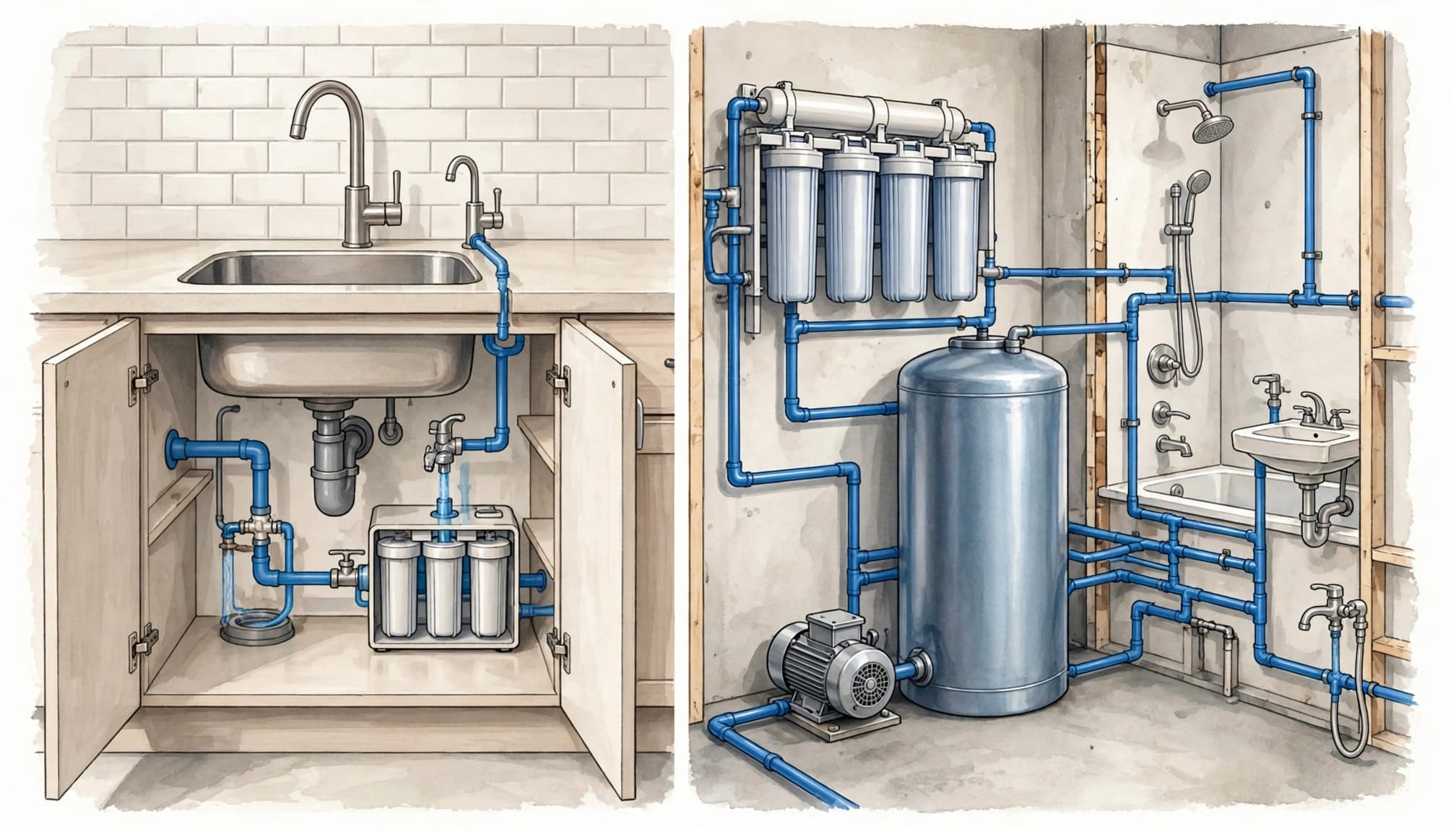
The two approaches have different space and plumbing needs.
| Consideration | Point-of-use RO | Whole-house RO |
|---|---|---|
| Typical use | Drinking and cooking at a dedicated faucet | Multiple connected household fixtures |
| Equipment | Compact filters, membrane, and usually a small tank | Larger pretreatment, membrane equipment, storage, and pumps |
| Water production | Sized for a limited number of outlets | Sized for daily household use and peak demand |
| Concentrate | Smaller discharge stream | Larger discharge stream that needs careful planning |
A kitchen unit can make sense when drinking and cooking are the only reasons for reducing lithium. Whole-house RO may fit when you want treated water at several fixtures or the well has broader dissolved-water concerns.
Neither setup automatically treats every water line on a property. Outdoor faucets, irrigation, and other branches may be connected before or after treatment, depending on the plumbing design.
Start with a well-water test
Before choosing equipment, request a laboratory analysis that names lithium . Don't assume a standard well-water panel includes it. The result establishes the untreated concentration and gives the treatment system a baseline for comparison.
Collect the source sample using the laboratory's instructions. Ideally, the sample comes from a tap that receives water before any existing treatment. If a suitable tap isn't available, a water-treatment professional can help identify a representative sampling point.
Test more than lithium
The water analysis should also provide information for pretreatment and membrane design. Useful measurements can include hardness, pH, total dissolved solids (TDS), iron, and manganese. Sediment conditions and water pressure matter as well.
The appropriate panel depends on the well and its history. For instance, a system designed around lithium still needs to account for iron if iron is present at a level that could foul the membrane.
Set a treated-water goal
Discuss the laboratory result and your intended use with a water-treatment professional. A clear goal helps determine whether a kitchen unit or a whole-house system is the better fit.
Keep the full laboratory report. The lithium result matters, but the other measurements help determine what the membrane will encounter every day.
What affects lithium reduction?
The same type of membrane can perform differently under different conditions. For that reason, broad RO claims aren't a substitute for a design based on the well and a test of the installed system.
Membrane and operating conditions
Membrane selection matters because RO products don't all perform identically. Feed pressure, water temperature, the amount of dissolved material, and the system's recovery setting can also affect production and separation.
Low pressure can reduce the amount of water the membrane produces. If the system operates outside its intended conditions, lithium reduction may differ from what was expected. A membrane that has become fouled or damaged can also perform differently.
Pretreatment and maintenance
Well water often needs treatment before it reaches the RO membrane. Sediment can clog filters, hardness minerals can form scale, and iron or manganese can foul equipment. Where chlorine is present, compatible pretreatment may be needed to protect the membrane.
The right combination depends on the analysis. A sediment filter, softener, iron filter, or carbon stage may be appropriate for a particular well, but adding every stage isn't automatically helpful. Unneeded equipment adds maintenance and can restrict flow.
Our guide to the stages of Florida well water purification explains how common treatment components fit together.
Size whole-house RO for actual water use
A whole-house system must supply both the total water a household uses and the flow needed when several fixtures run at once. Home size alone doesn't answer either question.
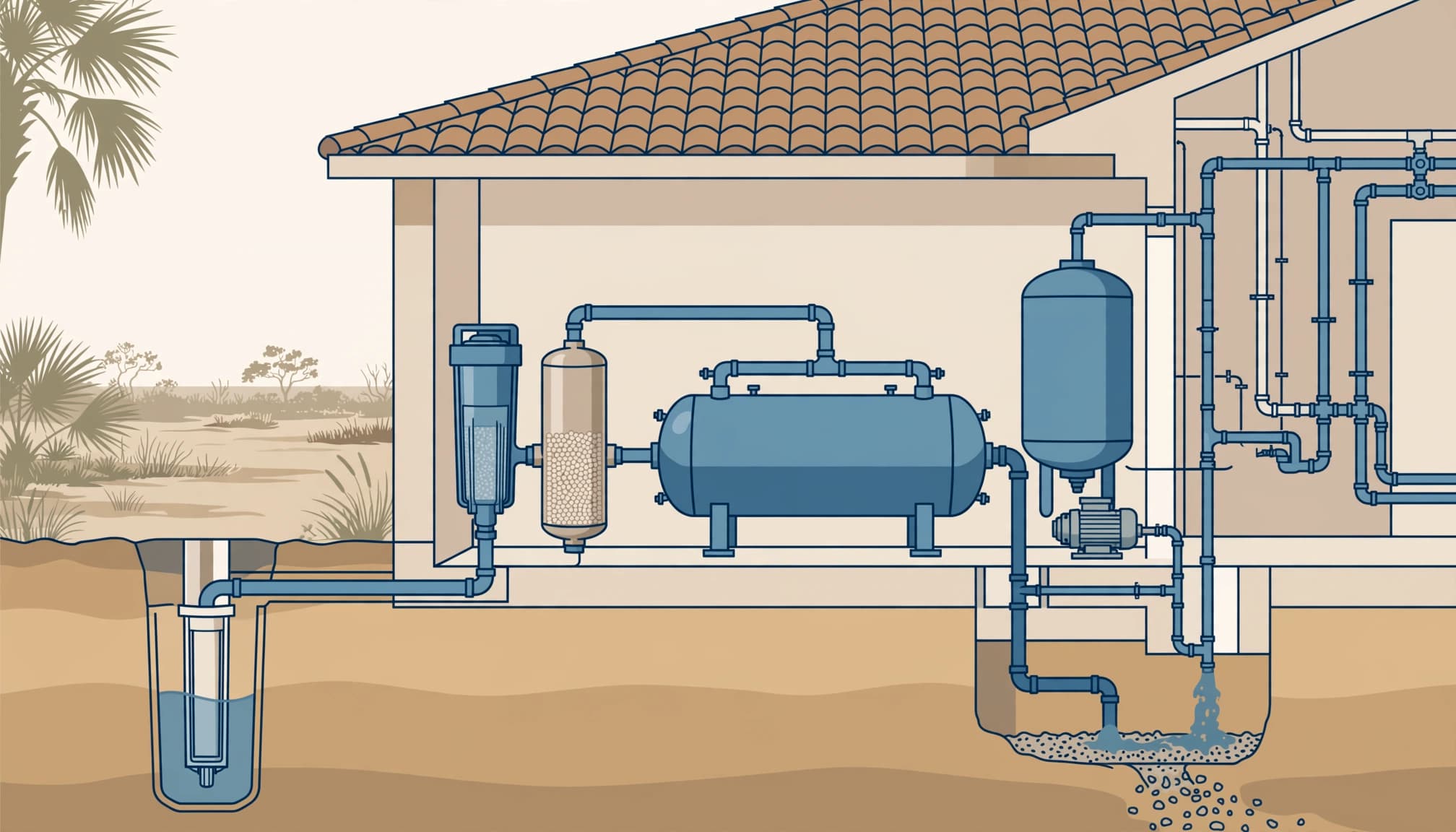
Production and storage do different jobs
The membrane produces treated water over time. A storage tank holds that water until the household needs it, and a distribution pump can send it through the plumbing at usable pressure.
For example, morning showers and a washing machine may draw water faster than the membrane can produce it. Storage helps cover that short period of demand. The membrane then needs enough capacity to refill the tank while meeting the home's continuing use.
An oversized tank can't make up for a membrane that consistently produces too little water. Likewise, a larger membrane may struggle if pretreatment restricts its incoming flow.
Account for the well and plumbing
System sizing also depends on the well pump, available feed pressure, pretreatment capacity, installation space, and the fixtures that will receive treated water. Pressure should be assessed while water is flowing, because a reading with everything turned off doesn't show how the system performs under demand.
For more detail on matching reserves to household use, see our guide to whole-house RO storage and peak demand.
Plan for recovery and concentrate disposal
RO doesn't turn all incoming well water into treated water. Some becomes product water, while the rest leaves as concentrate containing a greater share of the dissolved material rejected by the membrane.
Recovery describes the portion of feed water that becomes product water. A higher recovery setting means less concentrate for a given amount of product water, but pushing recovery too high for the water chemistry can increase scaling and cause operating problems.
The appropriate setting depends on the equipment and the well analysis. Household use matters, too: a system supplying showers and laundry will generally process more water than one serving a kitchen faucet.
The concentrate needs an appropriate discharge route. Drain capacity, plumbing requirements, and any septic-system concerns should be part of the installation plan. Discharge to landscaping, storm drains, canals, or other areas can raise additional concerns, so disposal needs professional planning rather than an improvised hose connection.
Test the treated water for lithium
After installation and startup, collect a treated-water sample for lithium analysis. A useful sample point is the faucet where your household will use the water. For a whole-house system, that means a fixture connected to the treated-water plumbing.
Compare the right samples
Compare the treated result with a representative untreated sample. Using the same laboratory and following consistent sampling instructions makes the comparison easier to interpret.
For a more detailed assessment, a treatment professional can sample the water entering the membrane and the product water leaving it. That helps separate membrane performance from conditions elsewhere in the plumbing, such as an unintended bypass or a connection to an untreated line.
If a result is reported as below the laboratory's reporting limit, it means the laboratory didn't measure lithium above that limit. It doesn't prove that the water contains none.
Repeat testing as conditions change
Keep the initial reports with the system's service records. Repeat lithium testing during ongoing service, particularly after a membrane replacement, a significant change in well water, or an unexplained change in performance.
A handheld TDS meter can help track general system operation, but it doesn't measure lithium specifically . A lower TDS reading alone can't establish how much lithium the system removed.
Alternatives for drinking and cooking water
Point-of-use RO is often the most practical alternative to whole-house treatment when the goal is limited to water consumed in the kitchen. It treats a smaller volume and generally requires less space, storage, and concentrate management. As with a whole-house system, lithium-specific testing shows how it performs at your home.
Distillation is another option for a limited volume of drinking water. A distiller boils water and collects the condensed vapor, leaving many dissolved minerals behind. Its production and maintenance needs differ from RO, so it may suit a household that needs only a smaller supply.
A softener can address hardness throughout the house, but don't assume it provides reliable lithium reduction. Likewise, an ordinary sediment filter or carbon filter shouldn't be chosen on the assumption that it will remove dissolved lithium.
Bottled water is another way to obtain water for drinking and cooking without installing whole-house equipment. Its composition depends on the source and product, so the relevant lithium information is the analysis for that water.
Choose the system around the test result
Whole-house RO can reduce lithium, but the finished result depends on the water, equipment, and operating conditions. A lithium test before treatment and another at a treated tap provide the clearest picture of performance.
If your goal is limited to drinking and cooking, a point-of-use system may be enough. If you want treated water at multiple fixtures, plan the storage, pumping, pretreatment, and concentrate disposal together.
At Trademark Water Systems, we provide water analysis and custom RO options for well-water users in Southwest Florida.
Latest posts
Read Our Blog
Tips, guides, industry best practices, and news.


Contact us
Get in touch
Our friendly team is ready to chat.
