
Whole-House RO Chromium-6: What Homeowners Should Know
Yes, a properly designed and maintained reverse osmosis system can reduce chromium-6, also called hexavalent chromium. However, whole-house RO chromium-6 treatment shouldn't be treated as an automatic guarantee because results depend on the membrane, water chemistry, pressure, flow rate, maintenance, and verified testing.
As of August 2026, the EPA federal drinking-water standard covers total chromium at 0.1 mg/L, or 100 parts per billion. That total includes chromium-6 and chromium-3, but the federal government doesn't have a separate maximum contaminant level for chromium-6. The right treatment decision starts with accurate testing and a system designed for your home's actual water.
Can whole-house RO chromium-6 treatment remove it?
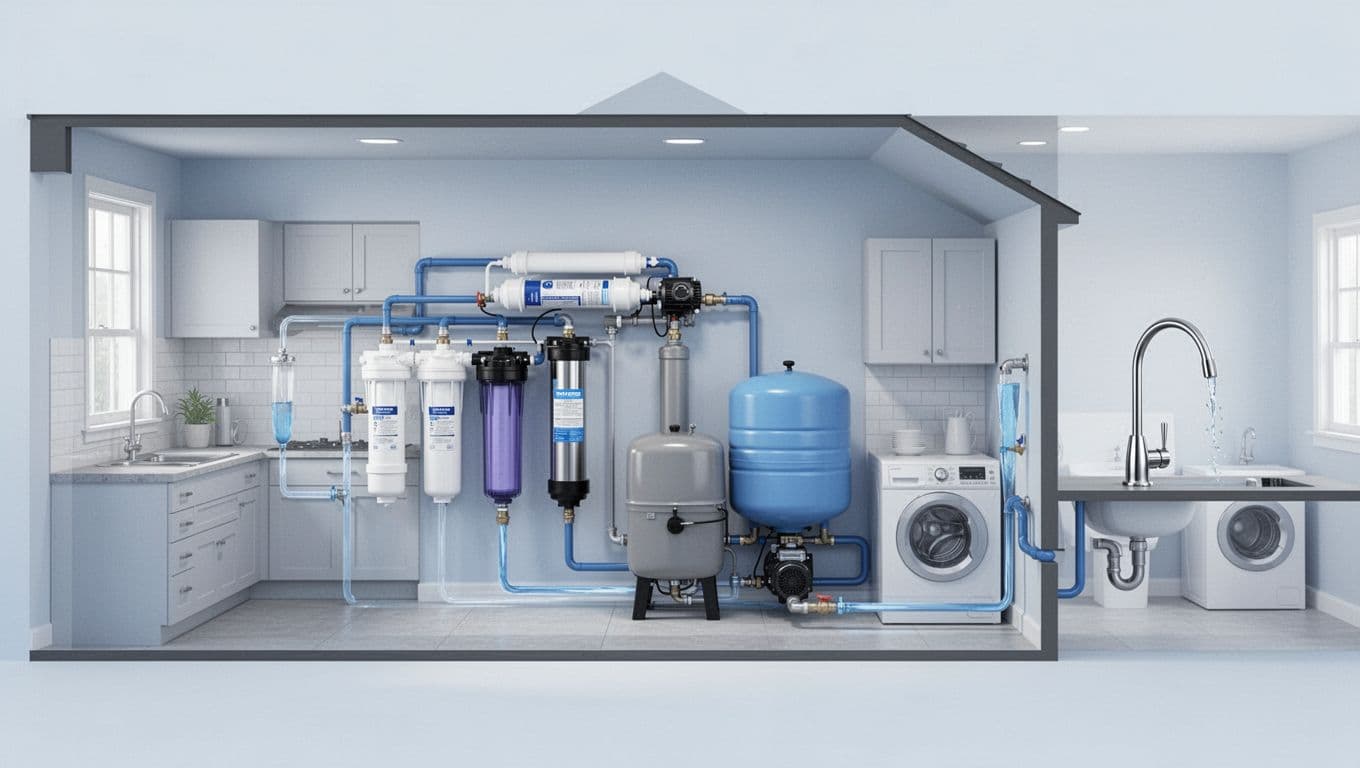
Reverse osmosis pushes water through a semi-permeable membrane. The membrane allows water molecules through while rejecting many dissolved substances, including certain metals and ions. Prefilters protect the membrane, while post-treatment can improve taste and stabilize the finished water.
A whole-house RO chromium-6 system treats water before it reaches household fixtures. Depending on the design, treated water may supply the kitchen, bathrooms, laundry, and other outlets. A point-of-use system treats water at one faucet, usually for drinking and cooking.
Chromium-6 and chromium-3 are different forms
Chromium-6 is the common name for hexavalent chromium, written as Cr(VI). Chromium-3, or trivalent chromium, is written as Cr(III). They have different chemical properties and can behave differently during water treatment.
The EPA's total-chromium standard includes both forms. Therefore, a water report showing total chromium doesn't always tell you how much is chromium-6. Ask the laboratory whether it can test for hexavalent chromium separately, especially if your initial report shows elevated total chromium.
Look for a verified chromium claim
The main certification standard to check for residential RO systems is NSF/ANSI 58 . Still, a general NSF label isn't enough. The product's certification listing or performance data should name chromium-6, hexavalent chromium, or the exact contaminant claim.
Aquasana's OptimH2O Reverse Osmosis and Claryum systems state that they reduce at least 97% of hexavalent chromium for the life of the filtration system. The iSpring RCC7AK is marketed as NSF/ANSI 58 certified with chromium reduction among its listed claims. These examples don't mean every RO system performs the same way. They show why homeowners need to review the specific model and certified configuration.
A certification logo alone doesn't prove chromium-6 reduction. The performance listing must identify the contaminant.
When is whole-house RO appropriate?
Whole-house RO can make sense when testing shows a water-quality concern throughout the property, or when the homeowner wants treated water at multiple fixtures. It requires more planning than an under-sink system because the equipment must meet peak household demand.
Before choosing equipment, review the source water, daily use, available space, drain capacity, storage needs, and well-pump performance. Whole-house reverse osmosis system sizing should begin with a current water analysis rather than a guessed equipment size.
Test the source water and treated water
Test untreated water before installation. Then test the water leaving the RO system after commissioning and again during routine service. Testing both points confirms whether the system is reducing the contaminant under real operating conditions.
For chromium concerns, request total chromium and hexavalent chromium testing when available. Keep the laboratory reports with the system records. A change in well conditions, municipal supply, pretreatment, or membrane performance can change future results.
Testing also helps identify related issues, such as high total dissolved solids, iron, manganese, sediment, hardness, or chlorine. Those conditions can affect membrane life and may require pretreatment.
Point-of-use RO may be enough
A whole-house system isn't automatically necessary for every home. If your concern involves drinking and cooking water, an under-sink RO system with an explicit chromium-6 claim may provide treatment where you use the water most.
Point-of-use treatment generally requires less space, lower water volume, and less complex plumbing. Whole-house treatment may be more suitable when several faucets need treated water or when the water-quality goal applies across the home. A comparison of whole-house RO and water softeners can also help clarify which equipment addresses your actual problem.
What affects chromium-6 removal performance?
The phrase "reverse osmosis" describes a treatment process, not one identical product. Two systems can use different membranes, pressures, recovery rates, pretreatment stages, and controls. Their chromium performance may differ as a result.
Membrane type and water chemistry matter
Most residential RO systems use a thin-film composite membrane. The membrane rejects dissolved substances, but its performance depends on feed pressure, temperature, pH, total dissolved solids, hardness, and other water conditions.
Sediment and carbon prefilters also matter. Sediment can restrict flow, while chlorine can damage some membrane materials. High TDS or scale-forming water can increase the treatment burden and raise reject-water volume. High-TDS RO design considerations can affect membrane selection, pretreatment, storage, and operating cost.
The manufacturer should state the conditions behind its chromium claim. Check the tested flow rate, pressure, feed-water limits, recovery rate, and replacement requirements before purchasing.
Maintenance protects the result
RO performance can decline when prefilters clog, carbon capacity is exhausted, pressure falls, seals wear, or the membrane becomes fouled. Follow the manufacturer's replacement schedule and monitor changes in pressure, production rate, taste, and treated-water test results.
Many homes need regular sediment and carbon filter changes, while the membrane lasts longer. Actual timing varies with water quality and use. RO prefilter replacement guidance can help homeowners plan routine service.
RO also produces a concentrate stream. Rejected chromium and other dissolved substances move into that water instead of disappearing. The system must send concentrate to an appropriate drain or disposal point, with local sewer or septic requirements and manufacturer instructions followed.
A practical buying checklist
Before installing a whole-house RO chromium-6 system:
- Start with a recent laboratory water analysis, including separate hexavalent chromium testing when available.
- Choose a product with NSF/ANSI 58 certification or another applicable, verifiable performance standard.
- Confirm that the documentation names chromium-6 or hexavalent chromium, not only "heavy metals."
- Ask how pressure, flow rate, storage, pretreatment, and peak demand affect the design.
- Confirm filter and membrane replacement requirements before installation.
- Plan for concentrate disposal and routine treated-water testing.
- Use a qualified installer who can service the system after installation.
A system that fits the water chemistry and household demand is more likely to deliver consistent results than an oversized or generic unit.
Conclusion
A certified, properly maintained RO system can reduce chromium-6, but performance depends on the complete setup. Testing, explicit NSF/ANSI 58 contaminant claims, correct sizing, scheduled maintenance, and follow-up water analysis matter more than the words "reverse osmosis" on a product label.
For drinking and cooking concerns, point-of-use RO may be the practical choice. When several fixtures need treated water, a whole-house design can make sense, provided the membrane, storage, pressure, pretreatment, and concentrate handling all match the home. The best next step is a current water test before choosing equipment.
Latest posts
Read Our Blog
Tips, guides, industry best practices, and news.



Contact us
Get in touch
Our friendly team is ready to chat.