
Can Whole-House RO Reduce Disinfection Byproducts?
Whole house reverse osmosis can reduce some disinfection byproducts in city water, but results depend on the specific compound and system design . Research has shown reductions in chloroform, one common byproduct, under controlled conditions. That doesn't establish a removal rate for every whole-house system.
For many homeowners, an under-sink filter is a more practical starting point when drinking water is the main concern. The right choice begins with understanding what's in your water and where you want it treated.
What Are Disinfection Byproducts?
Municipal utilities disinfect water to control disease-causing microorganisms. Disinfection byproducts, or DBPs, can form when disinfectants react with naturally occurring organic matter and other substances in the water.
Two commonly monitored groups are total trihalomethanes, known as TTHM, and five regulated haloacetic acids, known as HAA5. Chloroform is one of the four compounds measured as part of TTHM. Bromate and chlorite are other regulated byproducts associated with certain treatment processes.
The presence of a byproduct doesn't mean a utility has failed to meet a drinking water standard. Concentrations can vary across a distribution system and over time. A utility's water quality report provides a starting point, while a household test can help identify conditions at your property.
Our guide to assessing city tap water quality explains how municipal information fits into a home filtration decision.
How Reverse Osmosis Can Reduce Byproducts
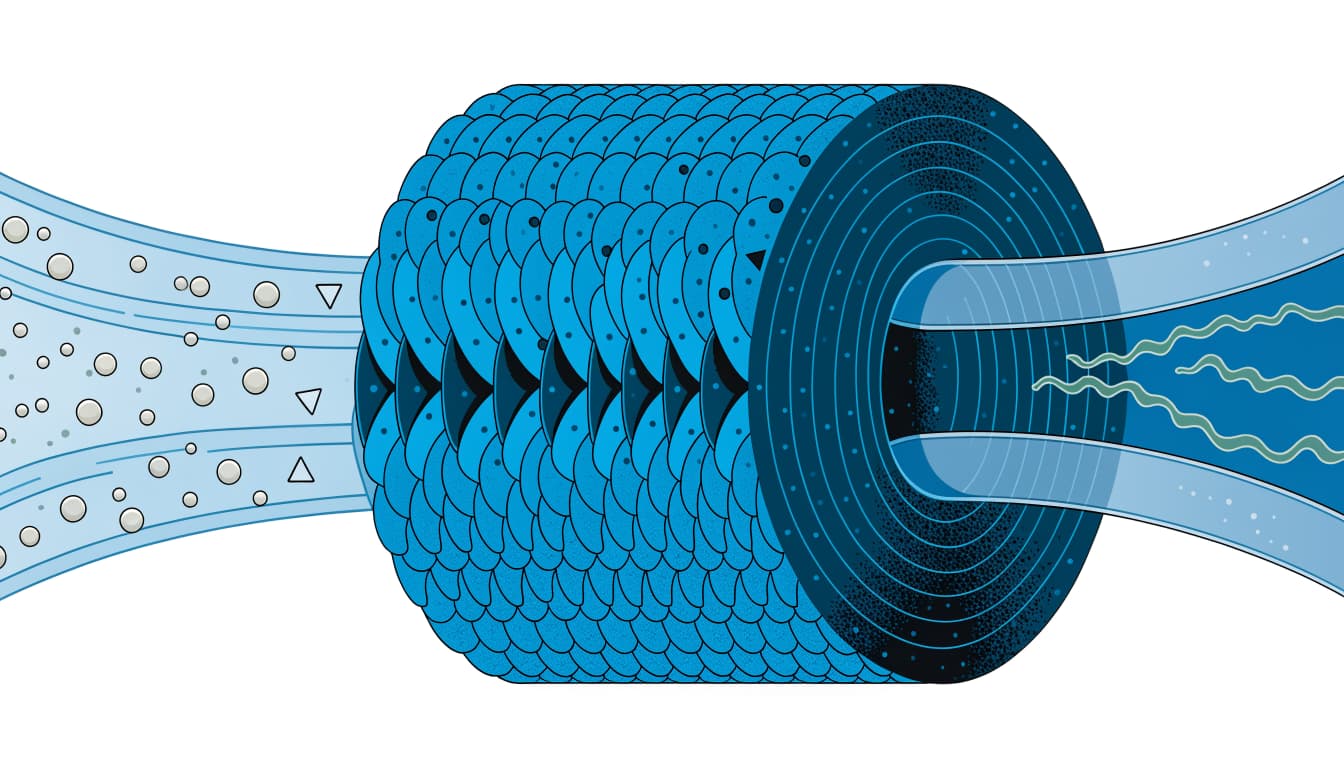
Reverse osmosis uses pressure to move water through a semipermeable membrane. Some dissolved substances remain on the concentrated side of the membrane and leave with a separate wastewater stream.
What Studies Found for Chloroform
A 2009 pilot study of domestic RO reported chloroform reductions of at least 80% under its reported test conditions. Its highest average result was about 85.7%.
Those results describe a particular setup, not a whole-house performance guarantee. The study also found that removal changed with operating conditions, including flow and water conductivity.
A separate membrane study found that rejection of certain trihalomethanes fell substantially during testing. Together, the studies show why one initial laboratory result can't establish a lasting removal rate for every RO installation.
Why the Compound Matters
DBPs have different chemical properties, so an RO membrane doesn't necessarily reduce each one to the same degree. A system that reduces chloroform shouldn't be assumed to deliver the same result for every member of TTHM or HAA5.
Bromate, chlorite, and chlorate are also distinct chemicals. A treatment plan needs performance information for the particular substance of concern, rather than a broad claim that RO removes disinfection byproducts.
Pretreatment may contribute to the overall result as well. For example, carbon can reduce some organic byproducts, but performance depends on the compound, media, flow rate, and remaining carbon capacity.
What EPA Limits Mean for Your Home
The U.S. Environmental Protection Agency sets limits for regulated contaminants in public drinking water. Its limits include 80 micrograms per liter for TTHM and 60 micrograms per liter for HAA5.
EPA also sets limits of 10 micrograms per liter for bromate and 1,000 micrograms per liter for chlorite. These are public water system standards , not promised removal levels for household filters.
For TTHM and HAA5, utility compliance generally relies on a locational running annual average. An individual sample can differ from that average. EPA's disinfection byproduct rule materials explain the monitoring framework.
A home system's performance is a separate issue. The useful comparison is between the target compound in incoming water and its concentration after the complete treatment system.
Whole-House RO vs. Point-of-Use Filtration
Whole-house RO treats the water sent to connected household fixtures. Point-of-use equipment treats water at a selected location, usually the kitchen sink.
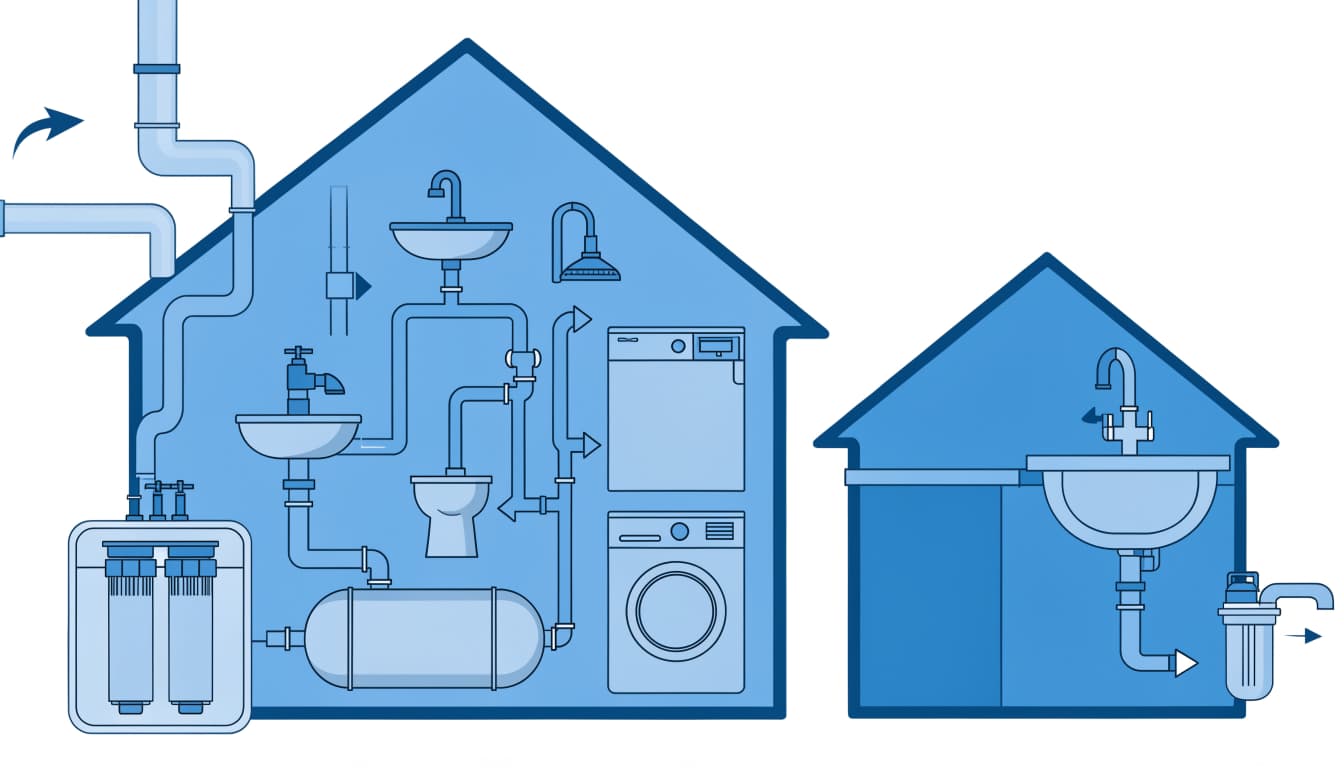
The differences are useful when deciding how much water needs treatment.
| Consideration | Point-of-use RO | Whole-house RO |
|---|---|---|
| Coverage | A dedicated faucet or connected appliance | Connected fixtures throughout the home |
| Equipment | Smaller filters, membrane, and often a tank | Larger pretreatment, storage, and pumping equipment |
| Water use | Treats a relatively small volume | Treats a much larger household volume |
| Cost and upkeep | Generally lower | Generally higher and more complex |
The main trade-off is coverage: whole-house treatment reaches more fixtures, but it requires a larger system.
When a Kitchen Filter Makes Sense
If your main concern is water used for drinking and cooking, an under-sink filter can focus treatment where you consume it. Some systems can also supply a refrigerator line.
An activated carbon filter with a documented claim for your target contaminant may be another option. An RO system can address additional dissolved substances, but its certification should include the specific reduction claim you need.
When to Consider the Whole House
Whole-house treatment may fit when you want treated water at bathroom sinks and showers or have other dissolved-water concerns throughout the home. Some volatile byproducts can also enter the air during showering, although the level of exposure depends on the water and household conditions.
A whole-house carbon system is another option for some goals. It can address disinfectant taste and odor throughout the home when properly sized, though it won't generally reduce dissolved salts or hardness. Our comparison of point-of-use and whole-house filtration covers the differences in more detail.
Design Choices That Affect RO Performance
A whole-house system needs more than a membrane. Its pretreatment, storage, pressure, and plumbing all affect what reaches your fixtures.
Pretreatment Protects the Membrane
City water can contain chlorine or chloramine, along with hardness and sediment. Many thin-film composite RO membranes are sensitive to oxidants, so pretreatment must reduce the disinfectant before water reaches the membrane.
Carbon treatment is common, but chlorine and chloramine don't always require the same design. Chloramine treatment may call for catalytic carbon or other suitable media with enough contact time. Our guide to chlorine and chloramine filtration explains that distinction.
Sediment filtration can protect equipment from particles. A softener or other scale-control approach may also be appropriate when hardness would otherwise foul the membrane. The combination should match the incoming water rather than follow a standard package.
Storage, Pressure, and Plumbing Matter
An RO membrane produces treated water at a limited rate. A whole-house installation may therefore need a storage tank and a pump to supply showers and appliances during periods of higher demand.
Pressure, water temperature, and recovery settings can affect production and contaminant reduction. Tank capacity matters too: a system that can't replenish stored water quickly enough may struggle during busy periods.
The plumbing plan should also identify which outlets receive treated water. For example, an irrigation line may be separate from the household RO supply. Our guide to sizing a whole-house RO storage tank covers capacity considerations.
Water Waste and Cost
RO sends part of its incoming water to a drain as concentrate. The amount depends on the equipment, water chemistry, pressure, and operating settings. Treating water for showers and laundry generally creates a larger total wastewater stream than treating drinking water alone.
An installer must account for drain capacity and applicable plumbing requirements. Where a home uses a septic system, concentrate disposal also needs appropriate planning. Our explanation of RO wastewater and water recovery describes the trade-offs.
Whole-house RO also generally costs more to install and operate than a single under-sink unit. The price depends on the required pretreatment, membrane capacity, tank, pumps, electrical work, and plumbing changes.
Ongoing expenses include replacement filters and membranes, electricity where pumps are needed, water used during filtration, and professional service. A whole-house carbon system paired with a kitchen RO unit can reduce the volume going through RO, although maintaining two systems has its own cost.
Maintenance and Testing Keep Results Meaningful
Service the Complete System
Carbon and sediment filters need replacement as their capacity is used. If carbon pretreatment stops reducing the disinfectant adequately, the membrane can suffer damage. Scale and sediment can also reduce production or shorten membrane life.
Service includes attention to pressure, treated-water production, concentrate flow, the tank, and pumps. Replacement timing depends on the equipment and water conditions, so the system's service plan matters more than a universal schedule.
Removing disinfectant before the membrane also reduces the residual protection in downstream plumbing. Storage and distribution should be designed and maintained with water quality in mind. RO alone isn't a complete household disinfection plan.
Measure the Byproduct You Care About
Total dissolved solids, or TDS, is a useful general RO operating measure. It doesn't tell you the concentration of chloroform or another specific DBP.
For a targeted concern, laboratory samples of untreated and treated water provide a more useful comparison. Sampling after installation establishes a baseline, and later testing can help identify changes. Because TTHMs are volatile, use the laboratory's sampling containers and handling instructions.
For point-of-use RO, NSF/ANSI 58 is a relevant drinking-water treatment standard. Look for a claim naming the contaminant, since certification to the standard alone doesn't establish reduction of every DBP.
Choosing Treatment for Your City Water
Start with the compounds identified in your utility report or a household laboratory analysis. Then decide which fixtures need treated water.
If drinking and cooking are the priority, a properly selected under-sink system often offers a simpler approach. Whole-house RO deserves consideration when the treatment goal extends across the property or several dissolved-water concerns justify the added equipment.
At Trademark Water Systems, we offer water analysis and treatment services in Naples and Southwest Florida. We can help match a treatment plan to the water entering your home and the way you use it.
The Bottom Line on Whole-House RO
Whole-house reverse osmosis can reduce certain disinfection byproducts, including chloroform under studied conditions. Its performance depends on the compound, membrane, pretreatment, and operating conditions.
For many homes, treating drinking water at the sink is the more practical choice. Whole-house RO makes more sense when you need broader coverage and are prepared for the additional water use and maintenance.
Latest posts
Read Our Blog
Tips, guides, industry best practices, and news.

Contact us
Get in touch
Our friendly team is ready to chat.
