
Radium Treatment Florida Wells: What Homeowners Need
Radium in private well water can't be detected by taste, odor, or appearance. If a laboratory report shows elevated radium, choosing the right radium treatment Florida wells need starts with understanding the complete water chemistry, not buying a standard filter.
Florida homeowners also face an important choice between treating every tap and treating only drinking water. The best system depends on your well results, household size, water use, operating budget, maintenance preferences, and plans for follow-up testing.
Key Takeaways
- Test the complete water profile first. Include hardness, iron, manganese, barium, sulfate, pH, and radium results.
- Radium treatment is system-specific. Water softeners, specialty ion exchange, reverse osmosis, and other media can fit different situations.
- Whole-home and point-of-use systems solve different problems. One protects water throughout the home, while the other focuses on drinking and cooking.
- Pretreatment matters. Sediment, iron, manganese, hardness, and pH can affect radium removal equipment.
- Testing after installation confirms performance. A treated-water sample is the only dependable way to verify the system is working.
Why Radium Matters in Florida Private Wells
Radium is a naturally occurring radioactive element. It can enter groundwater as water moves through certain rocks and mineral deposits. The two isotopes commonly discussed in drinking water are radium-226 and radium-228.
Long-term ingestion is the main concern when radium levels are elevated. Private wells don't receive the same routine oversight as public water systems, so the property owner must arrange testing and address water-quality problems.
The federal public-water standard for combined radium-226 and radium-228 is 5 picocuries per liter, written as 5 pCi/L. That standard is a useful reference for private-well owners, although it doesn't automatically create the same legal requirements for an individual household.
Radium often appears alongside other groundwater issues. Hardness can reduce treatment capacity, while iron and manganese may stain fixtures or foul filter media. Barium and sulfate also matter because they can affect mineral scaling, resin performance, and the design of pretreatment.
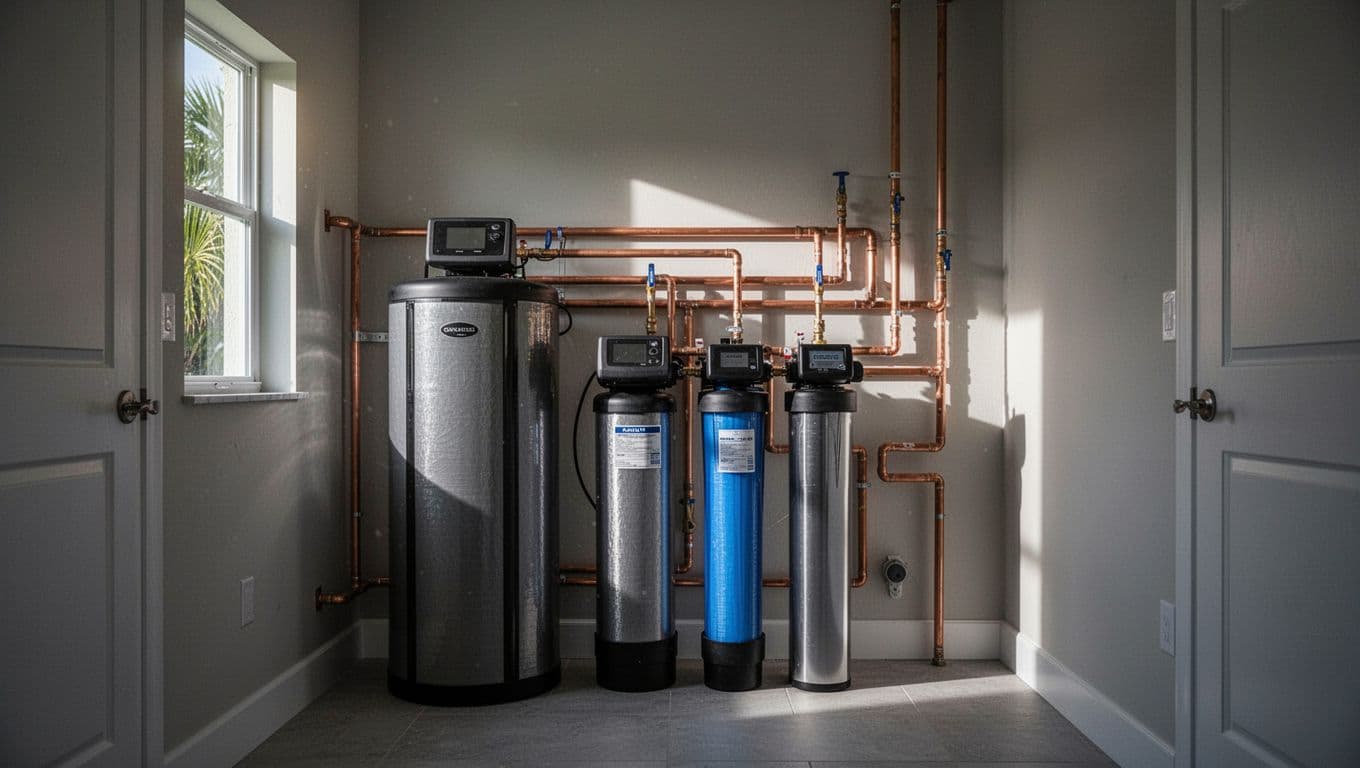
A water report may show radium without giving you enough information to select equipment. The treatment plan should account for the entire sample, the well pump, plumbing, pressure, and daily demand.
A filter that reduces one contaminant can still perform poorly when iron, manganese, hardness, or sediment overwhelms the treatment media.
Start With a Complete Well-Water Analysis
Radium treatment Florida wells require should be based on laboratory results from the raw well water. Collecting a sample from an untreated tap helps identify the water entering the home before filters, softeners, or storage tanks change it.
Ask for a report that includes:
- Radium-226 and radium-228, or a clearly identified combined-radium result
- Hardness
- Iron
- Manganese
- Barium
- Sulfate
- pH
- Total dissolved solids, when appropriate
- Coliform bacteria and nitrate for general private-well safety
The report should show the units and detection limits. Radium is often reported in pCi/L, while hardness may appear as milligrams per liter or grains per gallon. A treatment professional needs the actual values, not a description such as "high minerals" or "some radiation."
Barium and sulfate deserve close attention. They can contribute to scale and may change how a system handles regeneration or reject water. Iron and manganese can require oxidation or filtration before a radium-focused resin or membrane operates reliably.
pH also affects treatment. Some media perform within a defined pH range, so a low or high result can change the equipment sequence. A sediment filter may be necessary before advanced treatment if the well carries sand or fine particles.
Florida well owners should also retest periodically, with annual testing commonly recommended for private wells. Retest after flooding, well repairs, changes in taste or odor, or a major change in treatment equipment. You can review practical guidance on how often to test well water before scheduling a new sample.
Radium Treatment Florida Wells: Compare the Main Options
No single device fits every Florida well. The following options can be appropriate when the equipment matches the laboratory report and the required flow rate.
| Treatment option | Best fit | Main considerations |
|---|---|---|
| Cation-exchange softener | Radium with significant hardness | May reduce radium while softening, but performance depends on resin, capacity, iron, and maintenance |
| Specialty ion exchange | Whole-home treatment with confirmed radium levels | Requires proper pretreatment, regeneration, and media service |
| Point-of-use reverse osmosis | Drinking and cooking water at one or more taps | Focuses treatment where water is consumed, but doesn't treat showers or other fixtures |
| Whole-home reverse osmosis | Higher contaminant burden throughout the home | Needs storage, pressure control, pretreatment, and management of wastewater |
| Specialty adsorption media | Certain water chemistries and treatment designs | Must be selected for the tested contaminants and replaced according to service conditions |
Water softeners and cation exchange
A standard water softener is designed to remove hardness, not automatically to solve a radium problem. Some cation-exchange resins can reduce radium under suitable conditions. However, the installer should confirm the resin's intended use, capacity, operating limits, and required regeneration schedule.
Hard water, iron, and manganese compete for treatment capacity. If the well contains those contaminants, pretreatment may protect the resin and prevent early breakthrough. Salt use and brine discharge also become part of the operating plan.
Specialty ion exchange and adsorption
Specialty ion-exchange systems use media selected for dissolved contaminants such as radium. These systems can treat water for the entire home when sized for the well flow and household demand.
Some treatment designs use adsorption media instead. The correct media depends on pH, competing minerals, sulfate, barium, and other results. Media eventually needs service or replacement. Because radium can collect in spent resin or media, disposal should follow the installer's instructions and applicable local requirements.
Reverse osmosis
Reverse osmosis can provide treated water at a kitchen faucet, refrigerator connection, or another selected point. A point-of-use RO system is often practical when the primary concern is water used for drinking and food preparation.
Whole-house RO is a larger installation. It may require sediment and carbon pretreatment, water storage, a booster pump, drain connections, and careful sizing. The system also produces a reject stream, so the installer must consider the home's plumbing and wastewater arrangement.
For homeowners comparing treatment methods, this guide to reverse osmosis versus water softeners for well water provides useful context about what each system is designed to handle.
Systems that don't solve radium by themselves
Activated carbon filters, sediment filters, ultraviolet disinfection, and aeration can address other water problems, but they shouldn't be treated as automatic radium solutions. A UV unit controls certain microorganisms. It doesn't remove dissolved radium.
Likewise, a sediment cartridge can protect downstream equipment without reducing dissolved contaminants. Each component should have a defined role in the treatment sequence.
Whole-Home or Point-of-Use Treatment?
Whole-home treatment sends conditioned water to showers, sinks, laundry, ice makers, and other fixtures. This option can make sense when the well report shows radium throughout the supply and the household wants consistent treatment at every tap.
It also requires more equipment and higher capacity. A system for two people using modest amounts of water will have different flow and storage needs than one serving a large family with several bathrooms.
Point-of-use treatment focuses on water that enters the body through drinking and cooking. It usually costs less to operate than treating every gallon used for bathing and laundry. However, it protects only the connected faucet or appliance. You'll need to replace filters on schedule and verify that the refrigerator or secondary drinking tap is connected after treatment.
| Consideration | Whole-home system | Point-of-use system |
|---|---|---|
| Coverage | All connected fixtures | Selected drinking-water taps |
| Water demand | Must handle household flow | Handles a smaller treated volume |
| Installation | More space and plumbing changes | Usually limited to a cabinet or nearby location |
| Operating needs | May include regeneration, pumps, tanks, and media service | Includes cartridges, membrane service, and storage-tank care |
| Best match | Consistent treatment throughout the house | Focused drinking-water protection |
A treatment professional should also review well-pump capacity, water pressure, available floor space, drain access, and electrical requirements. These details can determine whether a proposed system will work properly.
Installation, Maintenance, and Follow-Up Testing
Installation should begin with a written treatment design based on the raw-water analysis. The plan should identify each stage, such as sediment removal, iron or manganese treatment, softening, radium reduction, storage, and final drinking-water treatment.
Sizing matters because undersized equipment can lose capacity quickly. Oversized equipment may cost more and waste water, salt, or media without improving results. Household size, peak flow, irrigation demand, and daily water use all belong in the calculation.
Maintenance depends on the technology. A softener may require salt and periodic cleaning. Specialty media can require backwashing, regeneration, or scheduled replacement. RO systems need prefilter and membrane changes, plus inspection of the storage tank and drain flow.
Keep service records that show filter changes, salt settings, media replacement, and water-test results. Those records make it easier to identify changes in well chemistry and prevent missed maintenance.
Testing after installation is essential. Take a sample from a treated drinking-water tap after the system has operated under normal conditions. For a whole-home system, test the kitchen tap and consider a second treated fixture. Compare those results with the original raw-water report.
Installation is only half the job. The treated-water test confirms whether the selected equipment is reducing radium under actual household conditions.
If the result remains high, don't assume that adding another cartridge will fix the problem. Check the treatment sequence, flow rate, valve settings, media condition, regeneration, sampling method, and changes in the well itself.
Conclusion
Radium treatment Florida wells need should never be selected from the radium result alone. Hardness, iron, manganese, barium, sulfate, pH, and other well conditions can determine which treatment method works and how long it lasts.
Whole-home systems provide broad coverage, while point-of-use reverse osmosis can focus resources on drinking and cooking water. Either choice requires correct sizing, regular maintenance, and testing after installation.
A complete water analysis turns an uncertain problem into a manageable treatment plan. For a Florida private well, that evidence is the starting point for safer, more dependable water.
Latest posts
Read Our Blog
Tips, guides, industry best practices, and news.

Contact us
Get in touch
Our friendly team is ready to chat.