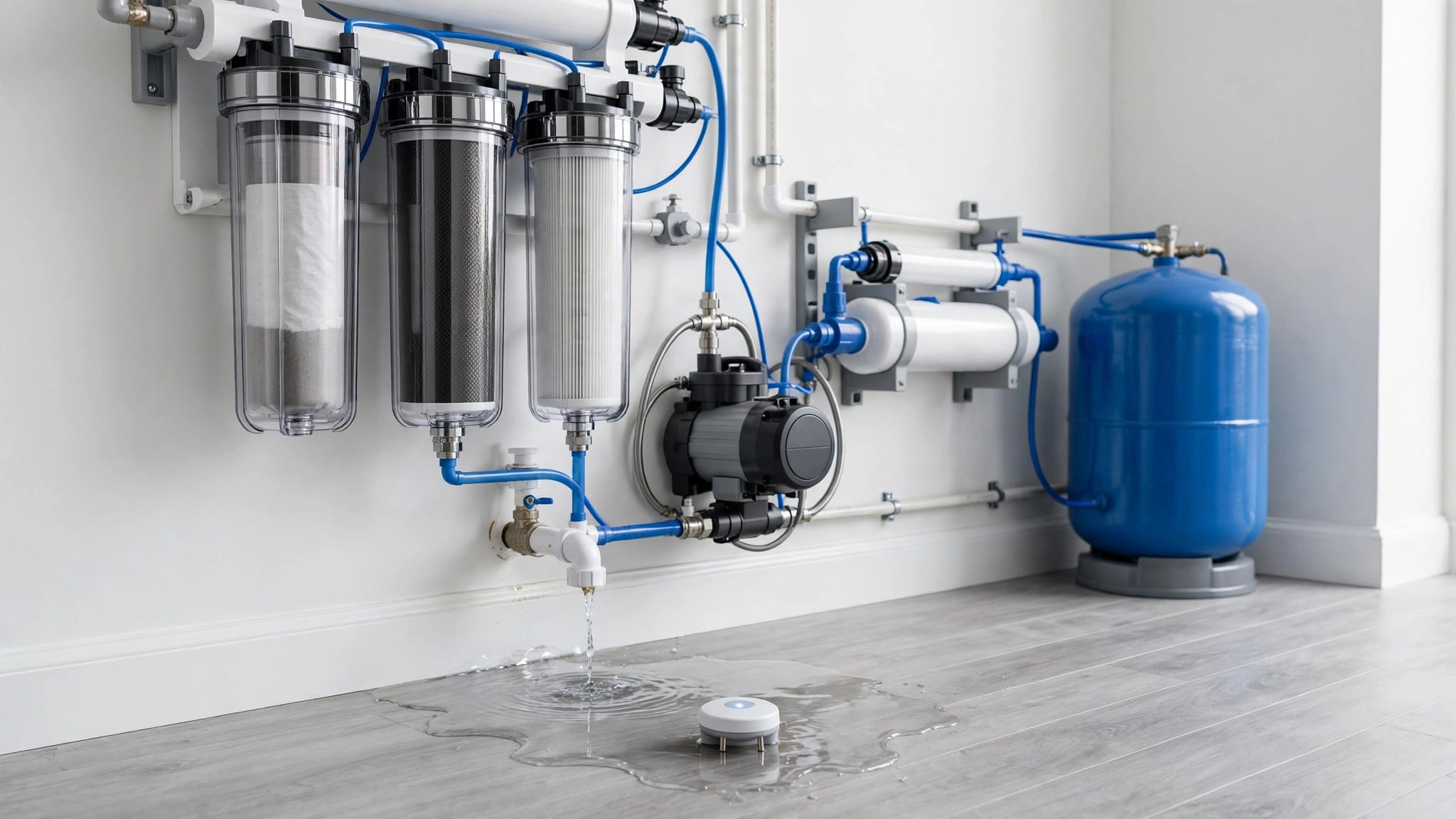
Water Softener Resin Beads at Your Faucets
Water softener resin beads belong inside the softener's resin tank. If they reach a faucet, the particles alone don't tell you how they escaped.
Beads can collect in fixture screens and restrict water flow. The softener may also need attention to restore normal treatment. Understanding what the resin does can help you describe the problem when you arrange service.
What water softener resin beads do
A traditional water softener reduces hardness through a process called ion exchange . As water passes through the resin bed, the resin exchanges calcium and magnesium for sodium or potassium.
Those hardness minerals are responsible for many familiar deposits on faucets, shower doors, and dishes. Removing them helps reduce scale throughout the home's plumbing.
The resin tank and the salt tank
The resin tank and brine tank have different jobs. The resin tank contains the treatment media. The brine tank holds the salt or potassium chloride used to make a regeneration solution.
Cleaning or adding salt to the brine tank doesn't replace resin that has left the other tank. You can learn more about the distinction in our guide to ion-exchange water softeners for hard water.
How regeneration works
Over time, the resin uses up its capacity to remove hardness. During regeneration, the control valve sends brine through the resin bed. The system then rinses the resin and sends wastewater to a drain.
Regeneration restores the resin's treatment capacity. It doesn't identify the reason particles have appeared at a faucet.
How particles can affect faucets and fixtures
A faucet aerator has a screen that can collect particles carried through the plumbing. As material accumulates, the stream may become uneven or the flow may slow.
Showerheads and other fixtures with small openings can also collect debris. A change at one fixture doesn't necessarily mean every fixture has the same amount of material inside it.
A localized flow problem
When one faucet has weak flow while others work normally, the restriction may be at that fixture. An aerator can collect several kinds of debris, so reduced flow alone doesn't establish that the material is softener resin.
Changes throughout the home
If several fixtures develop flow problems around the same time, the issue may extend beyond one faucet. The location and timing of the changes are useful details to share when requesting service.
Hard-water symptoms are a separate clue
A return of hard-water symptoms can occur alongside a fixture problem. White spots on dishes, scale around faucets, and poor soap lather can all indicate that water hardness is affecting the home.
Those signs don't identify a particular softener component. They can occur for more than one reason, including a problem with regeneration or water passing around the softener.
Water source affects treatment needs
Homes in Southwest Florida may use municipal water or a private well. Both can contain hardness minerals, while well water may also contain iron, manganese, or sediment.
These conditions affect how a treatment system performs. A softener addresses hardness, but it isn't a complete treatment for every substance that may be present in water.
Resin softening differs from salt-free conditioning
A salt-free conditioner works differently from a salt-based softener. It may alter how minerals form scale, but it doesn't remove calcium and magnesium through the same ion-exchange process.
Salt-based systems also produce brine discharge during regeneration. Our guide to water softeners and septic systems explains how that process relates to a home's wastewater system.
Getting your softener working again
Particles at a faucet deserve attention, but their appearance alone doesn't establish the cause. Restoring flow at a fixture and restoring water treatment are separate parts of the problem.
At Trademark Water Systems, we install, repair, and maintain water-conditioning systems in Naples and Southwest Florida. We can help homeowners address concerns with their softening equipment and fixtures.
Latest posts
Read Our Blog
Tips, guides, industry best practices, and news.


Contact us
Get in touch
Our friendly team is ready to chat.