
What High TDS Changes in Whole-House RO Design
A high total dissolved solids reading can turn a basic filtration project into a pressure, pretreatment, and wastewater problem. Whole-house RO design must account for more than the number on a handheld TDS meter, because dissolved minerals affect membrane performance and system life.
If you're planning treatment for a private well, large home, rental property, or small community, the right system starts with a laboratory water test. The results help a qualified designer select membranes, pretreatment, storage, pumps, and controls that match the actual water. First, it helps to understand what high TDS changes inside the system.
Key Takeaways
- High TDS increases osmotic pressure, which reduces the membrane's net driving pressure.
- Lower membrane flux and recovery may require more membrane area, higher pressure, or both.
- Scaling and fouling risks depend on the complete water chemistry, not TDS alone.
- Pretreatment can include sediment filtration, carbon, softening, antiscalant, iron removal, or pH adjustment.
- A laboratory water test and qualified system design should come before equipment selection.
What High TDS Means for RO Performance
Total dissolved solids, or TDS, measure the combined concentration of dissolved substances in water. These substances can include calcium, magnesium, sodium, chloride, sulfate, bicarbonate, silica, and other ions. TDS is usually reported in milligrams per liter, which is roughly equivalent to parts per million in water.
A TDS reading gives you a useful starting point, but it doesn't identify the individual contaminants. Two water sources can have the same TDS and behave very differently in an RO system. One may contain mostly sodium chloride, while another may contain hardness, silica, iron, sulfate, or alkalinity that creates a greater scaling concern.
Reverse osmosis works by applying pressure to the feed water. That pressure pushes water through a semipermeable membrane while leaving much of the dissolved material behind. As TDS rises, the water's osmotic pressure also rises. The RO pump must overcome that pressure before water can move efficiently through the membrane.
The practical result is reduced net driving pressure. When the feed pressure stays the same, higher TDS usually means lower permeate flow, lower membrane flux, or both. A system designed for moderate-TDS municipal water may produce less water when connected to a high-TDS well, even if the pump and membrane appear to be operating normally.
A TDS meter can show how much dissolved material is present, but it can't tell you which materials are creating the treatment problem.
High TDS can also affect water quality after treatment. RO removes much of the dissolved mineral content, so the finished water may taste flat. In some cases, low-mineral water can also have a lower pH and become more corrosive to metal plumbing. Post-treatment, such as controlled remineralization or pH adjustment, may be needed after the RO stage.
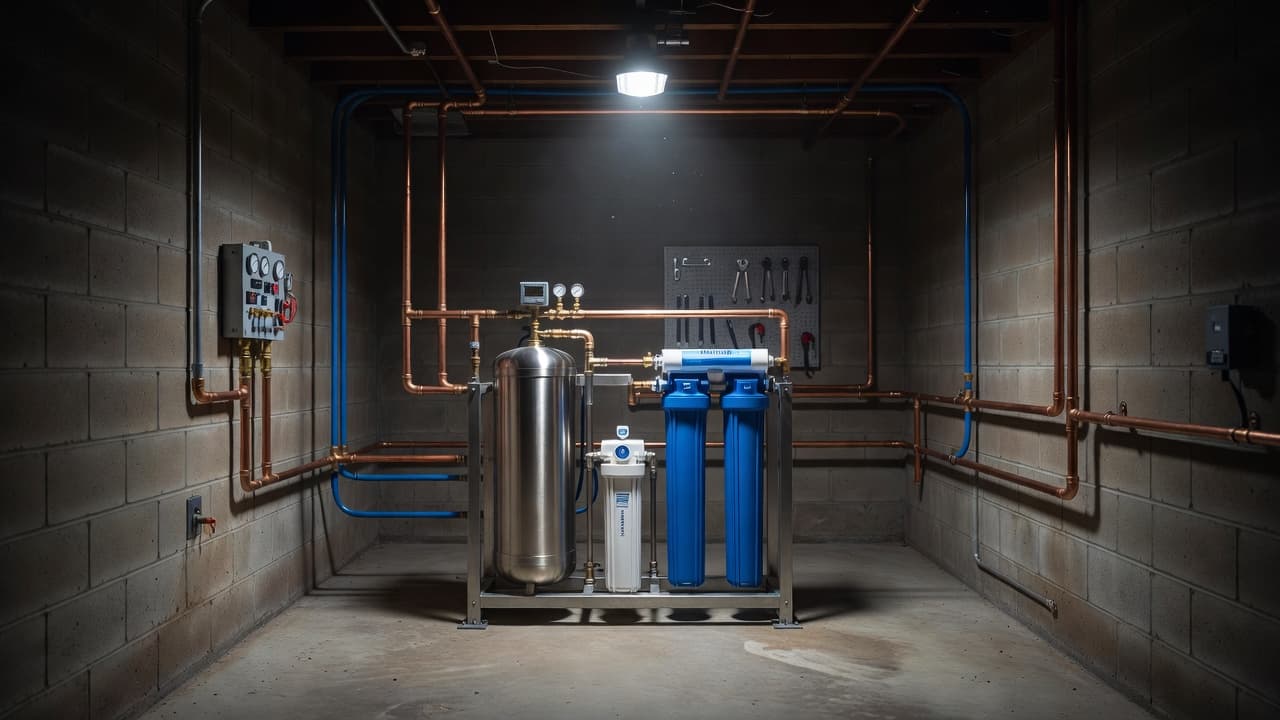
How whole-house RO design responds to high TDS
A high-TDS source doesn't automatically require one particular RO configuration. The designer must balance water demand, feed pressure, temperature, recovery, membrane rejection, and the chemistry shown in the laboratory report.
Higher pressure or more membrane area
The first design question is whether the available pressure can provide the required production rate. High osmotic pressure reduces the force available to move water across the membrane. A booster pump may restore the needed pressure, but it must match the membrane array and flow controls.
Another option is adding membrane area. More membrane surface allows the system to produce the required volume at a lower flux rate. Lower flux can reduce stress on the membranes and may help control fouling, although it increases equipment size and purchase cost.
Water temperature also affects production. Cold water moves through an RO membrane more slowly than warm water. A system sized from a warm-weather rating may produce less water during cooler conditions. Designers should use realistic operating conditions rather than relying on the highest rating shown on a product sheet.
Recovery and reject water
Recovery describes how much feed water becomes treated permeate. For example, a system producing 60 gallons of permeate from 200 gallons of feed water operates at 30% recovery. The remaining water carries a higher concentration of dissolved solids and leaves as concentrate, often called reject water.
High TDS makes recovery more difficult because the concentrate becomes even more concentrated as water leaves the system. Calcium carbonate, calcium sulfate, silica, and other compounds can reach their scaling limits sooner. A design that pushes recovery too high may save feed water while shortening membrane life and increasing cleaning needs.
A lower recovery rate may produce more reject water, but it can provide a safer operating margin. The correct target depends on the source chemistry, membrane type, pretreatment, flow rate, and discharge options.
Storage and peak demand
Whole-house systems rarely need to produce every gallon at the exact moment a fixture opens. A storage tank can let the RO unit run during controlled periods, then supply short bursts of demand through a delivery pump.
That matters in a large home or managed property with showers, laundry, irrigation, and several bathrooms. The designer must separate daily water use from peak flow. Oversizing the membrane for occasional demand can increase cost, while undersizing the storage tank can cause pressure drops during busy periods.
For more background on how RO compares with softening, see this guide to whole-house reverse osmosis vs water softener. The two systems address different water problems and may work together in some homes.
Why TDS alone can't determine pretreatment
Pretreatment protects the RO membranes from particles, chemicals, biological growth, scale, and metals. High TDS raises concern, but the water analysis determines which pretreatment stages belong in the system.
Sediment filtration removes sand, silt, and rust particles that can plug flow paths or collect on the membrane surface. Carbon filtration may be needed when chlorine or chloramine could damage the membrane material. Private wells may need additional treatment for iron, manganese, hydrogen sulfide, hardness, or turbidity.
Hardness deserves special attention. Calcium and magnesium can form scale when the RO concentrate becomes more concentrated. A water softener may reduce the scaling load before the membrane, while an antiscalant program may suit another installation. The choice depends on hardness, alkalinity, sulfate, silica, pH, temperature, recovery, and the intended membrane conditions.
Iron and manganese can foul membranes even at concentrations that seem modest. Organic matter and bacteria can create a separate fouling problem. If the source has microbiological concerns, the treatment plan may include disinfection and sanitary controls. RO treatment should not be treated as a substitute for testing and source protection.
A complete design may include:
- Sediment filtration for suspended particles and well sand.
- Carbon treatment when chlorine or other oxidants threaten the membrane.
- Softening or antiscalant for hardness-related scale control.
- Specialized iron, manganese, sulfur, or nitrate treatment when testing shows a need.
- pH correction or post-treatment for finished-water stability.
The final water also needs attention. Removing minerals can change taste, pH, and corrosion behavior. A qualified installer can select post-treatment that fits the plumbing materials and the property's intended use. Trademark Water Systems provides professional water conditioning services for Southwest Florida properties, including custom reverse osmosis options for well water.
Sizing a high-TDS RO system for the property
A good whole-house RO design begins with water use, not with a single equipment model. The designer should review the number of occupants, bathrooms, fixtures, appliances, operating hours, storage location, and expected peak demand.
The laboratory report should include more than TDS. Useful parameters often include:
- pH and temperature
- Hardness, alkalinity, calcium, and magnesium
- Sodium, chloride, sulfate, and silica
- Iron and manganese
- Nitrate, fluoride, and other regulated contaminants when relevant
- Turbidity and microbiological results when source conditions require them
The system's product-water target matters as well. A home may need reduced TDS for drinking water and cooking, while a property manager may require treated water throughout the building. Some applications need high rejection, while others place more emphasis on flow, recovery, or operating cost.
The designer should also confirm feed pressure and electrical service. A high-TDS system may require a booster pump, a larger pressure vessel, automatic flushing, conductivity monitoring, and controls that stop production when the storage tank is full. Drain capacity must handle the concentrate flow without backing up.
For a property with several bathrooms, storage usually provides a better experience than relying on membrane production alone. The pump and pressure tank then need proper sizing so treated water reaches fixtures at a usable pressure. Poorly matched components can cause cycling, noise, or inconsistent flow.
Operating costs, maintenance, and membrane life
High TDS often raises operating costs in several ways. The system may need more pump energy, greater membrane area, more pretreatment media, or a lower recovery rate that sends more water to the drain. Those costs should be estimated before installation.
Maintenance starts with regular testing and filter changes. Sediment and carbon filters need replacement based on pressure drop, capacity, and water quality. A membrane's performance should be tracked through permeate flow, feed pressure, concentrate flow, and permeate TDS. A rising permeate TDS level or falling production rate can point to fouling, scaling, seal damage, low pressure, or a pretreatment problem.
Cleaning intervals depend on the water and operating conditions. A membrane that receives suitable pretreatment can last much longer than one exposed to hardness, iron, oxidants, or heavy sediment. Cleaning chemicals and procedures must match the membrane manufacturer's requirements.
Reject-water management also belongs in the original plan. The concentrate may go to an approved drain or another permitted discharge point, depending on local rules and site conditions. It shouldn't be sent to a septic system, surface water, or a lake without confirming that the method is appropriate.
A laboratory water test and qualified system design are necessary before choosing equipment. Product listings and TDS numbers can't account for every chemical interaction, demand pattern, or installation constraint.
Conclusion
High TDS affects whole-house RO performance by increasing osmotic pressure, reducing available membrane driving force, and raising the risk of scaling or fouling. The system may need higher pressure, more membrane area, lower recovery, additional pretreatment, or larger storage.
The strongest design decisions come from complete water data and realistic property demand. A TDS reading starts the conversation, but a laboratory analysis and qualified design determine the equipment that can deliver dependable treated water.
Latest posts
Read Our Blog
Tips, guides, industry best practices, and news.


Contact us
Get in touch
Our friendly team is ready to chat.