
How Pond Shape Affects Fountain Circulation Coverage
Pond shape affects fountain circulation by changing the distance water must travel and the shoreline features it must move around. Circular, rectangular, irregular, and narrow ponds present different challenges, but none guarantees complete mixing from one fountain.
For your community, useful pond fountain circulation depends on water movement beyond the display , including sheltered corners and deeper areas. Start with the pond's geometry, then account for placement, pump flow, depth, wind, and obstructions.
Key Takeaways
- Pond shape helps identify likely low-circulation areas, especially distant corners, narrow coves, and water behind islands.
- Spray diameter describes the visible display, not the full area receiving meaningful circulation.
- Fountain placement and flow rate matter, but deeper or isolated water may need a separate aeration approach.
What Pond Fountain Circulation Coverage Means
A floating fountain draws water through an intake and discharges it above the surface. Falling droplets add oxygen near the surface, while the intake and returning water create movement around the unit.
However, three different effects can look similar from shore: spray landing on the water, ripples traveling outward, and actual water exchange between pond areas. Seeing ripples reach a distant bank doesn't establish that deeper water or a sheltered cove is mixing adequately.
Spray coverage and circulation coverage are different measurements. A tall plume may create an impressive display without moving much water through a distant pond arm.
Our explanation of fountain nozzle patterns distinguishes spray height and width from the pump and installation details that affect performance.
Therefore, treat the fountain as a source of localized movement. Its influence across the rest of the pond depends on the available flow paths and surrounding conditions.
Circular and Rectangular Ponds Have Different Flow Paths
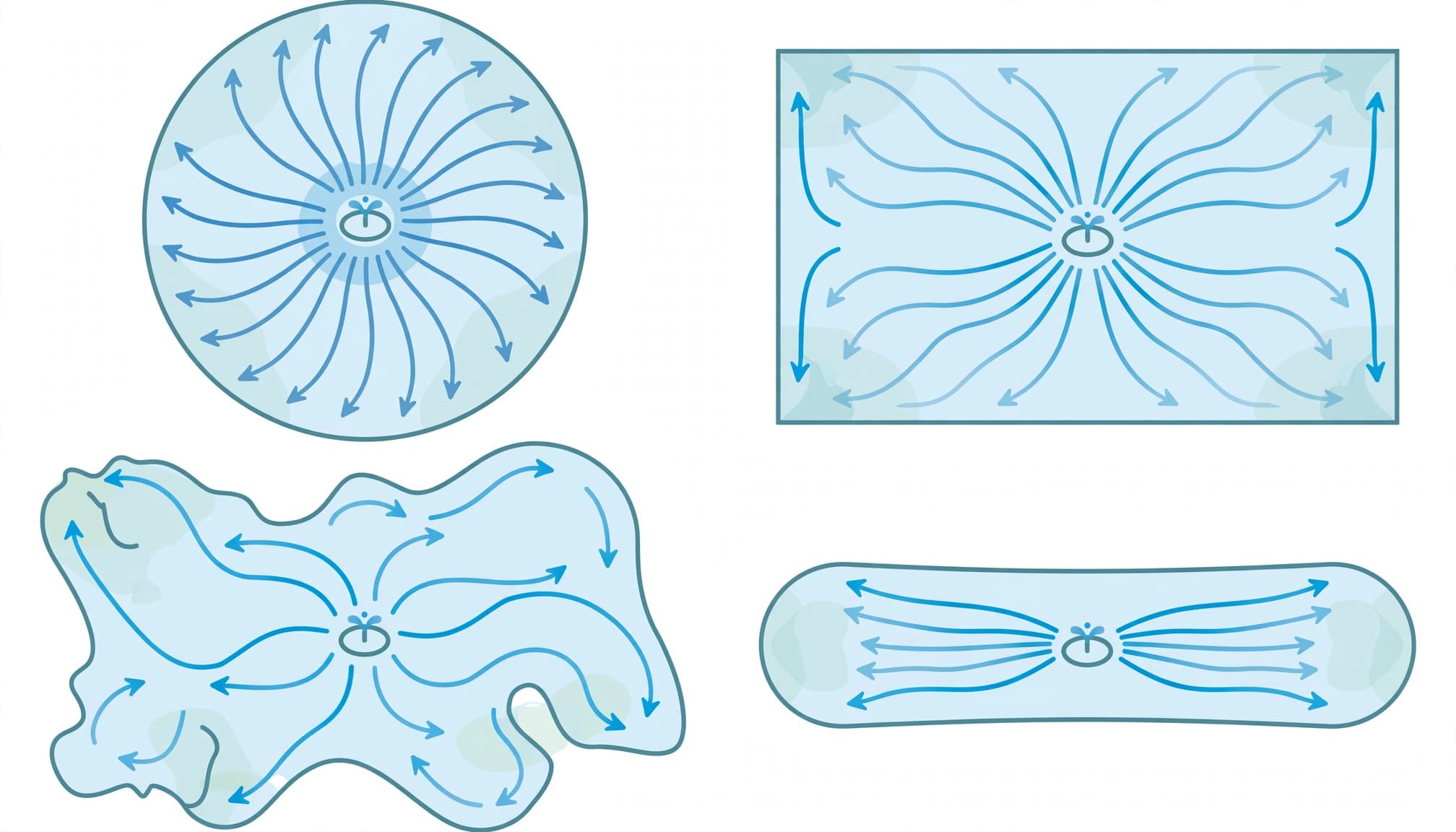
Circular ponds offer more balanced shoreline distances
In a circular pond, a centrally located fountain has similar distances to the shoreline in every direction. That makes the center a useful starting point when considering placement.
Without coves or projecting banks, water also has fewer shoreline barriers to move around. Still, a round outline doesn't establish a uniform circulation pattern.
Uneven depth, wind exposure, and shallow shelves can create different conditions around the same pond. If the intake sits above a shallow bottom, a visually balanced location may offer poor operating clearance.
The center is therefore a candidate location, not an automatic answer.
Rectangular ponds require attention to corners
A rectangular pond introduces corners and unequal travel distances. From a central location, the fountain sits farther from the corners than from the middle of the long banks.
Those corners deserve attention, particularly where vegetation, shallow water, or wind shelter reduces movement. A fountain can improve the central open-water area while leaving weaker exchange near the edges.
In a long rectangle, the ends also become separate concerns. Increasing spray width may bring water closer to nearby banks without improving movement at the far ends.
Placement should address the pond's proportions rather than its surface area alone.
Irregular and Narrow Ponds Need Closer Attention
Coves and islands can separate circulation areas
An irregular pond may contain broad open water connected to smaller coves. Projecting shorelines can shelter those coves, while islands interrupt direct routes between different parts of the pond.
A narrow connection doesn't prevent all water exchange. However, shallow water, dense vegetation, or accumulated sediment within that connection can limit movement further.
Consequently, a fountain operating in the main basin shouldn't automatically count as coverage for every adjoining pocket.
Map each cove and the water behind islands separately. Our guidance on sizing fountains for retention ponds explains why acreage alone misses these limitations.
Long, narrow ponds create a distance problem
In a narrow pond, the banks may sit close to the fountain while the ends remain far away. A broad spray can therefore run out of shoreline clearance before it addresses the pond's length.
Moving the unit toward one end changes which water receives the strongest nearby movement. It doesn't automatically establish effective exchange along the entire basin.
Similarly, an L-shaped pond combines distance with a bend that separates one arm from the other.
For these layouts, consider each arm or long section as a distinct circulation concern. Additional equipment may help, but its location and purpose matter more than simply adding another display.
Depth, Wind, and Obstructions Change Coverage
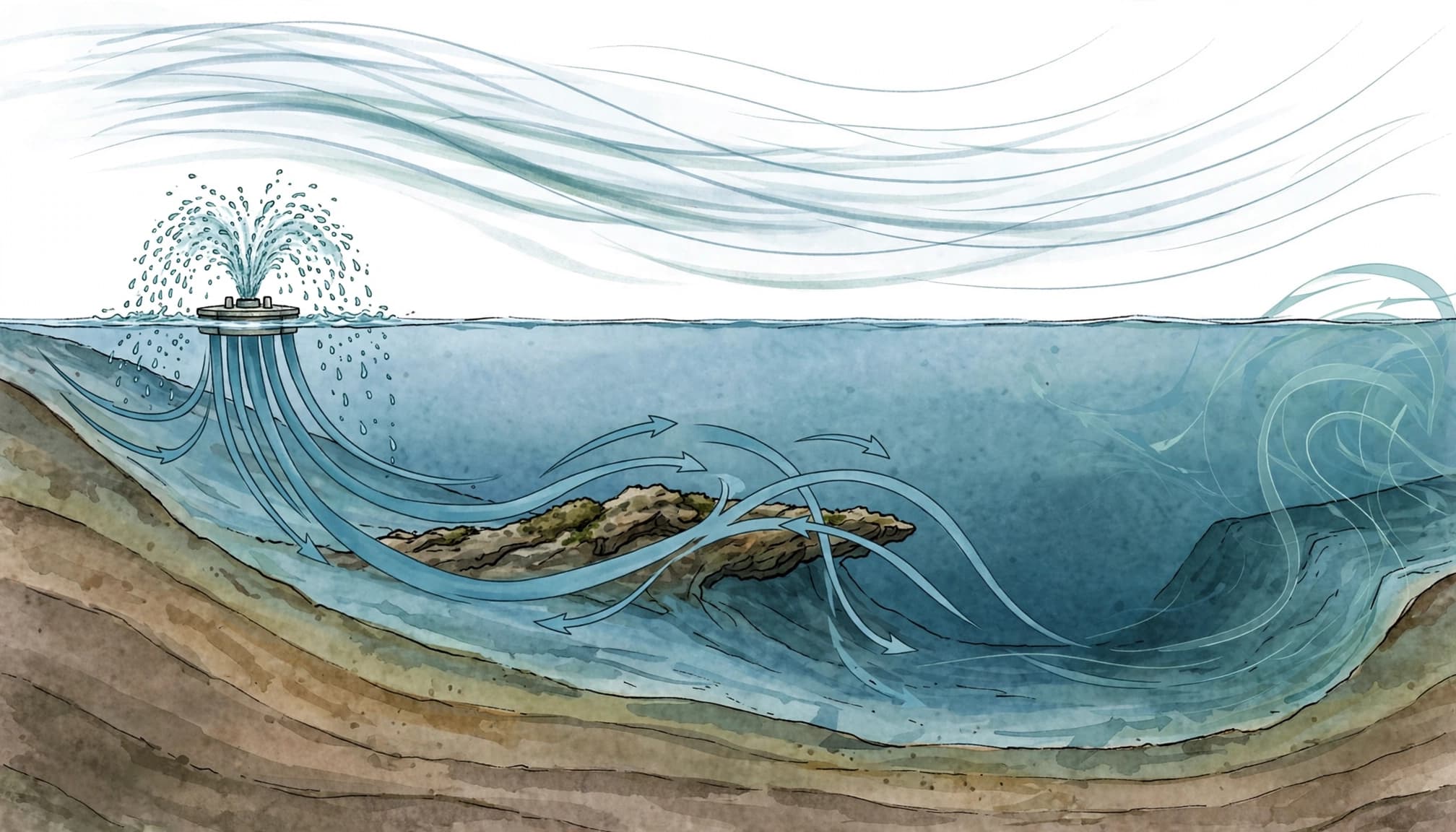
Depth controls more than intake clearance
Two ponds with matching shorelines can behave differently if their bottom contours differ. A deeper pocket holds water below the fountain's strongest surface effects, while a shallow shelf can restrict safe intake placement.
Warm water holds less dissolved oxygen than cool water. During calm conditions, temperature differences can also separate upper and lower water layers.
A surface fountain may improve conditions above those layers without adequately mixing the deeper water. Meanwhile, accumulated organic sediment reduces usable depth and can contribute nutrients under certain conditions.
Wind changes surface movement and spray landing
Wind can push surface water toward one bank and redirect falling spray. Buildings, trees, and shoreline orientation can shelter other areas.
As a result, the same fountain may appear to cover different areas on calm and breezy days. Spray drifting toward a cove doesn't prove that the cove receives sustained circulation.
Wind also affects placement around sidewalks, homes, and roads because drifting droplets can wet nearby surfaces. The circulation goal must fit within those shoreline limits.
Obstructions can restrict water exchange
Islands, submerged shelves, dense aquatic vegetation, and sediment bars can interrupt or narrow flow paths. Their effect depends on their size, position, and depth.
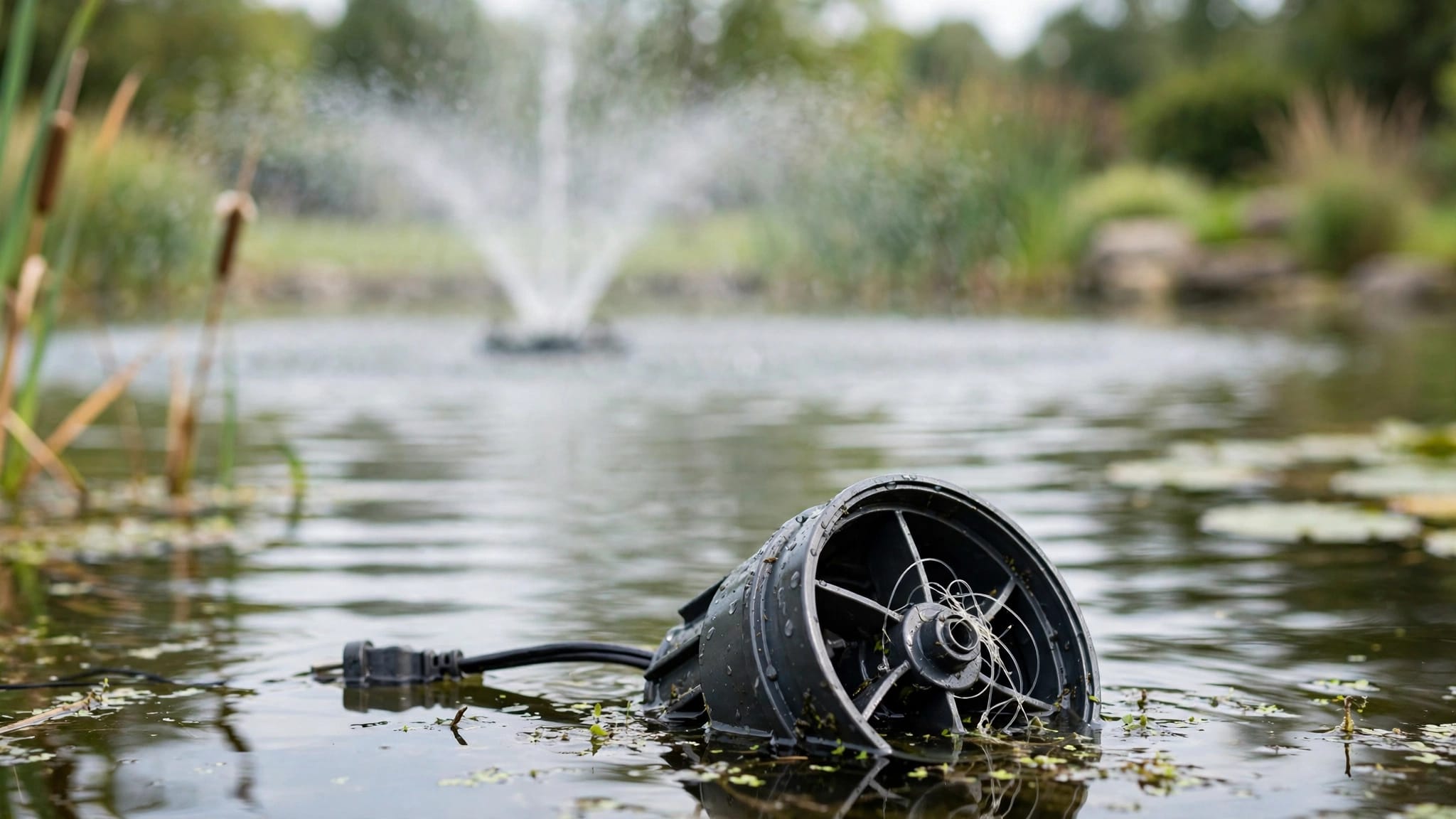
Floating leaves can also collect in sheltered pockets even when the main basin looks active. Meanwhile, debris around the intake can reduce fountain flow itself.
These are different problems: one concerns pond geometry, while the other concerns equipment performance. Both can contribute to weak circulation.
Placement and Flow Rate Must Work Together
Choose a location for the water, not just the view
The geometric center may offer a balanced display, but it isn't always the best operating location. Depth, nearby obstructions, shoreline clearance, and service access may favor another position.
For a community pond, the placement plan should identify the main circulation goal before choosing the viewing angle. Improving movement in an open basin is a different assignment from addressing an isolated cove.
Our Florida fountain placement guide covers shoreline conditions, spray drift, and access considerations.
Keep drainage inlets and outlets functional as well. A fountain doesn't replace stormwater maintenance or sediment management.
Compare water flow rather than horsepower alone
Pump flow rate describes how much water the equipment moves over time. However, actual discharge depends on the pump, nozzle, operating head, and equipment condition.
Horsepower alone doesn't describe the resulting circulation footprint. Likewise, a higher spray doesn't establish stronger exchange through distant pond sections.
A generic acreage rating can't account for every cove, depth change, or obstruction. Equipment selection needs to connect the expected flow with the actual basin layout.
Increasing pump output doesn't remove the shoreline barrier separating an isolated cove from the main basin.
Where geometry limits water exchange, changing placement or adding a different circulation method may address the problem more directly.
Assess Results Beyond the Spray
A useful assessment follows the water beyond the fountain's landing zone. It also distinguishes a persistent layout problem from a recent loss of equipment performance.
For an existing community fountain, use this sequence:
- Mark recurring low-movement areas on a pond plan, including corners, coves, and sheltered banks.
- Record whether those areas change with wind direction, seasonal water levels, or fountain operating hours.
- Arrange inspection when the spray weakens, becomes uneven, or the float moves away from its intended position.
- Assess deeper-water concerns with temperature and dissolved-oxygen measurements at different depths, rather than surface appearance alone.
Leaves collecting in one corner can identify a surface-flow pattern, but they don't measure bottom-water oxygen. Likewise, clearer-looking water doesn't prove uniform mixing.
Clogged screens, obstructed nozzles, and shifting anchors can change performance after installation. Our fountain maintenance checklist outlines routine inspection needs.
We provide lake fountain installation, repair, and maintenance in Naples and Southwest Florida. Those services address equipment performance, while broader pond conditions may require a separate management plan.
Frequently Asked Questions
Does an irregular pond always need multiple fountains?
An irregular outline alone doesn't determine equipment count. The important details include the size of each basin, the connections between them, depth, and the intended outcome.
One fountain may suit the main viewing area and provide useful nearby movement. However, sheltered water elsewhere may need separate attention. Multiple fountains also need deliberate placement; installing more units doesn't guarantee even circulation.
When can bottom diffusers help?
Bottom-diffused aeration may suit deeper areas where surface movement doesn't provide enough water-column mixing. Rising bubbles move surrounding water upward, so diffuser placement addresses different conditions than a decorative fountain.
A combined approach can provide both a visible display and deeper circulation. Our comparison of fountains and bottom diffusers explains their different roles.
Neither approach removes accumulated sediment or excess nutrients, so aeration remains one part of pond management.
Match Circulation Expectations to the Pond
Pond shape identifies where fountain-driven movement may face limitations. The most useful design combines that geometry with actual depth, operating flow, wind exposure, and safe placement.
Plan for the whole basin , including water outside the visible display. A well-matched fountain can improve appearance and nearby circulation while leaving deeper or isolated areas for a separate solution.
Latest posts
Read Our Blog
Tips, guides, industry best practices, and news.

Contact us
Get in touch
Our friendly team is ready to chat.
