
Whole-House RO Installation With Two Water Heaters
A whole house RO system should supply treated cold water to both water heaters before either heater warms it. Two heaters don't automatically require two RO systems, but their connections determine where treated water must enter the plumbing.
The design also needs enough stored water and delivery capacity to support simultaneous hot- and cold-water use. Start by tracing the existing pipes, because heater count alone doesn't reveal how water moves through your home.
Key Takeaways
- Place RO treatment on the incoming cold-water side, with treated-water distribution reaching both heaters and the intended cold-water fixtures.
- Identify whether the heaters operate in series, parallel, or separate zones before changing their supply connections.
- Size membrane production, usable storage, and pump delivery together, then provide accessible isolation valves and a clearly labeled bypass.
Where the RO System Belongs in the Plumbing
For whole-home treatment, incoming water typically passes through pretreatment and the RO membrane before entering treated-water storage. A delivery pump then supplies household distribution, including the cold-water connections serving both heaters.
Keep hot water out of the RO feed. Residential RO equipment designed for cold feed water shouldn't receive water from a heater outlet or hot-water recirculation return.
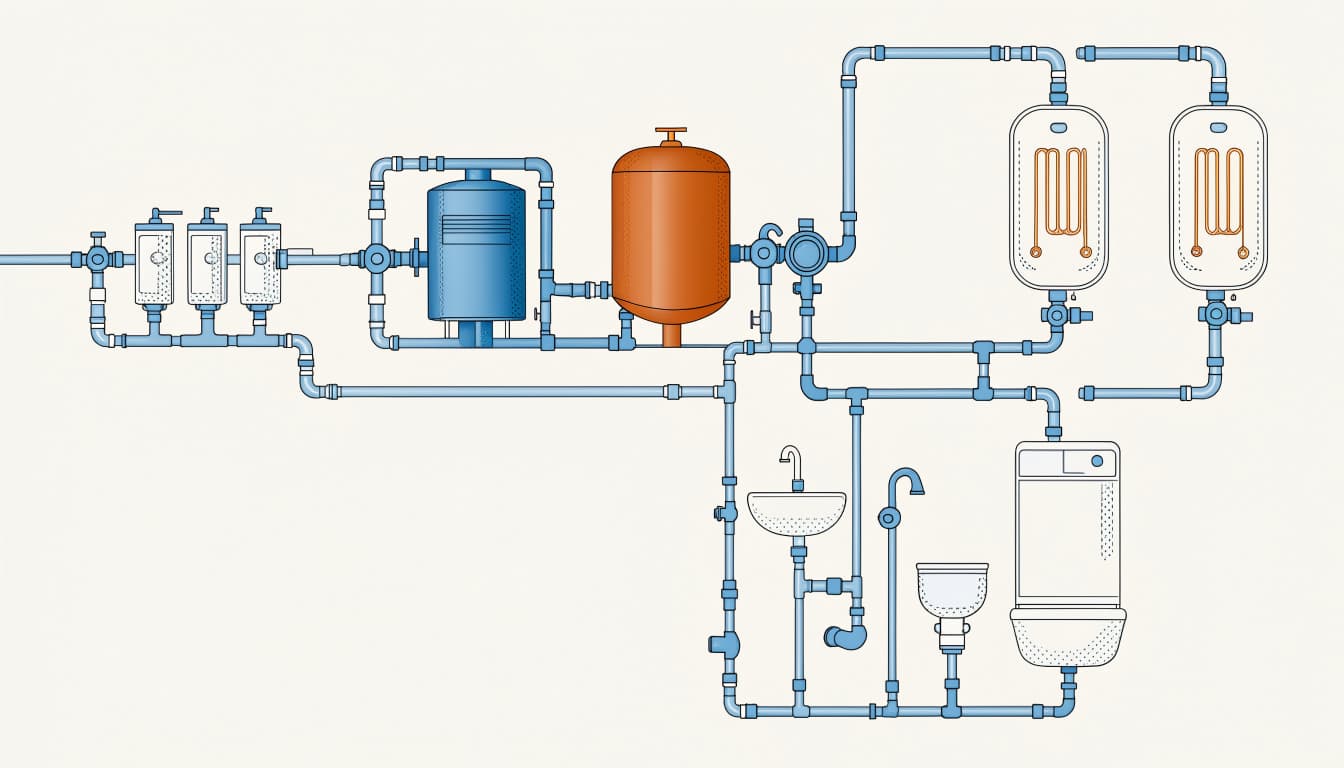
The existing layout matters because homes don't always have one convenient supply branch feeding both heaters. An addition, guest suite, or distant bathroom wing may have a separate cold-water route. Connecting treatment to only one branch can leave the other heater receiving untreated water.
Cold fixtures matter, too. Treating only the heater supply leaves showers and mixing faucets blending treated hot water with untreated cold water.
Meanwhile, irrigation or other intentionally untreated uses can remain on separate upstream branches. Those connections must stay separate from the treated distribution network. We recommend starting with a water test and a plumbing map so the treatment boundary is clear before equipment selection.
How the Two Water Heaters Connect
Series connections send water through both heaters
With heaters in series, cold supply enters the first heater. Its outlet then feeds the second heater, whose outlet supplies the hot-water distribution system.
In this arrangement, treated cold water enters ahead of the first heater. The second heater receives water through the existing interconnection rather than through a new parallel cold-water branch.
Adding RO doesn't require changing series piping to parallel. However, any recirculation return, mixing valve, or existing bypass must remain consistent with the heater design. Changing those connections can affect temperature control and circulation.
Parallel connections divide the incoming flow
With heaters in parallel, a cold-water supply divides between the heaters, and their hot outlets may join a common distribution line. Balanced pipe resistance helps the heaters share demand rather than forcing most flow through one tank.
The treated supply must reach both cold inlets. Pipe sizing, balancing arrangements, and existing check valves remain part of that design.
Some homes instead use two heaters serving separate zones without a shared hot-water outlet. Both zones can receive RO-treated water, but each cold supply route needs to fall within the treatment boundary. Heater location alone doesn't identify the arrangement.
Size Production, Storage, and Delivery Separately
Membrane production must cover daily demand
Membrane output describes how much treated water the RO equipment can produce over time. Household peak flow describes how quickly fixtures draw it. These are different requirements.
Two water heaters don't automatically double daily consumption. Occupancy, bathing habits, laundry, and simultaneous fixture use determine the actual demand.
Also, hot water leaving a storage heater usually draws replacement cold water into that heater. The RO delivery system must support that replacement flow alongside cold-water use elsewhere.
Membrane selection must account for feed-water conditions and operating temperature, because rated production doesn't describe every installation's actual output.
Storage and the delivery pump handle busy periods
Many whole-home installations use an atmospheric storage tank followed by a repressurization pump. Storage holds a reserve while the pump supplies the flow and pressure fixtures need.
Water stored inside the heaters isn't a substitute for this treated-water reserve. It already belongs to the hot-water system.
Our RO storage tank sizing guide explains how usable reserve, membrane production, and peak demand work together. For two-heater homes, the calculation should include simultaneous demand across both heater zones.
A larger tank also needs sufficient refill capacity. Otherwise, repeated busy periods can draw down storage faster than the membrane replenishes it.
Match Pressure and Pretreatment to the Water
Feed pressure and household pressure have different jobs
The RO membrane needs suitable operating pressure to produce treated water. A feed-side booster pump addresses that requirement when the source supply can't provide it.
A delivery pump after atmospheric storage has another job: supplying household plumbing. Increasing membrane feed pressure doesn't automatically correct weak shower flow downstream.
Pump selection must account for simultaneous demand, pipe restrictions, and elevation changes. Pressure measurements during water use reveal problems that a resting gauge reading can miss.
If either heater is tankless, the design must also support that unit's required operating flow and pressure. RO equipment shouldn't create an additional restriction that disrupts heater operation.
Pretreatment protects the membrane and downstream plumbing
Water testing determines which treatment stages belong ahead of RO. Sediment, hardness, iron, disinfectants, and other feed-water conditions can require different solutions.
For private wells, our guide to Florida well-water treatment stages explains why one filter rarely addresses every problem.
Treated-water chemistry matters after the membrane, too. Low-mineral RO water may need stabilization or remineralization based on pH, alkalinity, and plumbing materials. This helps manage corrosion concerns in pipes and water-heating equipment.
A low total dissolved solids reading alone doesn't establish microbiological safety. Storage hygiene and any required disinfection remain separate design considerations.
Plan Bypass, Shutoff, and Expansion Protection
A whole house RO system needs a service plan that allows maintenance without confusing treatment controls with the home's main shutoff.
Provide accessible isolation points for the treatment equipment, storage and pump assembly, and heater supplies as the design requires. Labeled valves and a simple piping diagram make future service safer.
A bypass can preserve household water service while treatment equipment is isolated. However, it may deliver untreated or partially treated source water to cold fixtures and both heaters.
Bypassing RO can put untreated water into the heaters. Returning the valves to service doesn't immediately replace the water already stored inside them.
Bypass operation should follow the installed system's labeled positions and operating sequence. There isn't one valve sequence that fits every arrangement.
Backflow devices and check valves can also create a closed plumbing system. A qualified plumber should evaluate thermal expansion protection when changing the supply arrangement. Heater temperature-and-pressure relief valves must remain unobstructed.
Before disconnecting equipment, isolate the required supplies, stop the applicable pumps, and relieve pressure. A bypass alone doesn't make a fitting safe to open.
Make Installation and Maintenance Accessible
Allow room for tanks, drainage, and service
The installation area needs space for filter replacement, pump work, tank cleaning, and access to both heaters. Equipment crowded behind permanent obstructions becomes harder to maintain.
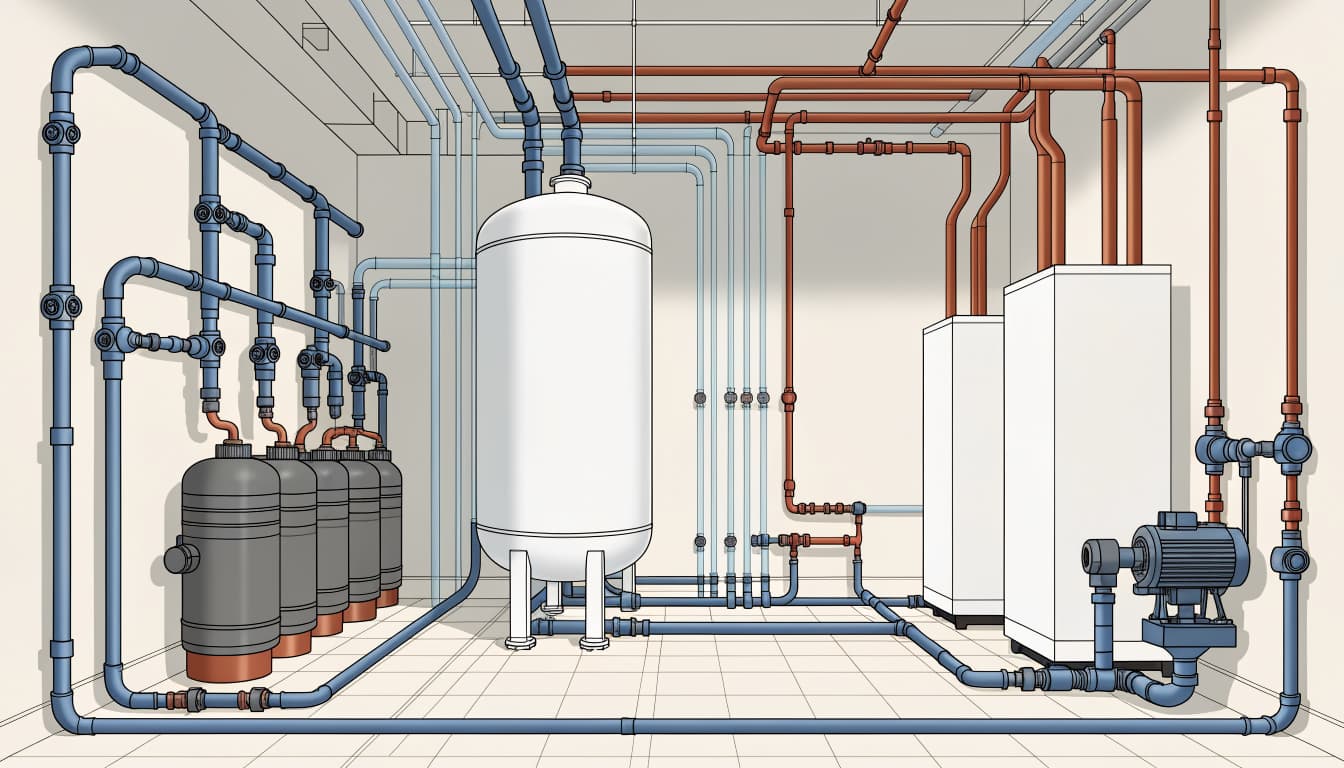
A full storage tank needs a stable, adequately supported surface. Electrical equipment needs protection from leaks, and tank overflow protection needs a planned route.
RO also produces concentrated reject water. Its discharge arrangement must suit the water chemistry and permitted disposal method; it shouldn't simply empty onto landscaping or into a nearby lake.
Serviceable unions and accessible valves reduce the amount of plumbing that must be disturbed during repairs.
Commission both hot-water paths and maintain the reserve
Commissioning should include flushing, leak inspection, control testing, treated-water testing, and operation under simultaneous household demand. Both heater supply paths need attention, not just the nearest faucet.
Existing heater tanks can retain sediment and previously supplied water. Any flushing or draining must follow the heater's service procedure, including the required shutdown and refill steps.
During ongoing service, track filter pressure drop, production rate, storage refill behavior, and treated-water quality. Many homes replace RO prefilters every three to six months, but sediment loading and manufacturer requirements determine the interval.
Our guidance on whole-house RO sanitization covers the broader storage and distribution system. Filter replacement alone doesn't clean the tank or household piping.
Frequently Asked Questions
Do two heaters require two RO systems?
Usually, one properly sized system can serve both heaters and the intended cold-water fixtures. Separate treatment may be appropriate for disconnected buildings or independent supplies, but heater count alone doesn't establish that need.
Can RO treat only the kitchen drinking water?
Yes. A point-of-use system can treat drinking and cooking water without supplying either heater. Our comparison of point-of-use and whole-house filtration explains that distinction. It addresses a different goal than treating showers, laundry, and both hot-water supplies.
Will stored RO water maintain pressure during a power outage?
An atmospheric tank holds water without maintaining household pressure. If the delivery pump loses power, the stored reserve doesn't guarantee normal fixture operation. Outage performance depends on the pump's power supply and the installed pressure-storage arrangement.
Build Around the Plumbing You Have
Two water heaters can work with one whole-house RO installation when treatment reaches both supply paths. The strongest design matches production, usable storage, and delivery capacity to actual household demand.
Start with the existing heater connections and water analysis. Then plan pretreatment, valves, drainage, and service access as one connected system. That approach supports both hot-water zones without overlooking cold-water use or future maintenance.
Latest posts
Read Our Blog
Tips, guides, industry best practices, and news.


Contact us
Get in touch
Our friendly team is ready to chat.
