
Can Whole-House RO Reduce Antimony in Well Water?
Yes, whole house reverse osmosis can reduce antimony in private well water. The amount removed depends on the equipment, the incoming water, and how well the system is maintained.
The important step is testing the water before and after treatment . A membrane may reduce dissolved contaminants, but its performance on your well can't be determined from appearance or taste.
If antimony shows up in your water report, start with the full test results before choosing equipment.
How reverse osmosis reduces antimony
Reverse osmosis, or RO, uses pressure to push water through a semipermeable membrane. Some water passes through the membrane for household use, while a separate stream carries away concentrated dissolved material.
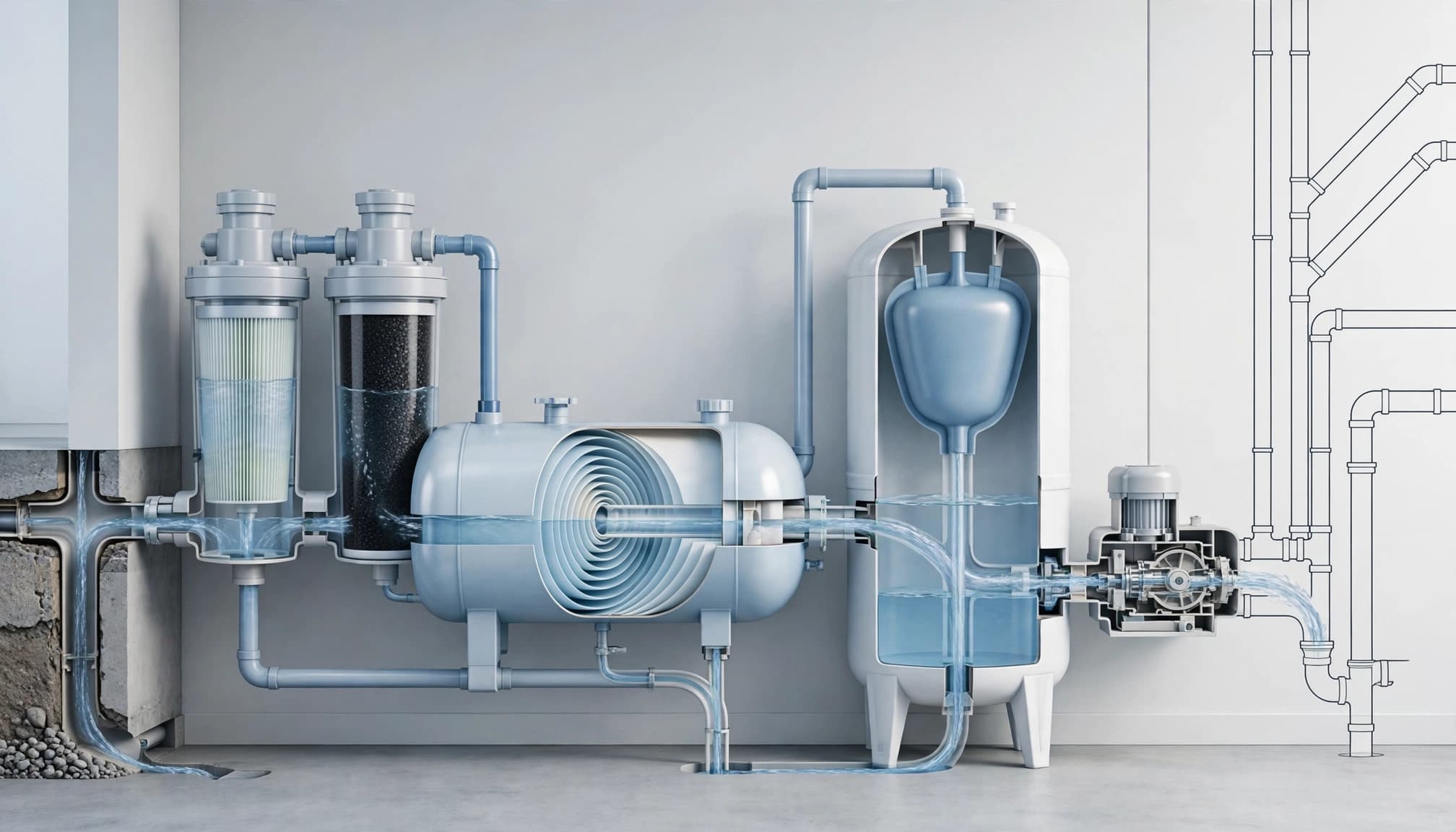
A whole-house system treats the incoming supply before it reaches the connected household plumbing. It usually includes pretreatment equipment, the RO membrane, a storage tank, and a pump that delivers treated water at usable pressure.
RO can reduce antimony, but that doesn't mean every system will produce the same result. Equipment design, source-water conditions, and maintenance all matter. We don't recommend assuming an antimony reduction rate based on a general RO claim or on how the system performs against another contaminant.
The result that matters is the antimony concentration in your treated water , measured by a drinking-water laboratory after installation. Testing also gives you a baseline for future comparisons.
Start with a complete well water test
A laboratory report gives you two pieces of information: how much antimony is present and what else may affect the treatment system. Both matter when deciding whether whole-house RO is a good fit.
Collect an untreated sample
Use a qualified drinking-water laboratory and request antimony testing. Collect the sample from the raw well supply before any softener, filter, or RO equipment. Follow the laboratory's instructions for the sample container and collection method.
If your report shows an elevated antimony result, use bottled water for drinking and cooking while you arrange treatment guidance with your local health department.
Also keep a copy of the report with your well records. An existing treatment system can make it difficult to tell what is coming directly from the well unless the sample comes from a location before treatment.
Test for conditions that affect equipment
Antimony is only one part of the design. Hardness, iron, manganese, sediment, pH, and dissolved solids can influence pretreatment and membrane performance. A well may also need separate bacteria testing and a disinfection plan.
Your report helps a treatment professional choose equipment for the water you have, rather than a standard package. Our guide to private well inspection and water testing covers other useful tests and equipment checks.
What affects antimony reduction?
A membrane needs suitable water conditions and enough pressure to perform as intended. A system that works well on one property may need different pretreatment or operating settings on another.
Water chemistry and pretreatment
Hardness can form scale on an RO membrane. Iron, manganese, and sediment can foul equipment or restrict flow. Depending on the test results, a well may need sediment filtration, iron treatment, a softener, or another pretreatment stage before RO.
A softener can protect an RO membrane by reducing hardness. It shouldn't be assumed to solve an antimony problem on its own.
Chlorine can damage many thin-film composite RO membranes. If a treatment plan adds chlorine for another water concern, it also needs a suitable way to address that chlorine before the membrane. Water with a high pH can add another design consideration, as we explain in our guide to high-pH well water before reverse osmosis.
Pressure, flow, and membrane condition
An RO system needs adequate feed pressure. If the well pump can't provide what the equipment needs, the design may include a booster pump.
Over time, fouling, scale, worn components, or damaged seals can affect output and water quality. That makes periodic service and treated-water testing important, even when the system still delivers water at the faucet.
Whole-house RO or an under-sink system?
The main difference is where you need treated water. An under-sink RO unit typically supplies a dedicated kitchen faucet and sometimes a connected refrigerator line. Whole-house RO supplies the household fixtures connected downstream of the system.
Here are the practical differences.
| Consideration | Under-sink RO | Whole-house RO |
|---|---|---|
| Treatment location | One faucet or connected appliance | Connected household plumbing |
| Typical use | Drinking and cooking | Multiple indoor fixtures |
| Equipment needs | Smaller unit and storage tank | More pretreatment, storage, and pumping |
| Water use and service | Smaller treatment volume | More reject water and equipment to maintain |
If drinking and cooking are your main concerns, an under-sink unit may meet your needs with less equipment. Whole-house treatment can make sense when you want treated water at multiple taps or when other measured water conditions support a broader system.
Neither choice treats an outlet that bypasses it. Outdoor faucets and irrigation lines, for example, may remain on untreated well water depending on the plumbing layout. Our comparison of point-of-use and whole-house filtration explains more about choosing the right treatment location.
How to choose a whole-house RO system
The right system starts with your laboratory report and your household's water use. A unit designed for a kitchen faucet won't necessarily meet the demand of showers, laundry, and other fixtures.
Size for daily use and busy periods
Whole-house RO systems produce treated water over time, so storage helps supply the home when demand is higher than membrane production. The tank and delivery pump need to support periods when several fixtures are running.
Well-pump capacity matters too. The system must receive enough feed water and pressure without leaving the household short during normal use. Space for tanks, pretreatment, and future service should be part of the plan.
Plan for the reject stream
RO sends part of the incoming water to a drain as a concentrated reject stream. A whole-house system treats more water than a kitchen unit, so drainage and water use deserve attention before installation.
The treatment design should account for a suitable discharge location, available drain capacity, and local requirements. It should also explain the expected production rate and storage needs for your home.
Pretreatment, plumbing changes, tank size, and ongoing service all affect the total investment. Our article on RO system cost factors for Florida homes explains why two installations can differ.
Test the treated water after installation
Once the system is operating, collect a treated-water sample and request another laboratory test for antimony. Use the lab's collection instructions and keep the results alongside the original well report.
A sample after the RO equipment shows how the system performs. A sample from a household faucet shows the quality of water delivered at that location after it has passed through the storage and distribution plumbing. Your treatment professional can help identify useful sampling points.
For the clearest comparison, use the same laboratory and comparable collection procedures for the untreated and treated samples. Record the date, sample location, and any equipment service performed around that time.
A lower total dissolved solids reading can indicate that an RO membrane is working, but it doesn't measure antimony. A laboratory antimony test is needed for that result.
Retest during routine service and when conditions change. Flooding, well work, equipment repairs, or a noticeable change in water quality are good reasons to discuss additional sampling. Water quality can vary, so the first successful test shouldn't be the last one.
Maintain the system to protect performance
Whole-house RO has more parts to care for than the membrane alone. A maintenance plan should cover the pretreatment equipment, storage system, pumps, and the RO unit itself.
Keep pretreatment working
Replace sediment and other prefilters according to the equipment's service schedule and the condition of your well water. If the system includes a softener, keep it supplied and maintained. Iron treatment or chemical feed equipment may need its own inspections and service.
When pretreatment stops working properly, the RO membrane can foul or scale sooner. That can reduce production and make the system harder to maintain.
Watch for changes and keep records
Track filter changes, membrane service, and laboratory results. A drop in production, a change in pressure, or a change in treated-water quality can point to a problem that needs attention.
TDS readings can help identify a change in general membrane performance, but they don't replace an antimony test. If a treated-water result no longer meets the system's goal, use another source for drinking and cooking while the issue is assessed.
Regular service also gives you a chance to review whether the system still fits your household's water use. A larger household or an added bathroom can change demand on storage and pumping equipment.
Address other well problems separately
RO isn't a substitute for every part of a well-water treatment plan. If bacteria are present, the well and plumbing need attention, and the home may need a disinfection system selected for the test results.
Similarly, a filter that improves taste or removes sediment shouldn't be assumed to reduce antimony. Each stage should have a defined job based on the water report.
At Trademark Water Systems, we provide water analysis and custom-made RO systems for well-water users in Southwest Florida. The goal is a treatment setup that fits the measured water conditions and the fixtures you want to supply.
Choose treatment based on the test results
Whole-house RO can reduce antimony, but its performance needs to be measured at your home. Start with an untreated well-water test, then use a treated-water test to see what the installed system achieves.
If you mainly need drinking and cooking water, an under-sink system may be enough. If you want treated water throughout the connected household plumbing, plan for the extra storage, drainage, and maintenance a whole-house system requires.
Latest posts
Read Our Blog
Tips, guides, industry best practices, and news.

Contact us
Get in touch
Our friendly team is ready to chat.
