
Can Whole House RO Remove Pharmaceuticals?
Yes, a whole house RO system can reduce many pharmaceutical residues in city water, but it can't promise removal of every drug. A reverse osmosis membrane can lower concentrations under proper operating conditions, yet treated water shouldn't be described as pharmaceutical-free.
That distinction matters when you're comparing whole house RO with a drinking-water unit at the kitchen sink. Performance depends on the compound, membrane condition, pretreatment, pressure, contact time, system design, and maintenance. A current water analysis should guide the decision.
What Can Whole House RO Remove?
The EPA describes reverse osmosis as a pressure-driven membrane process. Feed water moves across a semipermeable membrane, while many dissolved substances stay in a concentrate stream. That barrier can reduce contaminants that ordinary sediment filters don't capture.
Pharmaceuticals don't all behave alike. Published reverse osmosis and nanofiltration studies report strong rejection for many compounds, but lower retention for substances such as acetaminophen, gemfibrozil, and mefenamic acid. Results from a treatment plant or laboratory also don't guarantee the same result in a particular home.
EPA's 2026 drinking-water priorities identify pharmaceuticals as a priority contaminant group, but that designation isn't a blanket federal limit. Municipal supplies still differ by source, treatment, disinfectant, distribution system, and sampling date.
Reverse osmosis performance should be described as contaminant reduction under defined conditions, not proof of complete removal in every home.
Reduction Is Different From Elimination
A reduction claim means the measured level fell under stated test conditions. It doesn't mean every molecule disappeared or that the system will handle every pharmaceutical equally.
NSF/ANSI 58 is the main residential RO certification standard. However, certification applies to specific performance claims and tested substances. It isn't a blanket certification for all pharmaceuticals.
What Determines Pharmaceutical Reduction?
Two homes can install similar-looking equipment and get different results. The membrane is only one part of a working whole-house RO design.
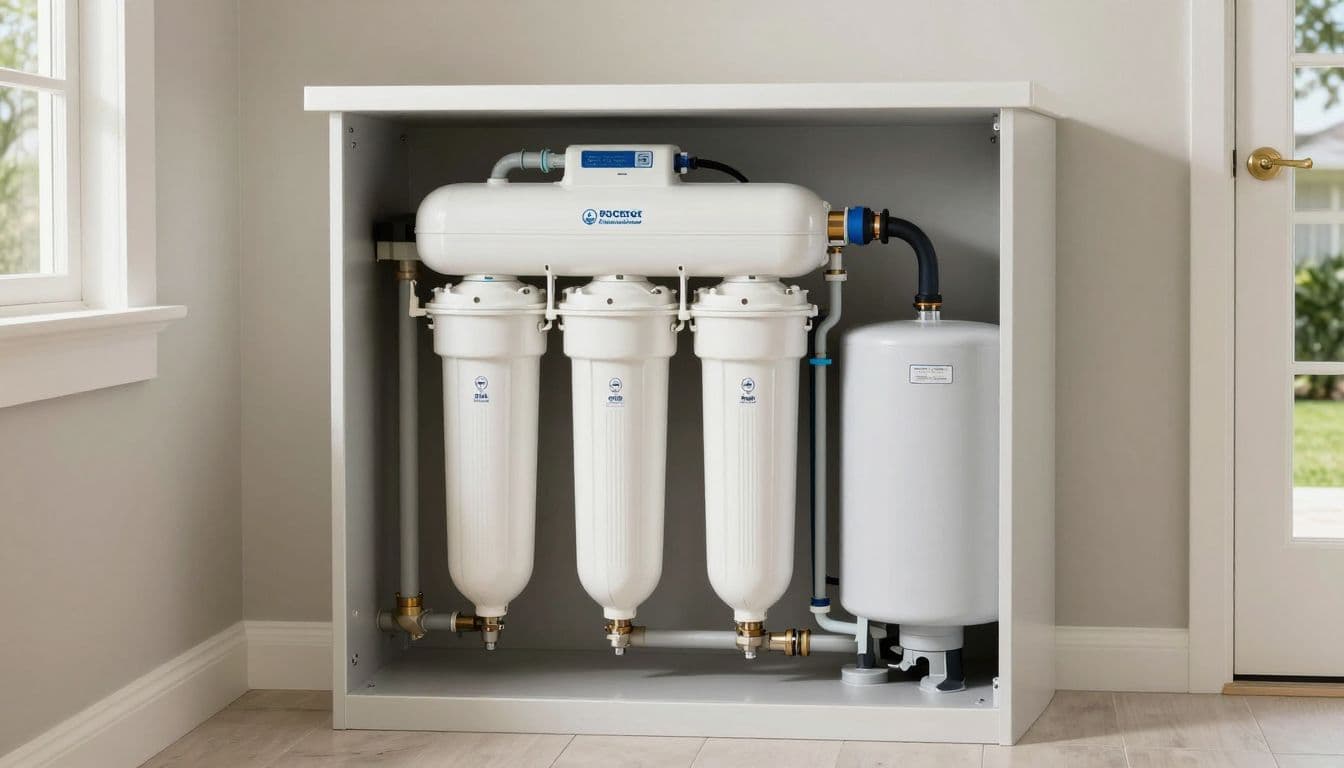
The Compound and Membrane Matter
Molecular size, electrical charge, and chemical behavior affect how readily a pharmaceutical passes through a membrane. Membrane material, age, fouling, scaling, seals, and physical damage also affect rejection.
A system that produces water quickly but has rising treated-water TDS may need service, even if the pump still runs. Low production, unusual pressure changes, or a change in water quality can also point to membrane or pretreatment problems.
Pretreatment, Pressure, and Hydraulics Matter
City water may contain chlorine or chloramine, hardness, sediment, iron, or other substances that shorten membrane life. A designer may add carbon, sediment filtration, softening, or other pretreatment after testing the source water. The correct choice depends on the disinfectant and water chemistry, so a generic filter package isn't enough.
RO needs adequate, stable feed pressure. Low pressure can reduce production and disturb the intended operating conditions. Flow control, storage capacity, concentrate routing, contact time, and residence time also matter in a whole-house installation.
If the system is undersized, short-cycles, or can't keep up with simultaneous demand, the water at the tap may not match the performance expected from a properly operated system.
Why Point-of-Use RO Often Makes More Sense
For pharmaceutical reduction in drinking water, point-of-use RO is often the more practical choice. A kitchen unit treats the water used for drinking and cooking, while a whole-house installation must supply showers, toilets, laundry, appliances, and outdoor fixtures.
Treating that larger volume requires more pretreatment, storage, pumping, floor space, maintenance, and reject-water planning.
| Consideration | Point-of-use RO | Whole-house RO |
|---|---|---|
| Main use | Drinking and cooking | All household fixtures |
| Design burden | Smaller flow and storage needs | Higher flow, pressure, and storage demands |
| Maintenance | Easier to inspect and service | More components and larger water volume |
| Wastewater | Smaller reject stream | Larger concentrate stream requiring planning |
This difference doesn't make whole-house RO wrong. It can fit homes with broad dissolved-contaminant concerns or a specific treatment plan for the incoming supply. However, if the goal is better drinking water, point-of-use RO usually limits cost and complexity while focusing treatment where consumption occurs.
A whole-house system may still be appropriate when homeowners want consistent treated water throughout the property. That decision requires a design based on actual flow demand and water chemistry, not only a pharmaceutical-removal claim.
How to Choose the Right System
Start by testing the water, then define the claim you want the system to support. A professional installer can review the city water report, collect a sample, and assess pressure, flow, space, drainage, and expected demand.
Ask for results tied to the actual system, not a general statement that RO removes pharmaceuticals.
Use Testing to Match Equipment
A useful test can identify TDS, hardness, chlorine or chloramine, iron, sediment, and other conditions that affect pretreatment. Pharmaceutical testing is more specialized and may require a qualified laboratory. A standard home water test shouldn't be assumed to cover every medicine.
Before buying, review whole-house reverse osmosis system sizing with actual household demand. The number of residents, bathrooms, fixtures, storage needs, and peak use all affect system capacity.
A qualified designer should also explain what happens if water quality changes or demand increases.
Read Certification Claims Closely
Look for NSF/ANSI 58 certification or equivalent documented testing, then read the contaminant-specific claim. Ask whether testing covers the compound of concern, the membrane model, operating pressure, and replacement conditions.
NSF/ANSI 58 covers RO system construction and performance, but it doesn't prove universal pharmaceutical removal. Manufacturers should provide operating limits, service requirements, and replacement guidance.
If a salesperson offers a guaranteed pharmaceutical-free result without naming a tested compound and test conditions, treat that claim cautiously.
Maintenance Determines Lasting Performance
Even a well-designed whole-house RO system loses reliability when service slips. Maintenance protects both water quality and flow.
Replace Filters and Monitor the Membrane
Sediment and carbon prefilters need replacement on the manufacturer's schedule, and sooner when pressure drops or loading is heavy. For many homes, three to six months is a starting range for prefilters, but city water quality and household use can shorten it.
Carbon pretreatment must remain effective when chlorine or chloramine could damage the membrane. Membranes don't have one universal replacement date. Many residential membranes last roughly two to five years, but rising permeate TDS, falling production, pressure changes, fouling, and seal problems are better service clues than the calendar alone.
Keep records of filter changes and readings. Review these whole-house RO maintenance signs when flow, taste, pressure, or leak conditions change.
Plan for Pressure and Reject Water
RO sends a concentrate stream to the drain. That water contains substances the membrane holds back, so the drain connection must be sized and installed correctly. Recovery and wastewater volume vary by system design.
A professional should address drain capacity, local plumbing rules, and septic-system concerns before installation. The system may also need a booster pump or repressurization stage after storage.
Have the installer verify pressure under real demand, not only when no fixture is running. Follow the manufacturer's sanitation, flushing, and replacement instructions.
Conclusion
Whole house RO can reduce many pharmaceutical residues in municipal water, but performance is compound-specific and maintenance-dependent. The strongest answer is conditional: choose the membrane and pretreatment for tested source-water conditions, keep pressure and hydraulics within design limits, and verify results when the concern is specific.
For most households focused on drinking and cooking, point-of-use RO is easier to size, maintain, and evaluate. A whole-house system deserves professional design when the home needs broader dissolved-contaminant treatment. Reduction , backed by testing and service, is a more reliable expectation than pharmaceutical-free water.
Latest posts
Read Our Blog
Tips, guides, industry best practices, and news.



Contact us
Get in touch
Our friendly team is ready to chat.