
How to Set a Water Softener Regeneration Schedule
A water softener regeneration schedule should match your water's hardness, your household's water use, and the softener's usable capacity. The goal is to regenerate before the resin runs out of capacity, without running unnecessary cycles.
Your control valve determines how you make that decision. A metered system tracks water use, while a timer follows the schedule you set. Start by understanding what happens during regeneration.
How Regeneration Restores Softening Capacity
A salt-based water softener removes calcium and magnesium as water passes through its resin bed. Eventually, the resin needs regeneration to keep treating incoming water effectively.
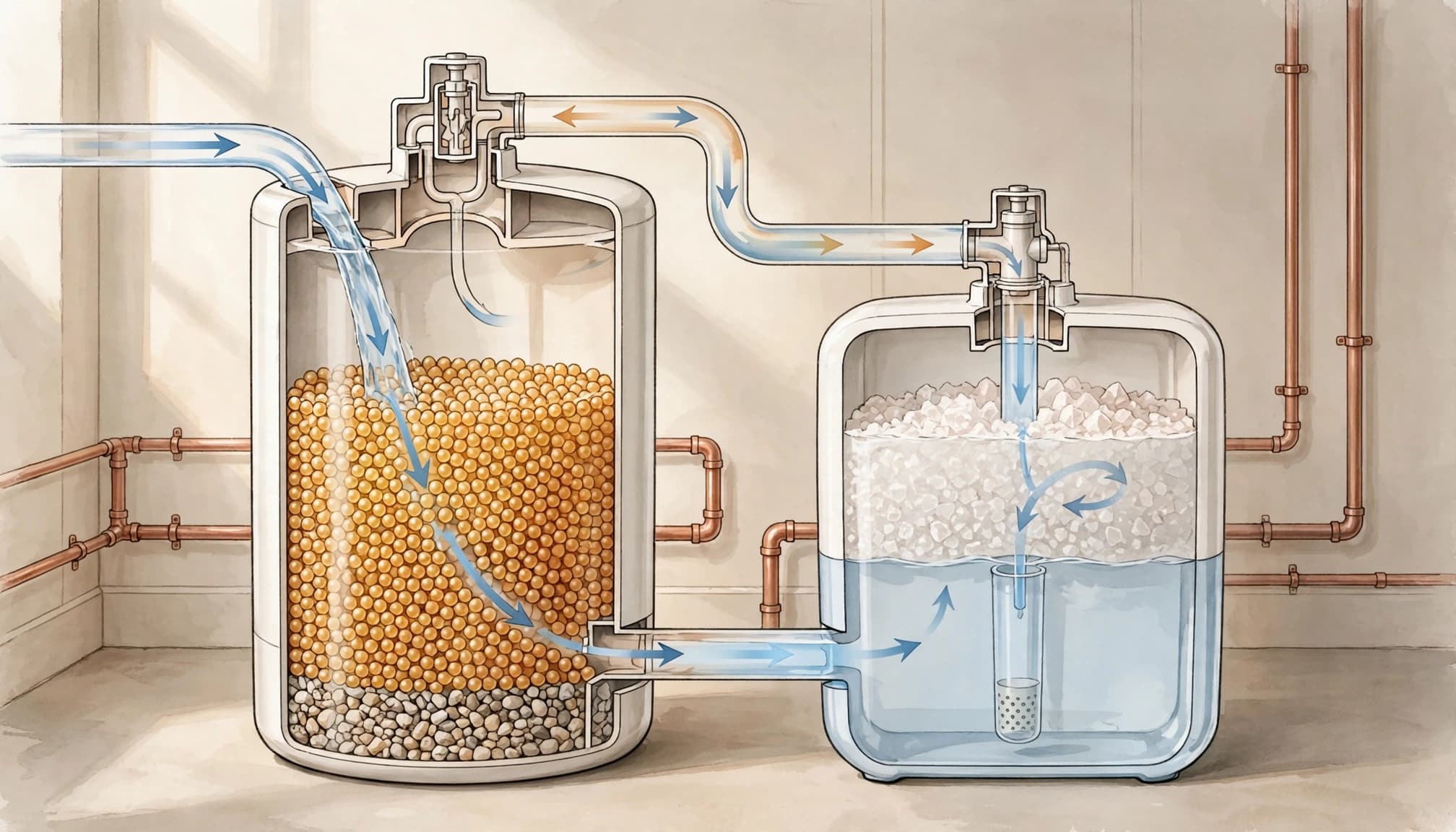
What happens during a cycle
The control valve sends brine from the salt tank through the resin, then rinses the minerals and brine to a drain. A cycle can also include backwashing and refilling the brine tank. The sequence and amount of water used depend on the equipment.
Each cycle uses water and salt, so more frequent regeneration isn't automatically better. On the other hand, waiting too long can leave you with hard water before the next cycle begins.
Why capacity is more than a tank label
A softener's capacity is the amount of hardness its resin can handle between regenerations. The usable capacity depends on the resin, salt dose, and water chemistry. A capacity printed on a product label may describe a maximum rather than the capacity available at the system's programmed salt dose.
That distinction affects both metered controls and fixed timers. Each needs an accurate picture of how much treatment the resin can provide between cycles.
Start With Your Water Hardness
Hardness tells you how much calcium and magnesium the softener must remove. The harder the incoming water, the faster a given volume of water uses the resin's capacity.
Use a result for your water source
Municipal water customers can use a water-quality report from their utility. For a private well, a current laboratory test of untreated water gives you a better starting point than a neighbor's result or an old report.
Hardness may be reported in grains per gallon or in milligrams per liter as calcium carbonate. Your softener control may ask for a particular unit, so use the unit required by that control.
Account for iron and other well-water conditions
Iron can use some of a softener's capacity. Certain controls account for it through an adjusted hardness setting, but the adjustment depends on the equipment and water conditions.
A well-water test can also identify issues such as manganese or sediment that affect treatment. If the report shows several water-quality concerns, we can help assess the treatment setup. A softener addresses hardness, but it isn't a substitute for contaminant-specific treatment.
Estimate How Much Softened Water You Use
Your daily demand depends on the water that passes through the softener. Showers, laundry, dishwashing, and other indoor uses all contribute, but household size alone won't capture every habit.

Use actual consumption when available
A water meter or utility bill can help establish an average. Compare readings over a period that reflects normal occupancy, rather than a week when the house was empty or full of guests.
If the meter measures water that bypasses the softener, such as irrigation, the total will overstate treated-water demand. Conversely, a leak on the softened-water side adds to the load even when nobody is using a fixture.
Allow room for a busy day
A daily average helps with planning, but use varies. Extra laundry or visiting family can use more capacity than an ordinary day.
A reserve gives the system a buffer before regeneration. Some metered controls calculate that reserve automatically; others allow a separate setting. Avoid subtracting a second reserve when the control already accounts for one, since that can cause earlier cycles than needed.
A Simple Household Demand Example
A planning estimate of 240 gallons of softened water per day adds up to about 1,680 gallons over a week. That gives you a picture of the volume the system needs to handle.
Volume alone doesn't determine the regeneration interval. The same amount of water uses more resin capacity when hardness is higher. Usable capacity also varies with the softener and its salt setting.
For a metered unit, enter the water hardness and the system's usable capacity in the fields your control requires. The valve then uses measured consumption and its reserve setting to decide when regeneration is due. For a timer, the expected demand and usable capacity help establish a recurring interval that leaves a reserve.
If the softener reaches its limit before the next planned cycle, the interval needs to be shorter or the equipment needs attention. Our guide to water softener sizing for private wells explains how capacity and household demand fit together.
Choose Metered or Time-Based Regeneration
Your existing control may offer only one of these approaches. Knowing which one you have helps you understand what the schedule can adjust.
Metered regeneration follows use
A metered, or demand-initiated, softener measures water passing through the unit. It regenerates when the programmed capacity is nearly exhausted, rather than solely because a set day has arrived.
That makes it useful for households whose occupancy changes. If guests use more water, the system reaches its trigger sooner. During a quiet period, it can generally wait longer.
The meter still depends on accurate hardness, capacity, and reserve information. Some controls also have a day override, which sets a maximum time between cycles even if water use is low.
A time clock follows fixed days
A timer-based softener regenerates at a recurring interval or on selected days, depending on its control. This approach can work when water use is fairly predictable and the interval fits the resin's usable capacity.
Its limitation is that it doesn't respond to an unexpected increase or decrease in demand. A busy household can run short before the next cycle; an empty home can regenerate without needing to. Review a timer setting when normal occupancy or water conditions change.
Set the Regeneration Day and Time
For a metered system, the control chooses when a cycle is needed. You generally set the preferred start time and, if available, a day override. The exact fields vary by valve, so use the names shown on your unit.
For a timer, select the recurring days or interval your control supports. Base that choice on the household's expected demand and the softener's usable capacity, with room for a higher-use day. Don't assume the factory schedule matches your home.
Choose a start time when the household rarely needs water and allow enough time for the cycle to finish before regular use resumes. Many systems bypass untreated water during regeneration, so running a shower or appliance at that time can send hard water into the home. Some systems have a different arrangement, including a second tank.
Also set the control's clock accurately. After a power interruption, confirm the displayed time; a shifted clock can move regeneration into a busy part of the day. If you rely on a septic system, regeneration discharge deserves attention too. Our guide to water softeners and septic systems covers the installation and maintenance considerations.
Adjust the Schedule When Your Household Changes
A schedule based on normal use can become a poor fit after the number of people in the home changes. Seasonal residents, extended guests, new appliances, and different laundry habits can all affect demand.
For a metered softener, the meter responds to changes in water use, but the hardness and capacity inputs still need to reflect the water and equipment. A timer may need a different interval when a change in demand becomes routine.
Water conditions matter too. If a new well-water test shows different hardness or iron levels, the programming may need to change. Don't compensate for an unknown water-quality issue by repeatedly shortening the interval.
Before adjusting a setting, record its existing value. Make one change at a time, then observe the system through several regeneration cycles. Note the cycle frequency, salt consumption, and whether treated water stays soft. Those observations make it easier to judge the change and describe the problem if you need service.
Recognize Signs That the Schedule Needs Attention
Hard-water symptoms near the end of the interval can mean the resin is running out of capacity too soon. Watch for fresh scale on fixtures, spots on dishes, or reduced soap lather. A hardness test at a treated tap can help distinguish returning hardness from old buildup.
Frequent cycles or an unexpected increase in salt use deserve attention as well. Higher consumption may reflect more household use, but a hidden leak can also make a metered softener regenerate more often. Our guide to high water softener salt usage covers common causes.
Rule out salt and equipment problems
A schedule change won't fix an empty brine tank or a salt bridge that prevents the system from making brine. Keep the appropriate salt in the tank and look for hardened salt or unusual standing water. Learn more about how low salt affects performance.
Hard water can also point to a bypassed system, a blocked injector, or a valve problem. If the tank overfills, the valve leaks, error codes return, or hard water persists after regeneration, arrange service rather than changing settings by guesswork.
Keep Your Schedule Matched to Your Water
The right regeneration schedule gives your household enough softening capacity between cycles while avoiding unnecessary salt and water use. Hardness, actual demand, and usable capacity are the inputs that make that possible.
Revisit the settings when your water or household changes, and pay attention to cycle frequency and water quality . At Trademark Water Systems, we help Southwest Florida homeowners with water softener installation, maintenance, and repairs when the system needs more than a schedule adjustment.
Latest posts
Read Our Blog
Tips, guides, industry best practices, and news.


Contact us
Get in touch
Our friendly team is ready to chat.
