
Water Softener Sizing for Private Wells
Accurate water softener sizing starts with the water coming from your private well, not the number printed on a tank. A unit that is too small may regenerate often, while an oversized system can waste salt and water without improving performance.
Good water softener sizing also depends on household demand, peak flow, well-pump capacity, and other water conditions. Start with a current certified well-water test, then use those results to select equipment that fits both your water chemistry and your plumbing.
Why Private Wells Need a Different Sizing Approach
Private wells don't deliver a standardized water supply. Each well has its own mineral content, pump, pressure tank, flow rate, and seasonal behavior. Two homes on the same road can have very different water treatment needs.
Municipal water usually arrives with relatively stable pressure and a utility-managed treatment process. With a private well, your pump must supply the home and treatment equipment at the same time. If the pump can't provide enough flow, a properly sized softener may still perform poorly.
Hardness is the first sizing factor. Calcium and magnesium cause hard water, which can leave white scale on fixtures, reduce soap lather, and shorten the life of water heaters and appliances. A softener removes these minerals through ion exchange , a process in which resin beads capture calcium and magnesium and release sodium or potassium.
Water hardness is commonly reported in grains per gallon (gpg) or milligrams per liter as calcium carbonate. One grain per gallon equals about 17.1 milligrams per liter. The higher the hardness, the more treatment capacity the resin needs.
A softener's capacity is measured in grains. However, the capacity printed on a product label doesn't tell you whether the unit fits your home. The usable capacity changes with the amount of resin, salt dose, regeneration settings, and water chemistry.
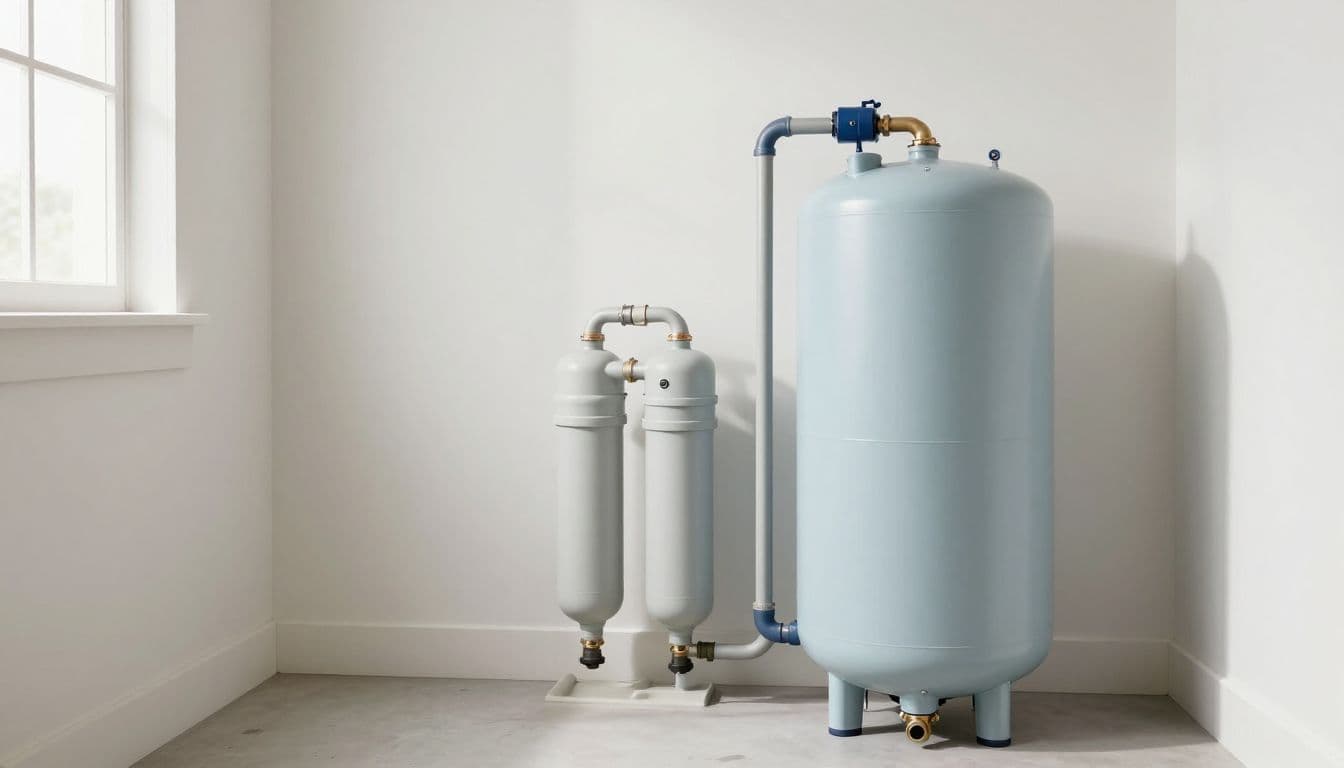
The pump and pressure tank also affect treatment performance. A unit may handle your household's daily water volume but fail to deliver enough service flow when multiple fixtures run together.
If white crust keeps appearing on sinks and shower doors, why well water causes white scale on fixtures can help identify whether hardness is the likely cause.
Water softener sizing starts with a certified well-water test
A current certified well-water test is the starting point for every private-well treatment decision. Don't size a softener using an old report, a strip test, or a neighbor's results.
Collect the sample according to the laboratory's instructions. In most cases, the sample should come from an untreated cold-water tap before filters, softeners, or other treatment equipment. A treated sample can hide the conditions that the new system must handle.
At a minimum, ask the certified laboratory to test for:
- Hardness, reported in gpg or milligrams per liter as calcium carbonate.
- Iron and manganese, with results reported in parts per million or milligrams per liter.
- pH, which shows whether the water is acidic, neutral, or alkaline.
- Total dissolved solids, often called TDS.
- Sediment or turbidity when the water looks cloudy or carries particles.
- Coliform bacteria and E. coli, especially when the well is new, repaired, flooded, or used seasonally.
- Nitrate and other contaminants that local health officials identify as a concern.
The test may also need to include arsenic, lead, sulfur-related compounds, or other contaminants based on local geology and the well's history. A water-treatment professional can help you choose a useful test panel before you spend money on equipment.
Why iron, manganese, pH, and sediment change the design
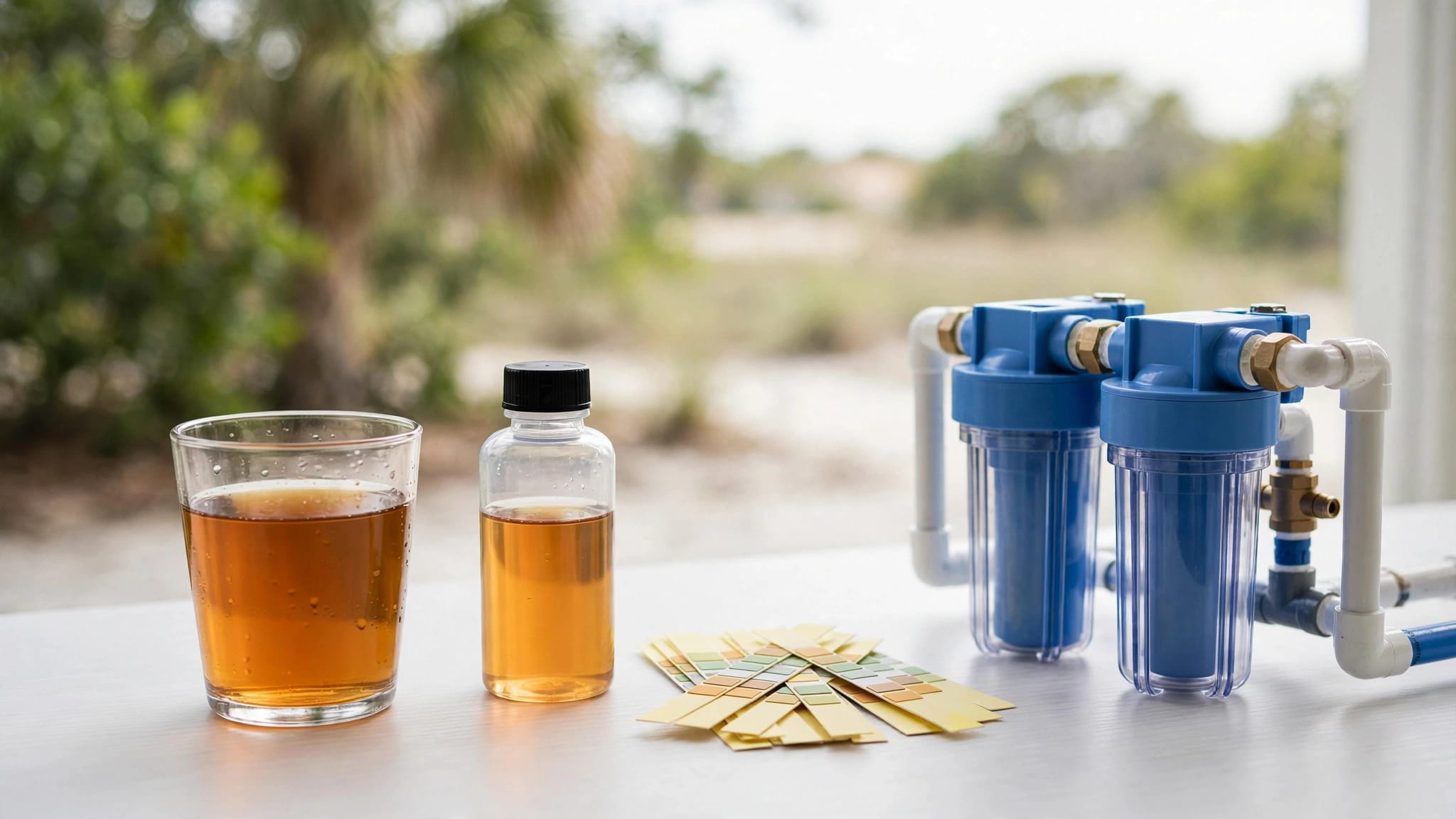
Iron is a common reason a softener becomes stained, clogged, or less effective. Some softeners can tolerate a small amount of clear-water iron, depending on the manufacturer's limits. That tolerance doesn't make the softener a dependable iron-removal system.
For a rough capacity estimate, many sizing methods add about 4 grains of hardness for every 1 part per million of iron. This adjustment helps estimate the extra resin load, but it doesn't solve the iron problem. Iron may need oxidation, filtration, or another treatment stage before the softener.
Manganese deserves separate attention. It can cause dark staining, taste problems, and resin fouling. Don't automatically apply the iron correction factor to manganese. The right treatment depends on its concentration, pH, oxidation state, and the rest of the water chemistry.
Low pH can make water corrosive to plumbing and fixtures. Acidic water may need a neutralizing filter or another pH-correction system before it reaches a softener. A softener isn't designed to correct low pH.
Sediment can damage control valves and block screens. A sediment filter, spin-down filter, or backwashing filter may need to sit before the softener. The correct choice depends on particle size and how much sediment the well produces.
A softener treats hardness. It doesn't make unsafe well water safe, and it shouldn't be selected as a substitute for disinfection or contaminant-specific treatment.
Calculate household demand before choosing grain capacity
Once the test gives you hardness, calculate how many grains the household adds to the water each day. The basic formula is:
Daily grain load = daily water use in gallons x adjusted hardness in gpg
Daily water use should reflect indoor use. Irrigation, pool filling, and outdoor hose connections usually shouldn't run through a softener. A bypass around those fixtures can reduce salt use and lower the system's workload.
A planning estimate of 50 to 75 gallons per person per day can provide a starting point. Actual use varies with laundry habits, fixtures, leaks, guests, and the home's plumbing. A water meter gives a better number when one is available.
For example, consider a four-person household that uses about 60 gallons per person each day. That equals 240 gallons per day. If the lab reports 18 gpg hardness and 1 ppm iron, a rough iron adjustment could bring the calculated hardness to 22 gpg.
The estimated daily load would be:
240 gallons x 22 gpg = 5,280 grains per day
A system shouldn't regenerate after every day's use. Instead, the control valve usually reserves enough working capacity for several days and then starts regeneration based on actual metered consumption. If you use seven days as a planning period, the basic load is:
5,280 grains x 7 days = 36,960 grains
A reserve is then added for higher-than-usual use. The reserve can be based on household history or a portion of daily demand. Avoid adding an arbitrary amount that makes the calculation look safer but produces unnecessary capacity.
This example points toward a system with more than 36,960 grains of usable capacity. It doesn't automatically mean that a product labeled "48,000 grains" is the correct choice. Product labels often show a maximum capacity at a particular salt dose. The usable capacity at an efficient salt setting may be lower.
Separate daily capacity from peak flow
Daily capacity measures how much hardness the resin can handle over time. Peak flow measures how many gallons per minute the system must treat when fixtures operate together. These are different calculations.
A home may use only a few hundred gallons per day but still need high flow during a busy morning. Two showers, a toilet refill, and a washing machine can place a larger short-term demand on the well and softener.
Use fixture ratings when available. The following ranges are useful for an initial estimate:
| Fixture or appliance | Approximate flow |
|---|---|
| Low-flow shower | 1.5 to 2.5 gpm |
| Bathroom faucet | 1 to 2.2 gpm |
| Kitchen faucet | 1.5 to 2.5 gpm |
| Toilet refill | 2 to 3 gpm |
| Clothes washer fill | 3 to 5 gpm |
These values are planning ranges, not a substitute for measuring the home's actual demand. Add only the fixtures that may run at the same time. For example, two 2-gpm showers and a washer filling at 4 gpm create an estimated peak of 8 gpm.
The softener's rated service flow should meet that expected demand without excessive pressure loss. The control valve also needs enough flow for backwashing and rinsing. A unit with a large resin bed may require more water during regeneration, so the well pump must handle both household use and the treatment cycle.
Confirm well-pump flow before buying treatment equipment
A softener can't create water that the well pump doesn't supply. The pump's horsepower rating alone isn't enough to confirm treatment compatibility. Delivered flow depends on well depth, pump condition, pressure-switch settings, pressure-tank performance, pipe size, and the water level in the well.
Check the pump's recovery rate, which is the rate at which the well produces water after use. Also check the flow available at the pressure tank and at the proposed treatment location. A pump may deliver a strong flow briefly while the pressure tank is full, then fall short as the tank pressure drops.
A basic flow check can reveal problems, but it has limits. A bucket test at a hose bib measures flow at one point and one pressure condition. It doesn't always show whether the system can sustain the flow required for a filter backwash cycle.
The treatment professional should compare:
- The household's likely peak demand.
- The softener's service-flow rating.
- The valve's backwash and rinse requirements.
- The well's recovery rate.
- The pressure-switch cut-in and cut-out settings.
- The drain line size and available drain flow.
- The pressure loss caused by prefilters and other equipment.
For more detail on this part of the decision, review how well pump flow rate impacts treatment sizing. Flow information often changes the equipment choice before tank capacity becomes the main issue.
Consult a qualified water-treatment professional when the pump flow is unknown, the well has low recovery, several fixtures run at once, or the system will include iron filtration, carbon filtration, neutralization, and reverse osmosis.
Choose usable capacity, not the biggest label
Softener capacity is often advertised in rounded numbers such as 32,000, 48,000, or 64,000 grains. Those figures help compare products, but they don't tell the whole story.
The amount of resin inside the tank matters. So does the salt dose selected during regeneration. A resin bed may have a high maximum capacity at a heavy salt setting, but running that setting every time can cost more and use more water.
Look for the system's usable capacity at a stated salt dose . Ask how many grains the unit provides at its most efficient settings. Also ask how the control valve calculates remaining capacity and when it adds reserve capacity.
A metered-demand control valve tracks water use and initiates regeneration when the programmed capacity is nearly exhausted. This is usually a better fit for a private well household with changing demand than a simple timer that regenerates on fixed days.
Time-clock controls can regenerate when the home has used little water, or they can wait too long after guests arrive and demand increases. A metered system still needs correct programming, including hardness, iron adjustments where appropriate, household size, and reserve settings.
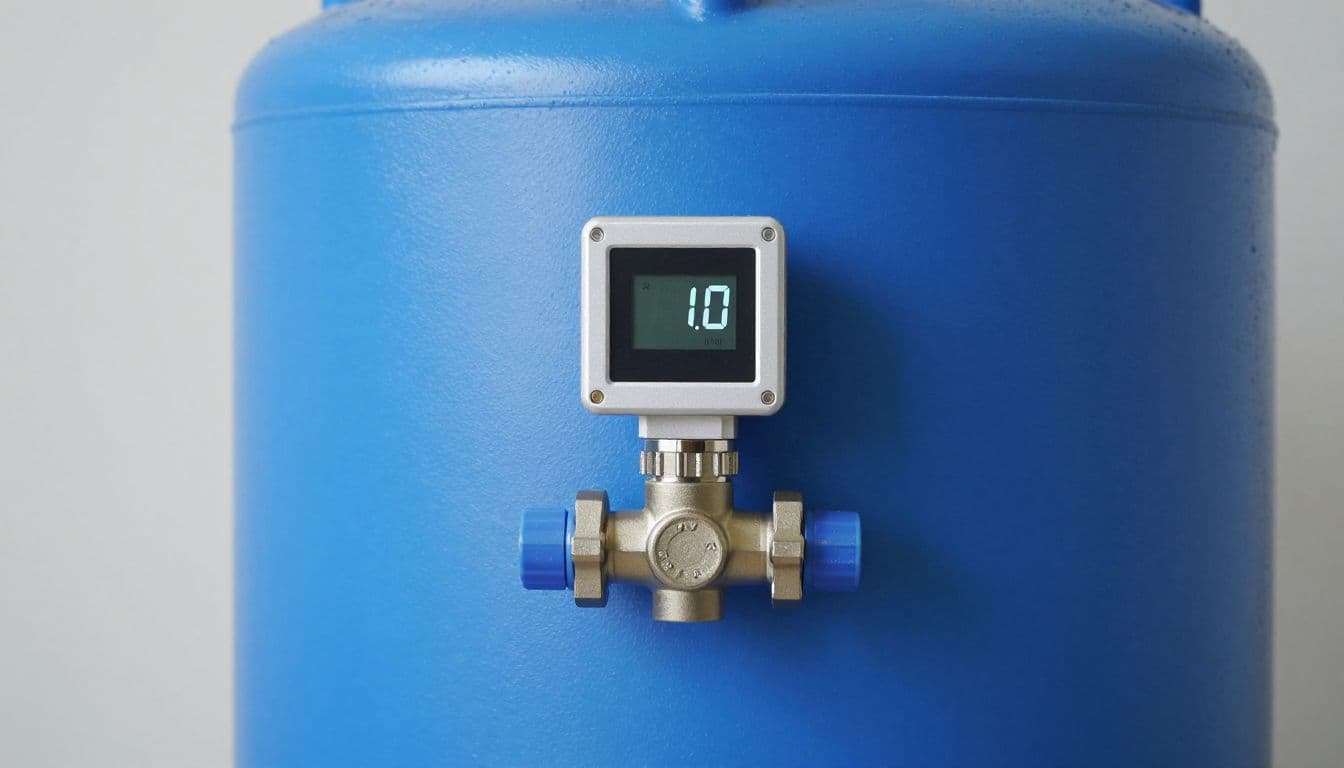
A larger tank isn't automatically better. Oversizing can increase purchase cost, require more backwash water, and allow long periods between regenerations if the control settings aren't correct. Undersizing can cause frequent regeneration, salt waste, and hardness leakage when demand rises.
The right size provides enough usable capacity for normal demand, enough service flow for peak use, and a regeneration schedule that matches the well's water supply.
Know when a softener isn't enough
A softener is designed primarily for calcium and magnesium hardness. It may improve scale and soap performance, but it doesn't remove every contaminant found in private-well water.
| Water condition | Why it affects treatment | Possible equipment direction |
|---|---|---|
| Iron | Can stain fixtures and foul resin | Iron filtration or oxidation before the softener |
| Manganese | Can cause dark staining and resin fouling | Manganese-specific filtration based on test results |
| Low pH | Can increase corrosion | Neutralizing or pH-correction equipment |
| Sediment | Can clog valves and screens | Sediment filtration before treatment |
| Very high hardness | Creates a large daily grain load | Higher-capacity, multiple-tank, or commercial-style design |
| Bacteria or E. coli | Can create a health hazard | Disinfection and well-system evaluation |
| Nitrate or arsenic | Requires contaminant-specific reduction | Certified treatment designed for that contaminant |
| High TDS | Indicates a high dissolved-mineral load | Additional treatment evaluation, possibly RO |
Very high hardness may require more resin, a larger control valve, multiple tanks, or a different system layout. The best choice depends on water use and peak flow, not hardness alone. High hardness paired with high TDS or another dissolved contaminant also calls for a broader treatment review.
Whole-house reverse osmosis and a water softener perform different jobs. If your report shows a dissolved-water problem beyond hardness, compare choosing between an RO system and a water softener for wells before selecting either system.
A softener shouldn't be expected to remove bacteria, nitrate, arsenic, fuel compounds, or other contaminants without a treatment design that specifically addresses them. It also doesn't solve sulfur odor, although a complete well-water system may include equipment that does.
Common sizing mistakes to avoid
Many sizing problems start with an incomplete calculation rather than a defective tank. Watch for these errors:
- Choosing a unit by household size without checking hardness.
- Using a water test that doesn't include iron, manganese, or pH.
- Treating a nominal grain rating as the unit's usable capacity.
- Sending irrigation and outdoor hose water through the softener.
- Ignoring the well pump's sustained flow during backwashing.
- Installing a softener before sediment or iron treatment when the water requires pretreatment.
- Selecting a system that regenerates too frequently because its working capacity is too small.
- Buying the largest available unit without checking salt settings, drain flow, and service capacity.
- Treating a softener as a complete water-safety system.
A current lab report and a measured flow check prevent most of these mistakes. If the water chemistry is complicated, professional sizing is less expensive than replacing equipment that never matched the well.
The right size starts with better measurements
Private-well water softener sizing depends on four measurements: hardness, household demand, peak flow, and well-water chemistry. Iron, manganese, low pH, sediment, and very high hardness can change the equipment plan before grain capacity is calculated.
Start with a current certified well-water test. Then confirm the well pump's sustained flow and choose a metered softener based on usable capacity at a practical salt setting. When the test shows more than hardness, use treatment designed for each contaminant instead of asking one softener to do every job.
Latest posts
Read Our Blog
Tips, guides, industry best practices, and news.

Contact us
Get in touch
Our friendly team is ready to chat.