
Reverse Osmosis Microplastics: Can It Clean Tap Water?
Microplastics can enter drinking water through source pollution, treatment systems, and household plumbing. If you're researching reverse osmosis microplastics, you likely want to know whether an under-sink filter can reduce these particles before they reach your glass.
The short answer is yes. A properly installed reverse osmosis system is one of the most effective residential options for reducing microplastics, with many tests reporting more than 99% removal. However, no responsible system claim means that every particle is removed from every glass of water.
Results depend on particle size, membrane condition, water pressure, system design, and maintenance. The difference between a well-maintained RO system and a neglected one can affect both water quality and flow.
How reverse osmosis microplastics removal works
Reverse osmosis uses water pressure to push water through a dense, semipermeable membrane. The membrane allows water molecules to pass while rejecting many larger particles, dissolved substances, and other contaminants.
Manufacturers often describe RO membranes as having an approximate pore size of 0.0001 microns, or 0.1 nanometers. That figure is far smaller than many microplastics found in drinking-water studies, which are often measured in the 1 to 100 micron range or larger.
The membrane doesn't work like a simple kitchen strainer. Reverse osmosis also relies on the way water and dissolved substances move through the membrane under pressure. Still, particle size is an important part of the reason RO performs so well against plastic fragments and fibers.
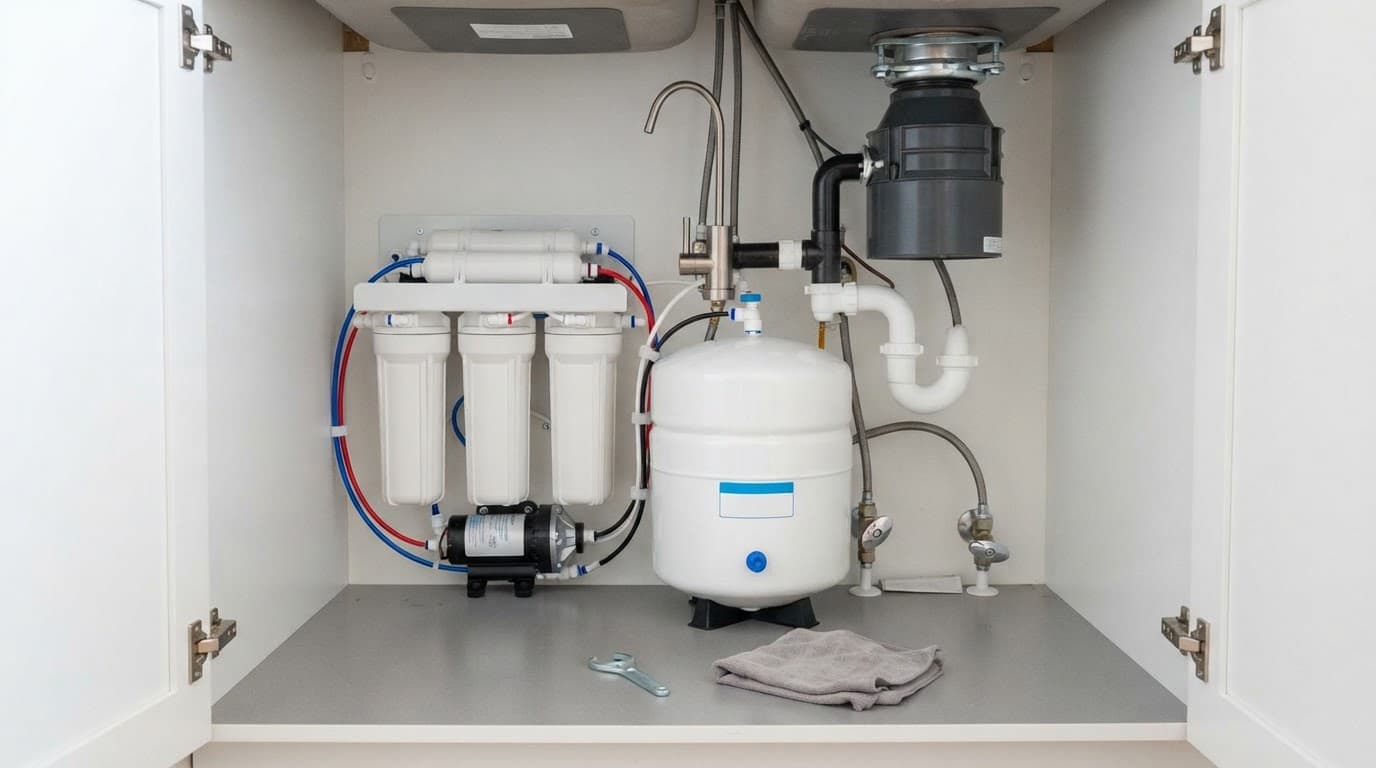
An under-sink RO system usually includes several stages:
- A sediment filter captures sand, rust, dirt, and other suspended material.
- Activated carbon filters reduce chlorine and certain compounds that can damage or affect the RO membrane.
- The RO membrane provides the main purification barrier.
- A post-filter improves taste before water reaches the dedicated faucet.
Water that doesn't pass through the membrane flows to a drain as reject water. The exact amount depends on the system's design, water pressure, temperature, and condition.
The practical answer is "more than 99% in many tests," not "100% under every household condition."
Published results vary. Some tested systems report approximately 98% removal, while other studies and product tests report 99.9% removal for microplastics and, in some cases, nanoplastics. Those differences reflect the test water, particle shape, membrane type, flow rate, and equipment setup.
Why real-world RO performance can vary
A laboratory result describes a controlled setup. Your home system faces changing water pressure, filter age, temperature, and plumbing conditions. These factors affect how the equipment performs.
Particle size and shape matter
Microplastics are not one uniform contaminant. They can appear as fragments, fibers, films, or irregular particles. A large plastic fragment is easier for an RO system to reject than a much smaller particle.
Nanoplastics create more uncertainty. They are much smaller than ordinary microplastics, and published claims about their removal are less consistent. RO can remove many nanoplastics, but the exact percentage depends on the membrane and test conditions.
Particle shape also affects movement through a membrane. Fibers may behave differently from round or irregular fragments. For that reason, a product claim should identify the test method instead of offering only a broad statement about plastic removal.
Membrane condition and water pressure matter
A membrane can lose performance when it becomes fouled by sediment, hardness, iron, or organic material. That is why prefilters matter. They protect the membrane and help it maintain stable performance.
Low feed pressure can also reduce production and affect rejection. A system that produces water slowly may have a pressure problem, clogged prefilters, a full storage tank, or a membrane nearing the end of its service life.
Damaged seals and loose fittings create another concern. Water can bypass the membrane if the system has a poor connection or a failed housing component. In that situation, the membrane's rated performance won't describe the water coming from the faucet.
Downstream components deserve attention
After water passes through the RO membrane, it may enter a storage tank, post-filter, faucet, and several lengths of tubing. These components need clean installation and regular service.
A dirty storage tank or overdue post-filter can affect taste and hygiene. Plastic tubing and fittings also sit after the main membrane, so the system should use quality components and follow the manufacturer's sanitation instructions.
When a product page makes a reverse osmosis microplastics claim, look for performance information covering the complete system, not only the membrane in isolation.
How RO compares with other household filters
Different filters handle suspended particles in different ways. This quick comparison shows why RO is often selected when microplastic reduction is a priority.
| Filter type | Likely role in microplastic reduction | Main limitation |
|---|---|---|
| Sediment filter | Captures particles at or above its stated micron rating | Performance depends on rating, flow, and replacement |
| Activated carbon | May trap some particles while improving taste and reducing certain chemicals | Carbon alone isn't a dependable barrier for every microplastic |
| Ultrafiltration | Blocks many suspended particles through a membrane | Exact performance depends on pore size and membrane integrity |
| Reverse osmosis | Provides a very fine membrane barrier, with many tests reporting over 99% reduction | Requires pressure, maintenance, and produces reject water |
| UV treatment | Disinfects water by damaging microorganisms | Doesn't physically remove microplastics |
A sediment filter can help protect an RO membrane, but it isn't a substitute for one. Likewise, a carbon pitcher may improve taste without providing documented microplastic performance.
Ultrafiltration can be useful when you want particulate reduction without the reject water associated with RO. However, RO usually provides a stronger barrier for drinking water when the system is properly selected and maintained.
Choosing an RO system for drinking water
For most homeowners concerned about what they drink and cook with, a point-of-use system under the kitchen sink is a practical starting point. It treats water at one dedicated faucet instead of sending every gallon used for showers, laundry, and toilets through the RO membrane.
Before buying, ask for documentation that covers the finished system. NSF/ANSI 58 certification is a useful quality reference for residential RO systems, but it doesn't automatically prove that every configuration has a specific microplastic reduction claim. Look for test data that names the contaminants, reduction rate, and test conditions.
A water test also helps determine the right equipment. Useful measurements can include total dissolved solids, hardness, iron, chlorine, sediment, and water pressure. Private-well owners may need additional pretreatment because iron, sulfur, or heavy sediment can shorten membrane life.
Consider these practical details:
- Choose prefilters that match the water entering your home.
- Confirm that the system can operate at your available pressure.
- Check the replacement schedule and cost for each filter.
- Look for an accessible design that allows service without removing cabinets.
- Ask how much reject water the system produces during normal operation.
- Confirm that the faucet, storage tank, tubing, and fittings are included in the service plan.
- Choose a system with documented microplastic testing when that reduction is your main goal.
Maintain the membrane and filters
Most RO systems need regular prefilter and post-filter replacement. Many manufacturers recommend changing these filters every six to 12 months, although heavy use and poor source water can shorten that interval.
RO membranes often last two to five years, but the actual service life depends on water chemistry, pretreatment, pressure, and daily demand. Follow the equipment manufacturer's schedule rather than waiting for a noticeable change in taste.
Slow flow, unusual taste, frequent cycling, leaks, or a sudden change in total dissolved solids can indicate a service problem. A technician can check pressure, tubing, seals, tank operation, and membrane performance.
The storage tank and lines also need sanitation at the intervals recommended for the system. A clean membrane cannot compensate for contamination introduced later in the treatment path.
Does whole-house RO make sense?
Whole-house RO can reduce contaminants at every tap, but it requires more planning than an under-sink unit. The design may need pretreatment, larger storage, repressurization, drain planning, and enough capacity for peak household demand.
For a Naples or Southwest Florida home, the right setup depends on the source water and existing plumbing. City water, private wells, hard water, high total dissolved solids, and sediment problems can lead to very different equipment choices.
A water softener and RO system also solve different problems. A softener reduces hardness minerals, while RO reduces many dissolved contaminants and provides a fine barrier for suspended particles. If you're comparing both options, review this guide to whole-house reverse osmosis versus a water softener.
If you need RO water throughout the property, correct sizing matters. Daily demand, pretreatment, storage, and peak use all affect the system, as explained in this guide to whole-house reverse osmosis system size.
Conclusion
Reverse osmosis is highly effective at reducing microplastics in tap water. Its dense membrane is much finer than the particles commonly measured in drinking-water studies, and many tested systems achieve more than 99% reduction.
The result still depends on the complete installation. Proper pretreatment, stable pressure, sound seals, clean storage components, and regular filter changes all matter.
For drinking water, a well-maintained under-sink RO system is often enough. When every tap needs treatment, a water test and careful whole-house design can help protect the membrane and deliver more consistent microplastic reduction .
Latest posts
Read Our Blog
Tips, guides, industry best practices, and news.



Contact us
Get in touch
Our friendly team is ready to chat.