
Tankless Water Heater Florida: Protect It From Hard Water
The tankless water heater Florida homeowners choose for steady hot water still needs protection from hard water. Calcium and magnesium can form scale inside the heat exchanger, where even a thin deposit changes how the unit heats and moves water.
That risk isn't the same in every Florida community. Hardness varies by city, ZIP code, water source, and private well, so the right treatment and service schedule depend on your address.
Before you buy or repair a unit, check the water chemistry and understand what scale can do. Then match the heater, filter, softener, and maintenance plan to the actual mineral load.
Florida water hardness varies by location
Florida water can be soft in one community and very hard in another. Many groundwater sources pass through limestone and pick up calcium and magnesium, while utilities may draw from different wells or blend supplies. A statewide label can't predict what comes from your faucet.
Hardness is usually reported as milligrams per liter (mg/L) or parts per million (ppm) of calcium carbonate. One grain per gallon (gpg) equals about 17.1 mg/L. Common classifications place water between 7 and 10 gpg in the hard range, while water above 10 gpg is very hard.
Use local data, not a statewide average
JEA's published ZIP-code table shows how much local conditions can change. It lists 372 ppm, or 22 gpg, in ZIP code 32081, while ZIP code 32065 is listed at 120 ppm, or 7 gpg. Both locations are in the same utility service area, yet their scale risk isn't identical.
A July 2026 Florida water-hardness compilation lists Miami at 247.6 mg/L, or 14.5 gpg, and Apalachicola at 291 mg/L, or 17 gpg. It also lists Bay Lake at only 2.7 mg/L, or 0.2 gpg. The practical takeaway is simple: check the number for your home before selecting treatment.
Municipal water and private wells need different checks
Municipal water isn't automatically soft. Your utility's consumer confidence report, water-quality page, or hardness table may provide a useful starting point. Ask whether the published result represents your pressure zone or source, since some systems use multiple wells or adjust source blends.
What to check on city water
Look for total hardness in ppm as calcium carbonate or in gpg. If the utility doesn't publish it, a water-treatment company or certified laboratory can test a sample. Take the sample from a cold tap before any existing treatment, then keep the result with your tankless heater records.
White crust on faucets confirms that minerals are depositing, but it doesn't show the exact hardness. A home test can screen the water, while laboratory testing gives you a stronger basis for sizing treatment equipment.
Why well water requires a wider test
Private wells need direct testing because no utility report covers the water entering your home. Test hardness along with iron, manganese, sulfur, pH, sediment, and health-related items required for your situation. A well can have hard water and another issue at the same time.
A softener handles calcium and magnesium. It doesn't replace treatment for bacteria, nitrate, arsenic, or other contaminants. Review how to read a Florida well water test before choosing equipment, especially if staining, odor, or low pH appears with scale.
How a tankless water heater Florida homes rely on handles hard water
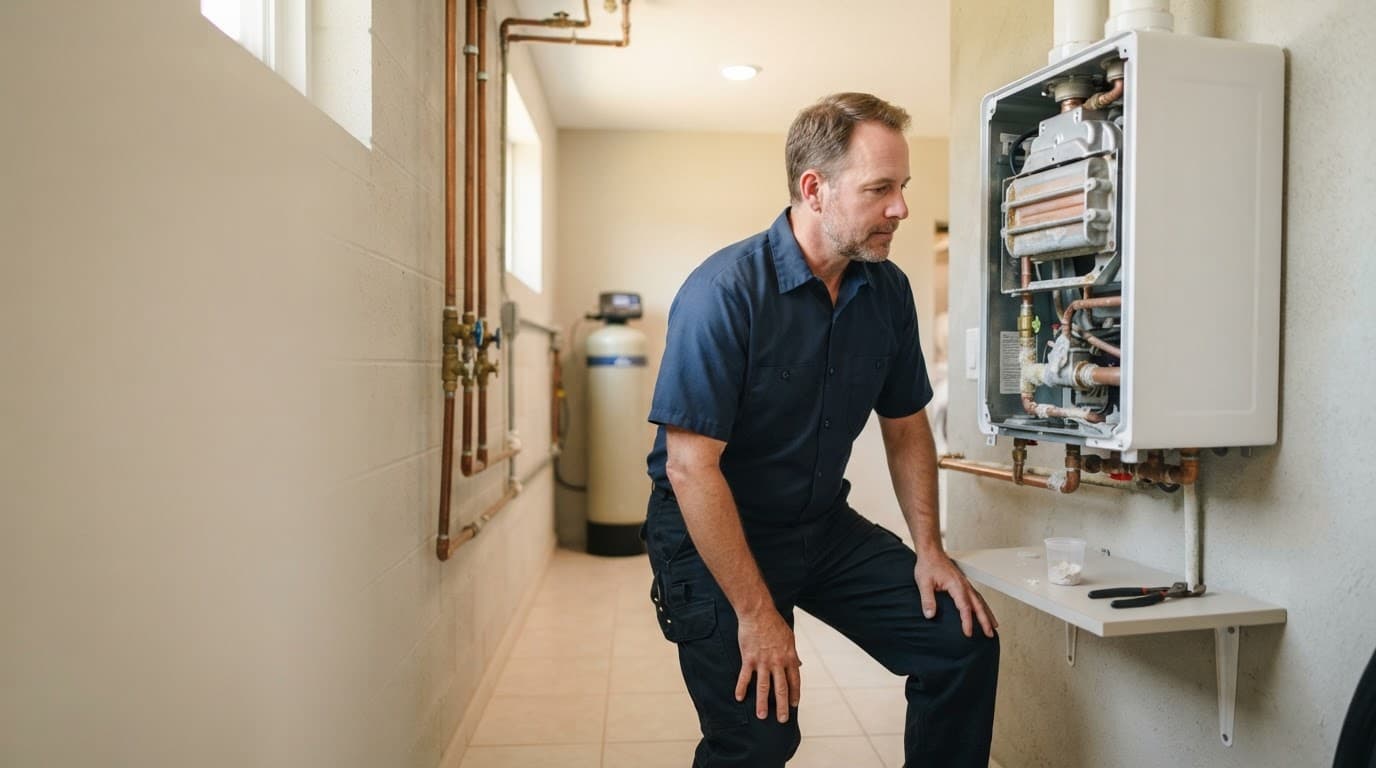
A tankless unit heats water as it passes through a heat exchanger. That design saves space, but it also puts minerals in direct contact with narrow, high-temperature passages. When a tankless water heater Florida homeowners install runs on hard water, scale can affect performance before the unit stops working.
Scale reduces heat transfer
When heated water releases calcium carbonate, deposits cling to the exchanger surface. Scale acts as insulation between the heat source and the water. The burner or electric elements may need longer cycles to reach the set temperature, and outlet temperature can become less stable.
The deposit also creates a rough interior surface. That increases resistance as water passes through, which can lower effective flow at a shower or fixture. Energy use may rise because the heater works harder to meet the same demand.
Low flow and error codes can follow
As passages narrow, the heater may detect less flow than expected. Some units cycle on and off, limit output, or shut down when the temperature rises too quickly. Scale can also affect the readings used by flow and temperature sensors.
Error codes vary by manufacturer and model, so one code doesn't provide a universal diagnosis. A clogged inlet screen, low supply pressure, undersized piping, gas or electrical problems, and a dirty filter can create similar symptoms. A technician should check flow, inlet conditions, and the exchanger before blaming scale.
Chronic scaling increases cleaning frequency and thermal stress. It can shorten service life, especially when the unit misses several flushes or continues operating with restricted flow.
Water filters vs. water softeners for a tankless heater
When a tankless water heater Florida homeowners install shares water with the whole house, treatment should match the problem. A filter and a softener aren't interchangeable, even though both can sit near the heater.
| Treatment | Main job | Effect on scale |
|---|---|---|
| Sediment filter | Catches sand, rust, and loose particles | Protects screens and valves, but doesn't remove dissolved hardness |
| Carbon filter | Reduces chlorine, taste, and odor, depending on its media | Doesn't lower calcium or magnesium |
| Water softener | Exchanges calcium and magnesium through ion exchange | Directly reduces hardness entering the heater |
When a filter helps
A sediment filter catches sand, rust, and loose particles. It helps protect the heater's inlet screen and valves, which matters for private wells and older plumbing. A carbon filter can reduce chlorine, taste, and odor when its media and flow rating fit the water.
Neither type removes dissolved calcium and magnesium. A cartridge can look clean while hard water continues to form scale. Filters also create pressure loss when clogged, so choose a model rated for the home's peak flow and replace cartridges on schedule.
When a softener fits the problem
A salt-based softener is the direct treatment for calcium and magnesium hardness. It needs the right capacity, adequate service flow, a drain, and regular salt service.
In Naples and nearby Southwest Florida communities, homeowners can review water conditioning services in Naples when hard-water deposits affect several fixtures. A softener can protect plumbing and appliances throughout the house, but it doesn't purify drinking water or remove every well contaminant. Add a separate filter or point-of-use reverse osmosis system when testing shows another need.
Salt-free conditioners may change how some minerals deposit, but they don't lower the measured hardness. Check the heater's requirements before selecting one.
Hard-water maintenance checklist
Regular care protects the heat exchanger, but the interval depends on hardness, water use, heater model, and treatment equipment.
Keep these tasks on a routine schedule
- Record the latest hardness result and water source with the heater's installation documents.
- Check and clean the inlet water screen according to the heater manual.
- Flush or descale the heater at the manufacturer's recommended interval. Hard water may require shorter intervals.
- Check the softener salt level and confirm that the unit regenerates correctly.
- Replace sediment or carbon cartridges before they become clogged and restrict flow.
- Review the heater's error history after maintenance or whenever hot-water performance changes.
- Keep service valves, drains, and electrical connections accessible to the technician.
Know when to call for service
Schedule service when showers lose hot-water flow, temperature swings appear, or the heater shuts down during normal demand. Repeated scale-related codes also need attention, especially after a softener runs out of salt or a filter becomes restricted.
Don't pour descaler into a connected unit without the correct isolation valves, instructions, and product. Gas and electrical isolation add safety concerns. A qualified technician can determine whether the problem is scale, pressure, flow, combustion, or controls.
Plan water treatment before tankless installation
The heater and treatment system need to work together. Incoming water temperature affects sizing, and it varies by season, property, and supply source. Choose capacity based on peak hot-water demand, inlet temperature, and the manufacturer's flow tables.
Size treatment for flow
A filter or softener that's too small can restrict flow and create a low-flow problem at the heater. Private well homes also need enough pump output and pressure-tank capacity for treatment regeneration and household demand. Review well pump flow rate for water treatment before selecting equipment for a well property.
If two showers or a large fixture run together, include that demand before purchasing. A larger tankless unit won't fix a treatment system or plumbing line that can't supply enough water.
Place equipment for access
Install sediment protection where the water source requires it, and place a softener according to the heater manual and plumbing design. Include bypass valves, a proper drain, electrical access, and enough room for filter changes or service.
Outdoor tankless units and treatment equipment also need clear service access. Follow local code and the manufacturer's clearance requirements, particularly when equipment is installed in a tight utility area or exposed location.
If the home already has a tankless heater, treatment can still be added. Have the installer check pipe size, pressure, inlet screens, and isolation valves before making a recommendation. A tankless water heater Florida homeowners install should be treated as part of the home's water system, not as an isolated appliance.
Conclusion
Hard water doesn't make tankless heating a poor choice for Florida homes. It does make water testing and maintenance part of the installation decision. Check local hardness, test private wells directly, use a softener for dissolved hardness, use filters for sediment or taste issues, and flush the heater on the schedule its manufacturer specifies.
When performance changes, act before a low-flow symptom becomes a failed heat exchanger. For a tankless water heater Florida homeowners install, the most reliable setup pairs the unit with treatment sized for the home and service planned around the water coming through the pipes.
Latest posts
Read Our Blog
Tips, guides, industry best practices, and news.

Contact us
Get in touch
Our friendly team is ready to chat.