
Well Water VOC Contamination: Whole-House Treatment
A private well can look, smell, and taste normal while carrying chemicals you would never choose to bring into your home. Well water VOC contamination requires laboratory testing because odor and taste cannot tell you which compounds are present or whether the water is safe.
Fuel releases, industrial solvents, leaking storage tanks, and nearby commercial activity can affect groundwater. Once a lab identifies the contaminant and its concentration, you can choose treatment that fits your home's exposure risks.
How VOCs can reach a private well
Volatile organic compounds, or VOCs, are carbon-based chemicals that can evaporate into air. Many enter groundwater after spills, leaks, improper disposal, or releases from industrial and commercial sites.
A well draws water from underground formations. Therefore, contamination can travel through soil and groundwater before it reaches the well casing or pump. Distance from a source matters, but groundwater flow direction, soil conditions, well depth, and casing condition matter too.
Petroleum-related compounds
Gasoline and fuel oil releases can introduce benzene, toluene, ethylbenzene, xylene compounds, and methyl tertiary-butyl ether, often called MTBE. Risks may be higher near gas stations, vehicle repair businesses, fuel storage areas, or old underground tanks.
Benzene has an EPA maximum contaminant level of 5 micrograms per liter, also written as 0.005 milligrams per liter. That small number shows why a smell test isn't a reliable safety check.
Chlorinated solvent contamination
Trichloroethylene, or TCE, and tetrachloroethylene, also called PCE or perchloroethylene, were widely used as industrial degreasers. PCE is also associated with dry-cleaning operations.
Vinyl chloride can form as certain chlorinated solvents break down underground. Its EPA maximum contaminant level is 2 micrograms per liter. If a report identifies one chlorinated solvent, ask the lab or an environmental professional whether related compounds and breakdown products should also be tested.
Laboratory testing must come before treatment
A carbon filter might help with one VOC and perform poorly for another. A reverse osmosis unit may improve drinking water at one tap, yet it won't protect a family from untreated shower water. Treatment starts with a contaminant-specific lab result , not a product choice.
The CDC recommends annual testing of private wells for baseline concerns such as total coliforms, pH, total dissolved solids, and nitrates. VOC testing should be added when local conditions point to a risk, including nearby fuel facilities, industry, spills, wildfire damage, or leaking tanks.
Choose a lab and panel that match the concern
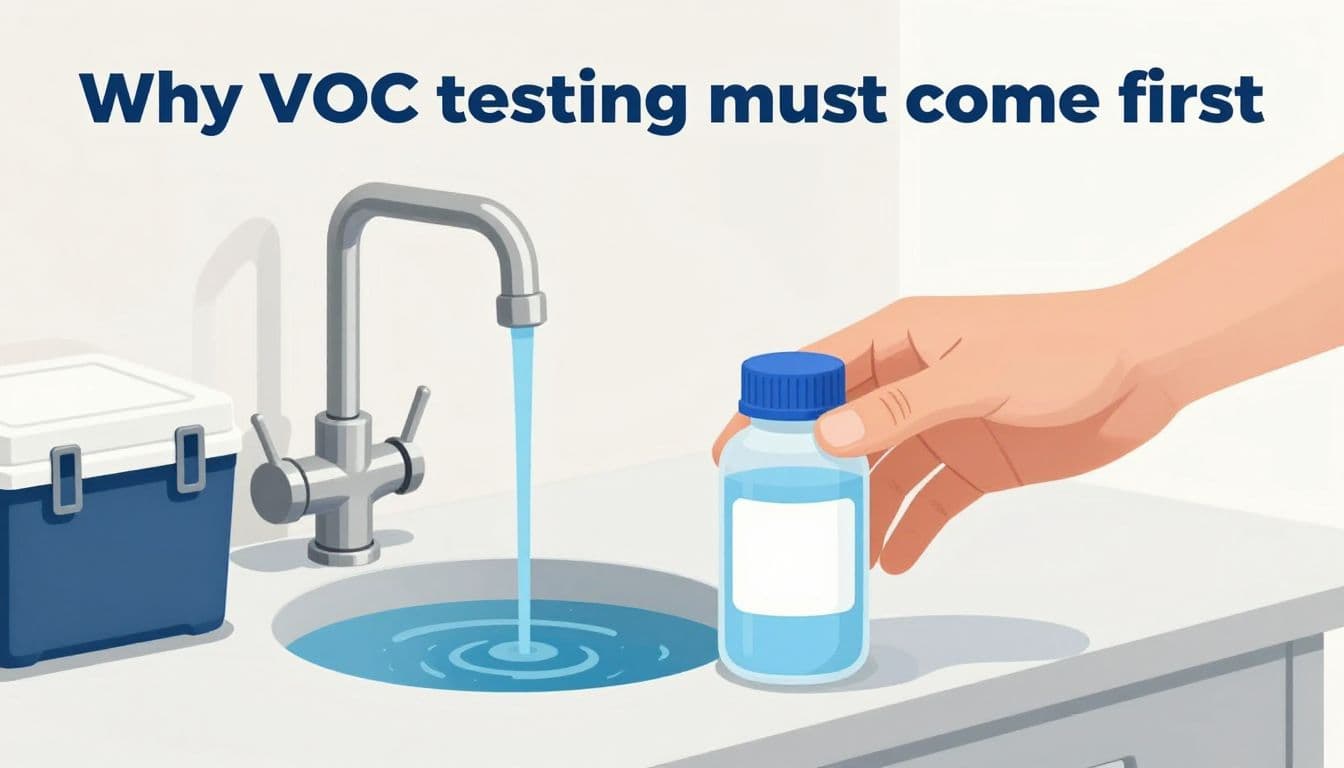
Use a state-certified laboratory or another qualified drinking-water lab. Tell the lab what prompted the test. A suspected fuel release calls for a petroleum-focused VOC panel, while a nearby dry cleaner or industrial property points toward chlorinated solvents.
Ask whether the panel includes benzene, TCE, PCE, vinyl chloride, carbon tetrachloride, toluene, and MTBE when those compounds fit your local risk. In areas affected by wildfire or fire-damaged plumbing, ask whether a broad VOC and semi-volatile organic compound test is appropriate.
Follow the laboratory's sampling instructions
VOCs can escape from water samples. For that reason, the bottle type, preservation, filling method, holding time, and delivery schedule all matter. Don't rinse a laboratory-provided vial, leave headspace, or substitute a household container.
Collect raw-water samples before existing treatment when you need to identify the well's actual condition. A second sample after treatment can confirm equipment performance. If a result exceeds a health standard, EPA guidance recommends retesting to confirm both the compound and concentration.
A water test that misses the suspected compound cannot prove the well is free of contamination.
Reading a VOC water test report
Laboratory reports may show results in micrograms per liter, written as ug/L, or milligrams per liter, written as mg/L. One mg/L equals 1,000 ug/L. Compare results with the applicable federal standard and any state drinking-water requirements.
For several well-known VOCs, the federal maximum contaminant level is 5 ug/L: benzene, TCE, and PCE. Vinyl chloride has a lower EPA limit of 2 ug/L. MTBE does not have a federal EPA maximum contaminant level, so state guidance may be relevant.
A detection is not the same as a diagnosis
A detected chemical deserves attention, yet the next step depends on its concentration, whether the result was confirmed, and the likely source. Some reports also list a method detection limit or reporting limit. Those figures show the lowest level the laboratory can confidently report, not a safety threshold.
Keep the complete report, including sample location and date. An installer needs more than a single compound result. They should also review pH, hardness, iron, manganese, sediment, flow rate, pressure, and any microbial findings that could affect treatment design.
Act promptly on unusually high results
If a result is unusually high, or you suspect a recent spill, don't treat the issue as a routine filter change. Contact your county health department, state environmental agency, or a qualified environmental professional. They can help assess the source, potential plume, and whether other wells may be affected.
Use an alternative drinking and cooking source while you investigate if local health authorities recommend it. Avoid relying on boiling. Heat does not remove every chemical safely, and it can release VOCs into indoor air.
VOC exposure goes beyond drinking water
Drinking water is the obvious concern, but VOCs can also move from water into air during showers, baths, dishwashing, and laundry. Warm water, spray, and steam increase the opportunity for volatile chemicals to enter indoor air.
This matters when deciding between a filter at the kitchen sink and treatment at the water's entry point. A point-of-use unit can reduce ingestion at one faucet. It cannot treat water flowing through a showerhead or washing machine.
Reduce exposure while you investigate
Ventilate bathrooms during showers and baths by running the exhaust fan and opening a window when conditions allow. Keep shower time reasonable, particularly when a confirmed VOC result is under review.
Don't assume that bottled water alone resolves household exposure. It may protect drinking and cooking uses, but it doesn't change untreated water used elsewhere. A qualified assessment can help determine whether temporary changes, whole-house treatment, or another response is appropriate.
Whole-house treatment for well water VOC contamination
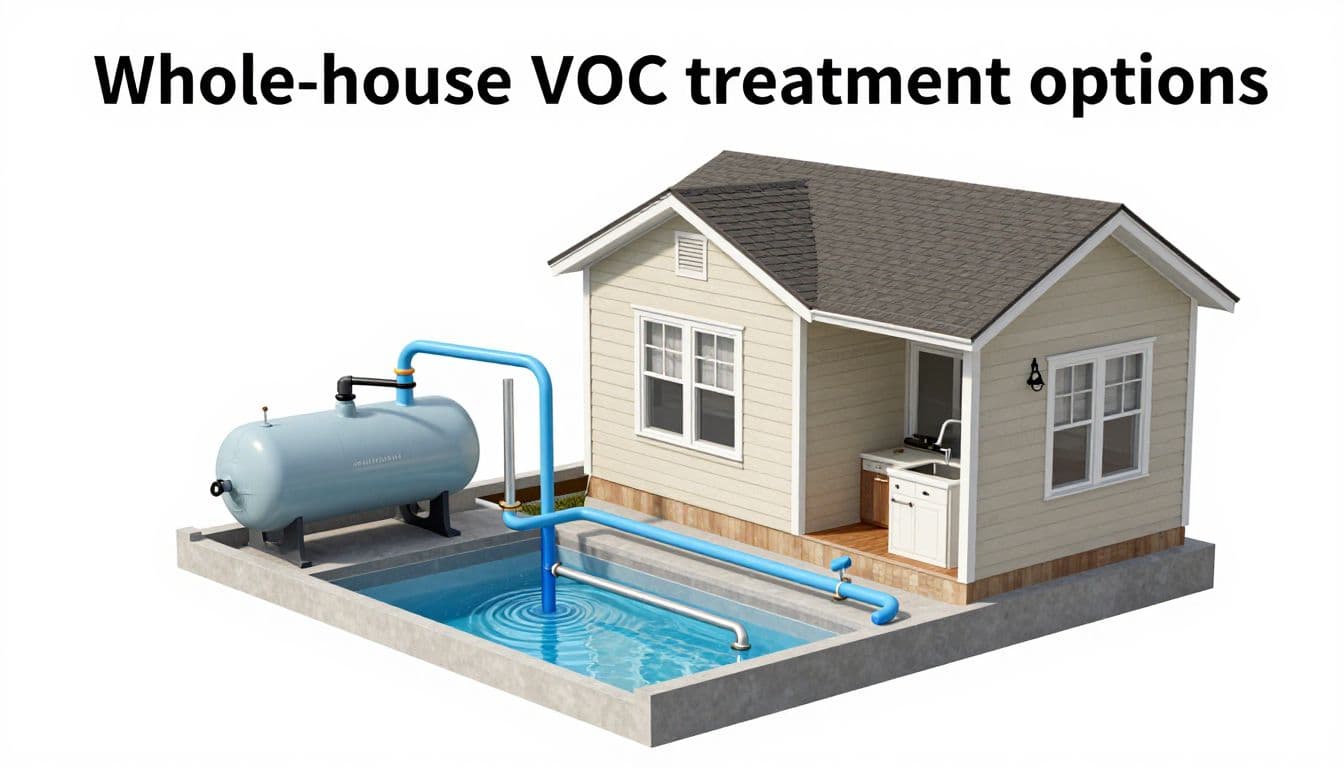
Whole-house treatment, also called point-of-entry treatment, goes on the main water line after the well pressure system and before water reaches household fixtures. It can address exposure at taps, showers, tubs, appliances, and outdoor connections, depending on the plumbing layout.
Point-of-use treatment sits at a single location, usually beneath a kitchen sink. It is often practical when the goal is to improve drinking and cooking water only.
| Treatment location | Water protected | Typical reason to choose it |
|---|---|---|
| Point-of-use | One designated faucet | The concern is limited to drinking and cooking water |
| Point-of-entry | Water throughout the home | Showering, bathing, and whole-home exposure also matter |
For well water VOC contamination , the choice should follow the test result and how your household uses water. A point-of-entry system is often the more fitting category when inhalation during bathing is a concern.
Whole-house equipment needs enough flow
A treatment tank can only work properly if the well pump and plumbing supply the needed flow and pressure. Undersizing equipment may reduce contact time, restrict household water flow, or make backwashing equipment unreliable.
Before selecting a system, review well pump flow rate for water treatment. The installer should measure real flow at the home, not rely on a guess based on pump horsepower.
Activated carbon is a common whole-house option
Granular activated carbon, or GAC, is a widely used treatment medium for many dissolved organic chemicals, including many VOCs. Water passes through a carbon bed, and compounds adsorb onto the carbon's porous surface.
Carbon is not interchangeable across every contaminant and concentration. Bed size, empty-bed contact time, water flow, competing contaminants, and expected water use all affect performance. A small cartridge can exhaust much faster than a properly sized treatment tank.
Carbon breakthrough requires monitoring
Carbon has a finite capacity. Once the media becomes loaded, a target VOC can pass through the bed. This is called breakthrough, and it may occur before water develops any noticeable odor or taste.
A treatment plan should state the expected carbon service interval and the conditions that might shorten it. Follow-up laboratory testing is the only dependable way to check whether the system continues to reduce the contaminant at the treated-water sample point.
Iron, sediment, and hardness can change the design
Well water often contains sand, iron, manganese, hardness minerals, or sulfur-related issues alongside VOC concerns. Those conditions can foul equipment and interfere with the intended treatment process.
Pretreatment may include sediment filtration, iron removal, or softening before carbon or reverse osmosis. A softener helps with hardness, but it isn't a VOC treatment device. Compare whole-house reverse osmosis vs. a water softener when the report shows several dissolved-water concerns.
Air stripping and reverse osmosis have narrower roles
Air stripping moves VOCs from water into an air stream. It can work well for certain volatile contaminants when engineered for the chemical concentration, water temperature, air-to-water ratio, and household flow demand.
Because the process transfers chemicals into air, the system needs proper design and ventilation. An installer should explain how exhaust air is handled and whether local permits or environmental requirements apply.
Reverse osmosis often suits a drinking-water tap
Reverse osmosis, or RO, uses a membrane to reduce many dissolved contaminants. It is commonly installed at a kitchen sink as a point-of-use system and may be part of a broader plan for treated drinking water.
However, a standard under-sink RO system doesn't address water used for showers or baths. Whole-house RO requires more space, storage, pumping, pretreatment, and maintenance. It may also produce reject water. The water analysis and household demand should drive that decision.
Don't stack equipment without a plan
More equipment doesn't automatically mean better protection. Unneeded stages add cost, maintenance, pressure loss, and possible service problems. A sound design identifies the target VOC, protects any membranes or carbon media, and provides sample locations before and after treatment.
For large RO systems, whole-house RO storage tank sizing should reflect daily demand, production rate, and pressure needs.
Questions to ask a treatment installer
A capable installer welcomes detailed questions because VOC treatment should be based on measured water quality. Bring the complete lab report, not only a verbal summary.
Ask these questions before you authorize work:
- Which VOCs and concentrations is this system designed to address, based on my laboratory report?
- Will the system treat the whole house or only one faucet, and which household exposure routes will remain?
- What flow rate, pressure, contact time, and water use assumptions shaped the sizing?
- Which pretreatment stages are needed for sediment, iron, hardness, or bacteria?
- Where will you install sample taps before and after treatment?
- When should I retest the water, and which laboratory panel should I repeat?
- What maintenance tasks, media replacement intervals, and service costs should I expect?
- How should spent carbon or other used media be handled and disposed of?
Get the answers in writing. The proposal should identify the equipment, treatment sequence, bypass arrangement, maintenance responsibilities, and verification plan.
Retesting and maintenance protect treatment performance
Installers should disinfect and flush new carbon equipment as directed before it enters service. After long periods away from home, follow the manufacturer's flushing directions before using stored or stagnant water.
Record service dates, filter changes, water-pressure changes, and laboratory results. Sudden pressure loss can signal a clogged prefilter or other mechanical issue. Yet water pressure alone cannot reveal carbon breakthrough.
Treat spent carbon as potentially contaminated
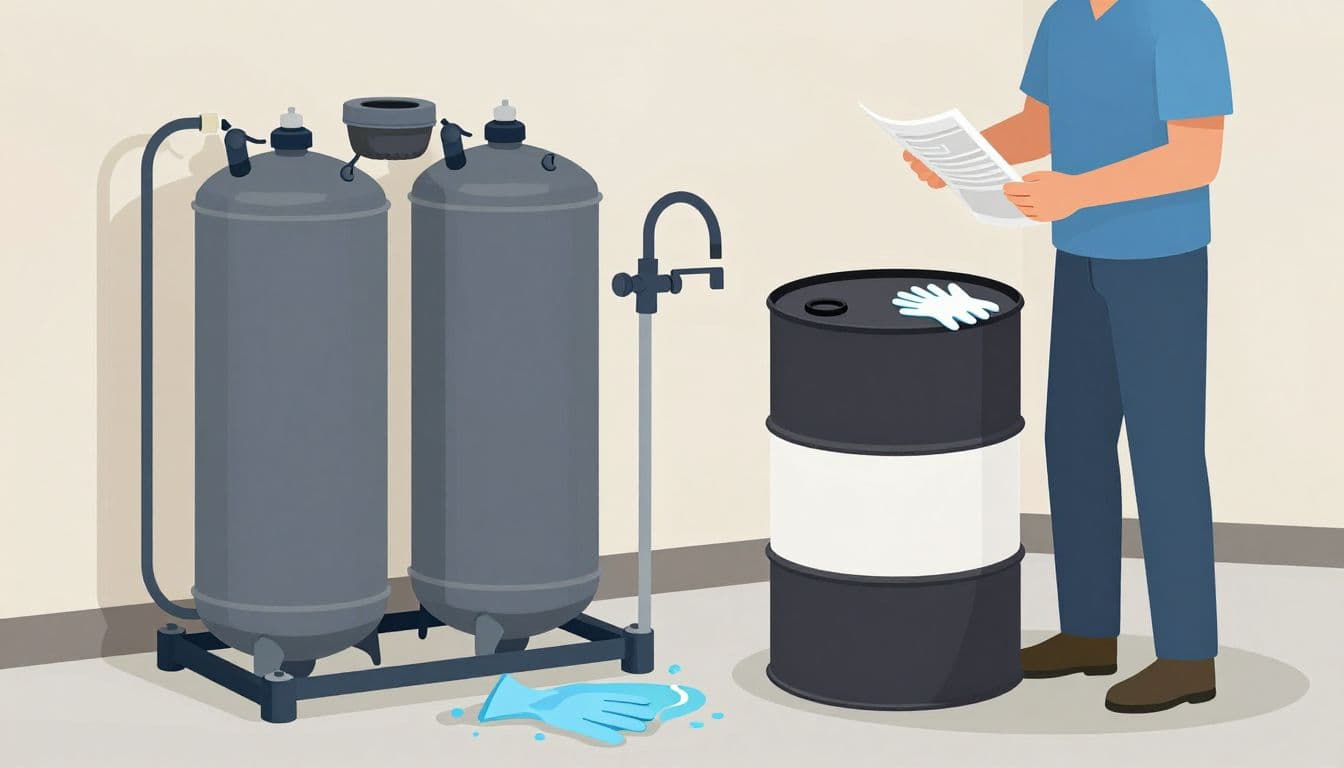
Used carbon may hold the VOCs it removed. Don't dump it in the yard, burn it, or place it in household trash unless the equipment supplier and local waste authority confirm that disposal route is allowed.
Your treatment company, laboratory, county solid-waste office, or environmental agency can help determine appropriate handling. The right method depends on the contaminants found and local disposal rules.
Verify with post-treatment samples
Sample at the designated treated-water tap after installation and at intervals set by the treatment plan. Compare the new results with raw-water findings and applicable health standards.
Maintenance schedules are useful, but results matter more. If testing shows reduced performance, schedule service promptly and use temporary exposure-reduction steps until the issue is resolved.
A tested plan is safer than a guess
Well water VOC contamination calls for a measured response. Identify the actual chemicals through a qualified laboratory, consider drinking and bathing exposure, then select point-of-use or whole-house equipment that fits the results.
A properly designed system includes flow planning, pretreatment where needed, service access, and post-installation testing. Regular retesting turns treatment from a one-time purchase into an ongoing safeguard for the water your household uses every day.
Latest posts
Read Our Blog
Tips, guides, industry best practices, and news.
Contact us
Get in touch
Our friendly team is ready to chat.