
NSF Certified Water Filters: What the Label Means
A filter can carry an NSF mark and still fail to address the contaminant in your water. NSF certified water filters meet specific testing and performance requirements, but the certification applies only to the claims listed for that exact model.
That distinction matters when you're choosing equipment for city water, well water, or a drinking-water faucet. Start with the water concern, confirm the certified contaminant claim, then maintain the system according to its instructions. The label becomes useful when you know how to read it.
What NSF certification actually tells you
NSF certification is an independent evaluation of a water-treatment product. The manufacturer submits a filter or system for review against a defined NSF/ANSI standard. The evaluation can cover materials, structural safety, performance, contaminant reduction, and other requirements connected to that standard.
A certified product has met the requirements for the claims shown in its certification record. For example, a listing may show that a particular cartridge reduces chlorine taste and odor. Another model may have a certified lead-reduction claim. Those two products don't have the same capabilities simply because both carry an NSF reference.
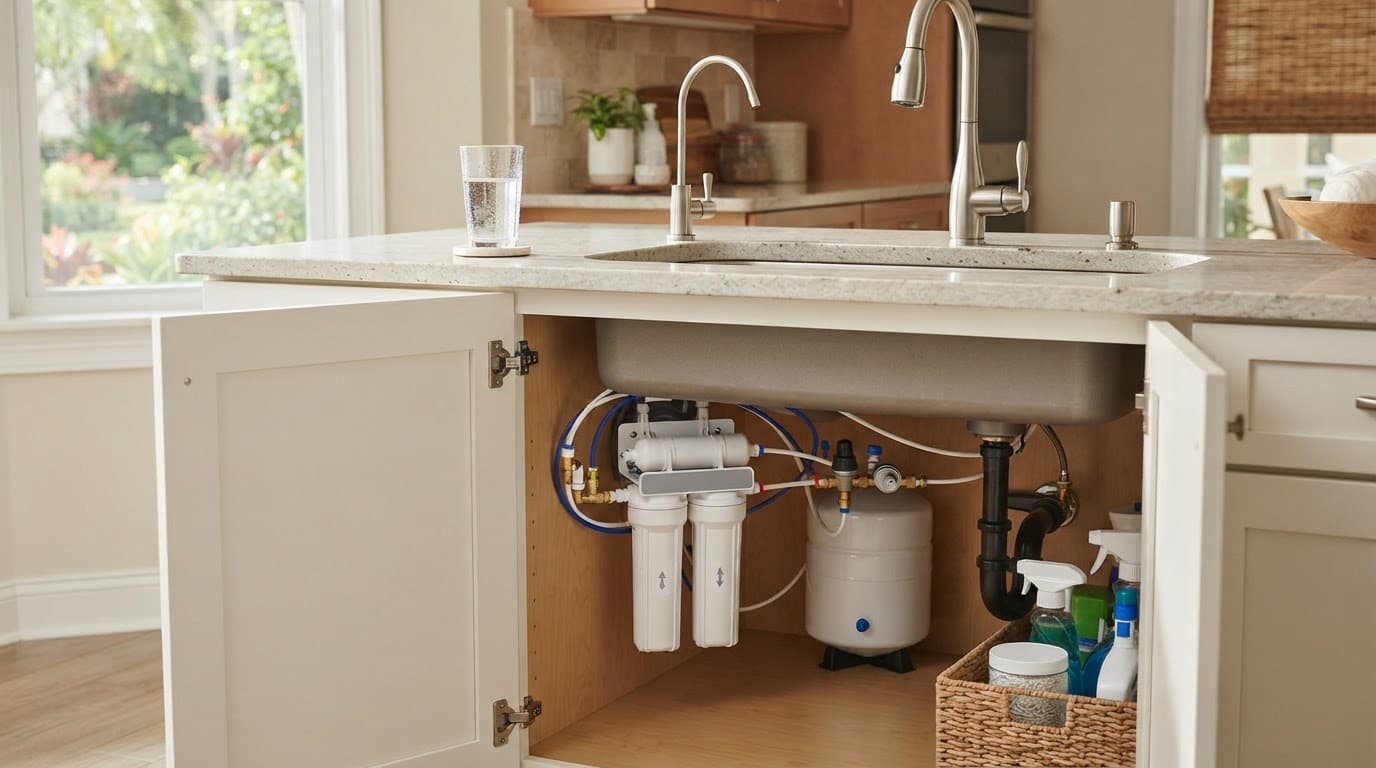
The certification belongs to the specific model and claim , not to an entire brand or product category. It also doesn't certify every part of your home's plumbing. A certified under-sink system doesn't automatically make water from every faucet treated, and certification for one cartridge doesn't transfer to an unlisted replacement.
NSF certification supports a defined contaminant-reduction claim under stated conditions. It isn't a blanket statement that the filter removes everything.
Certification is different from testing
A company may say that a product was tested to an NSF standard. That wording isn't always the same as certification. Testing may describe one laboratory evaluation, while certification means an independent organization reviewed the product and listed it for specified requirements.
Packaging language can also be broad. Terms such as "tested against," "designed for," or "comparable to" don't prove that the exact product has an active certification. Check the model number in NSF's public certified-products database before you buy.
Certification doesn't replace water testing
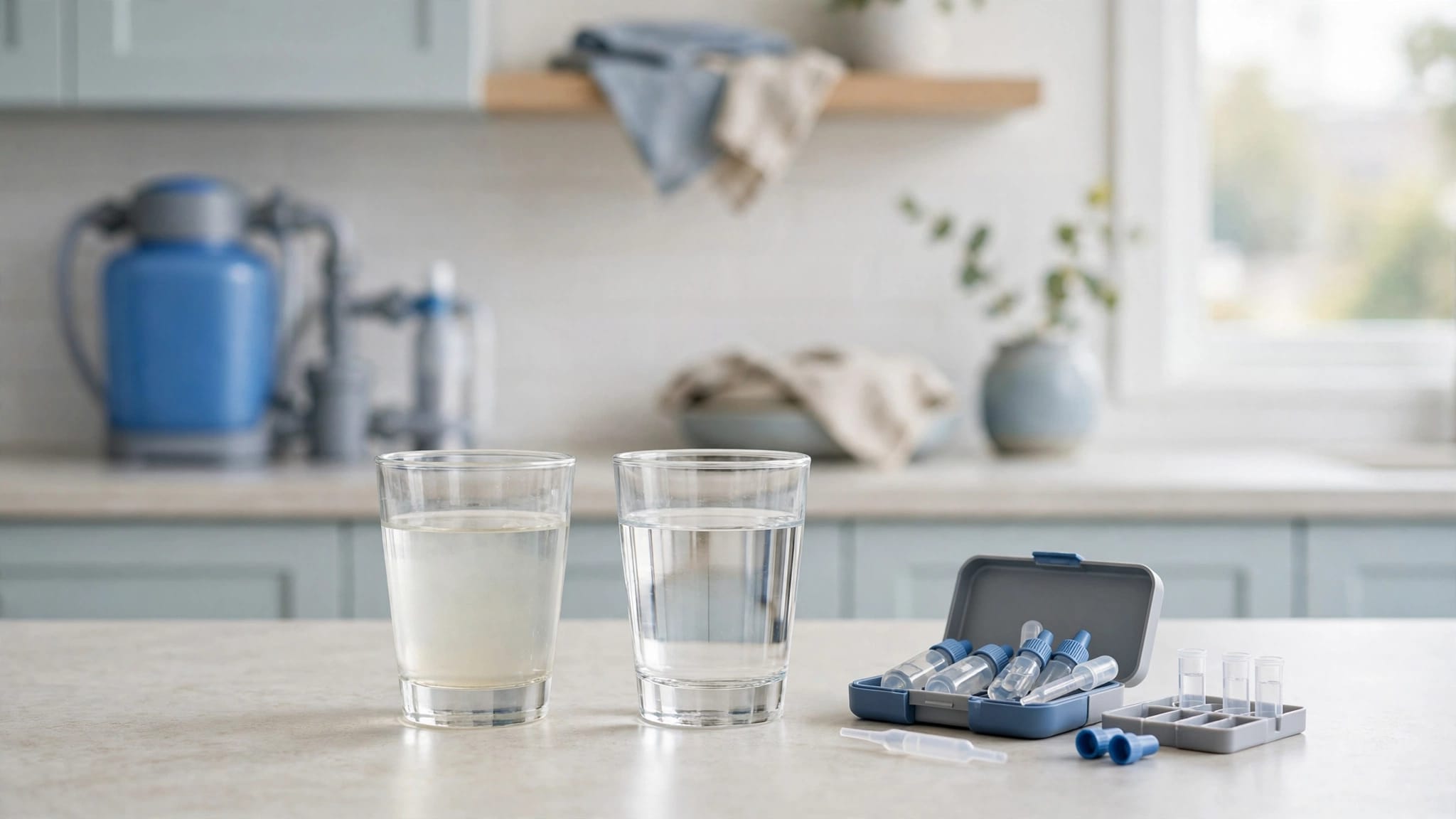
A certified filter can't identify the problem in your water. It only treats water according to its design and certified claims. If your home has a private well, recent plumbing work, unusual taste or odor, staining, or a known local concern, water testing should come first.
Municipal water customers can review available utility testing information, but a household test may still help with a filter decision. Private well owners should use a qualified laboratory and choose treatment based on the results. A basic test strip may not measure the contaminants that matter most.
NSF standards explained in plain language
The standard number gives you a starting point, but it doesn't tell the whole story. You still need to check the exact contaminant claim attached to the product.
| Standard | What it generally covers | Common examples |
|---|---|---|
| NSF/ANSI 42 | Aesthetic effects | Chlorine, taste, odor, particulates |
| NSF/ANSI 53 | Health-related contaminant claims | Lead, cysts, and other listed contaminants |
| NSF/ANSI 58 | Reverse osmosis systems | Contaminant reduction by RO units |
| NSF/ANSI 401 | Emerging or incidental compounds | Certain pharmaceuticals and pesticides |
| NSF/ANSI 55 | Ultraviolet treatment systems | Microbiological treatment claims |
| NSF P473 | Certain PFAS claims | PFOA and PFOS reduction listings |
The table helps narrow your search, but the product record controls the final answer. Standards can include many possible claims, and a filter may be certified for only some of them.
NSF/ANSI 42 and 53 cover different concerns
NSF/ANSI 42 addresses aesthetic effects. A filter certified under this standard may improve chlorine taste, odor, or visible particulate matter. Those changes can make water more pleasant to drink, but they don't prove the filter reduces lead, nitrate, bacteria, or other health-related contaminants.
NSF/ANSI 53 covers health-related contaminant claims. Lead and cyst reduction are common examples, but the product must list the specific claim. A filter certified under 53 isn't automatically certified for every contaminant included within the standard.
Lead deserves careful attention in older homes. Look for the exact model's lead-reduction claim, follow the rated capacity, and replace the cartridge on time. A general NSF statement isn't enough.
Reverse osmosis and newer treatment categories
NSF/ANSI 58 applies to reverse osmosis systems. RO uses a semipermeable membrane to reduce many dissolved substances, but the system still needs the correct pretreatment, water pressure, storage, and maintenance. High total dissolved solids, or TDS, may support an RO discussion, although TDS alone doesn't identify which substances are present.
NSF/ANSI 401 covers selected emerging or incidental contaminants, such as certain pharmaceuticals and pesticides. NSF P473 appears in certified-product listings for certain PFOA and PFOS reduction claims. A UV system falls under NSF/ANSI 55, but the listing determines which microbiological claim and operating conditions apply.
Bacteria and viruses aren't blanket claims for ordinary carbon filters. UV, specialized disinfection equipment, and other treatment methods have different requirements. If microbiological contamination is possible, test the water and review the exact treatment listing before relying on a filter.
Match the certified claim to your water concern
The right filter depends on what you need to reduce. Buying a product because it has a long list of marketing claims can leave you with the wrong equipment and a missed contaminant.
A good selection process begins with four questions:
- What is in the source water?
- Which faucet or fixtures need treatment?
- What certified claim addresses the concern?
- What capacity, flow rate, and replacement schedule fit the household?
A kitchen pitcher, under-sink carbon filter, whole-house carbon system, RO unit, and UV system solve different problems. Whole-house treatment may be appropriate when you want filtered water at multiple fixtures. An under-sink system may make more sense when the concern involves drinking and cooking water only.
City water and well water need different planning
City water commonly leads homeowners to ask about chlorine taste, odor, sediment, or lead from household plumbing. A certified carbon filter may address some of those concerns, but only when its listing includes the relevant claim.
Well water requires more investigation. Iron, hardness, sulfur odor, sediment, bacteria, nitrate, and dissolved solids can require different equipment. A water softener handles hardness, but it isn't a general-purpose filter. RO can reduce many dissolved substances, while UV treatment addresses a different type of concern.
If you're comparing equipment for a private well, review this guide to choosing the right whole-house RO system size. System capacity depends on water quality, household demand, storage, pressure, and pretreatment.
A certified claim has operating limits
Certification tests a product under stated conditions. Those conditions may include water pressure, flow rate, temperature, capacity, installation method, and cartridge life. Your home's results can differ if the system operates outside those limits.
For example, a filter may have a certified lead claim for a certain number of gallons. Once it reaches that capacity, the cartridge needs replacement even if the water still flows normally. A clogged sediment cartridge can also lower flow and place more strain on downstream equipment.
How to verify NSF certified water filters
Don't rely on a logo alone. Use NSF's public certified-products search to review the exact product record before purchasing or installing a system.
Search by the manufacturer and full model number. Then check:
- The product's current listing status.
- The NSF/ANSI standard or standards shown.
- The exact contaminant-reduction claims.
- Rated capacity and flow information.
- Any required installation or component limits.
- Replacement parts identified for the certified system.
Model numbers can differ by size, cartridge type, region, or system configuration. A product page may show several similar models, but certification for one version doesn't automatically cover another.
Check the cartridge, housing, and complete system
Some certifications apply to a complete treatment unit. Others may relate to a cartridge used in a listed housing or configuration. Read the manufacturer's installation instructions and the certification record together.
Replacing a certified cartridge with a generic part may change the system's performance. The substitute may fit physically but lack the same materials, capacity, or testing history. The same caution applies to RO membranes, UV lamps, flow restrictors, and other components.
Installation also affects results. Incorrect tubing, reversed connections, insufficient pressure, poor sanitation, or an improper drain connection can reduce performance. A professional installer can confirm that the system matches the home's plumbing and water conditions.
Maintenance protects the filter's performance
Certification doesn't remove the need for routine care. Filters collect or reduce contaminants over time, and cartridges eventually reach their rated capacity. Waiting until the water tastes bad can mean the system has already passed its recommended service point.
Follow the product manual for cartridge changes, flushing, sanitation, and storage. Keep a simple record of installation dates and replacements. If your water contains heavy sediment, the schedule may be shorter than the general recommendation.
For whole-house RO equipment, replacing sediment and carbon prefilters helps protect the membrane and maintain water flow. Prefilters often need attention every 3 to 6 months as a starting point, but water quality and household use determine the actual interval.
Watch for changes in system behavior
A sudden pressure drop, unusual taste, leaks, unusual noise, or a rising TDS reading can indicate a maintenance problem. A cloudy cartridge or visible sediment may also show that source-water conditions have changed.
Don't keep using a system after a cracked housing, failed seal, damaged UV lamp, or suspected contamination event. Shut it down according to the manual and arrange inspection or service. Repairs should use compatible parts and preserve the system's intended configuration.
Know what NSF certification doesn't cover
NSF certification doesn't test the water entering your home. It doesn't remove contaminants that aren't listed for the product. It doesn't guarantee performance after an overdue cartridge, incorrect installation, or unapproved component change.
It also doesn't mean every water-treatment product on your property has the same certification. A drinking-water filter, water softener, pump, and lake fountain have different purposes and evaluation requirements. Choose equipment according to its job, then confirm the claims that matter for that application.
Conclusion
NSF certified water filters give homeowners a reliable way to compare products, but the certification only supports the claims attached to the exact model. NSF/ANSI 42 may address chlorine taste and odor, while 53, 58, 401, 55, or P473 cover different treatment needs and specific listings.
Start with water testing when the concern is unknown. Match the certified contaminant claim to that result, install the system correctly, and replace components on schedule. A filter label is useful when you treat it as a precise performance record, not a promise to remove every contaminant.
Latest posts
Read Our Blog
Tips, guides, industry best practices, and news.
Contact us
Get in touch
Our friendly team is ready to chat.