
Sulfate Removal From Well Water With Whole-House RO
A sulfate removal well water system can improve taste and reduce dissolved minerals throughout a Florida home, but the right design depends on more than one test result. Whole-house reverse osmosis (RO) can reduce sulfate, yet it also requires pretreatment, storage, pressure, maintenance, and a legal plan for concentrate disposal.
Florida private wells vary widely, even between neighboring properties. A laboratory analysis should guide the equipment choice, while local site conditions determine whether the system will work reliably. Here is what Florida homeowners should know before choosing whole-house RO for sulfate removal.
Sulfate Removal Well Water Systems: What the Numbers Mean
Sulfate is a naturally occurring dissolved mineral. It can enter groundwater through local geology, fertilizers, soil minerals, and other sources. Unlike sand or rust particles, sulfate stays dissolved in water, so a basic sediment filter cannot remove it.
Florida's sulfate benchmark
The Florida Department of Environmental Protection lists 250 milligrams per liter (mg/L) as a secondary drinking-water standard for sulfate. This is an aesthetic benchmark, not a primary health limit. It relates to water characteristics such as taste, odor, staining, and possible corrosivity.
For a private-well owner, that number is useful for interpreting a lab report. It isn't a universal order that every home must meet, and it shouldn't be treated as a diagnosis of unsafe water. Your household's needs, the water chemistry, and the intended uses of the water all matter.
Sulfate is different from other well contaminants
Sulfate isn't the same as hydrogen sulfide, the compound often associated with a rotten-egg odor. It also differs from chloride, hardness, iron, manganese, bacteria, nitrate, and arsenic.
A water softener primarily exchanges hardness minerals such as calcium and magnesium. It doesn't provide the same treatment as RO for sulfate. Iron and manganese may stain fixtures or foul equipment, while bacteria and nitrate require separate attention. High total dissolved solids (TDS) can indicate a broad mineral load, but TDS alone won't identify sulfate or tell you which treatment is needed.
A sulfate result should be read with the rest of the laboratory report, not treated as a standalone equipment specification.
How Whole-House RO Removes Sulfate
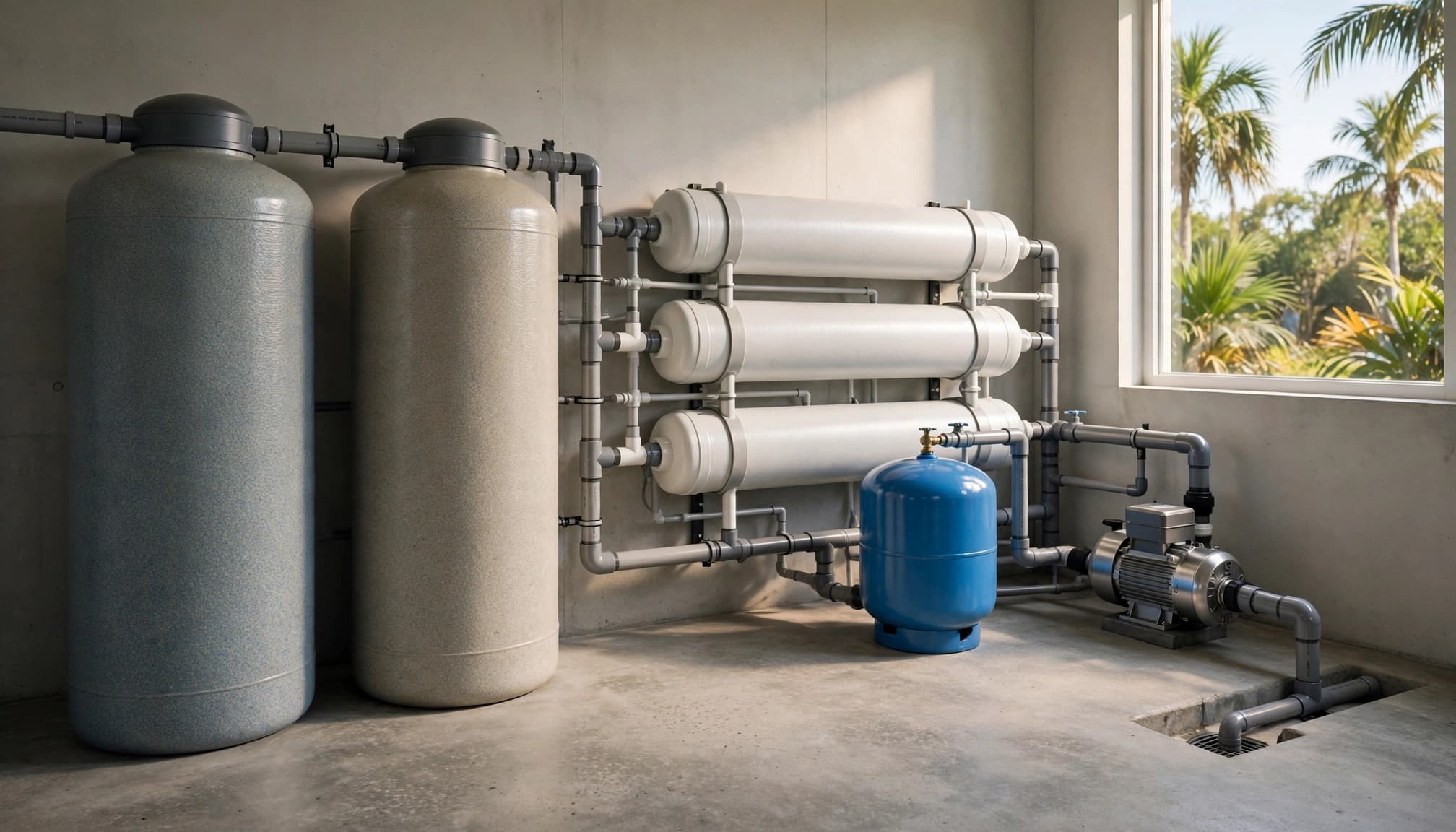
Whole-house RO pushes pretreated water across a semipermeable membrane. The membrane separates much of the dissolved mineral content into two streams: treated water and concentrate. The treated water goes to a storage tank or distribution system, while the concentrate requires a planned discharge route.
RO is often a strong option when sulfate is part of a larger dissolved-mineral problem. However, the equipment must be sized for the home's daily demand. A point-of-use drinking-water unit and a whole-house system operate on very different scales.
Why storage and pressure matter
RO membranes produce water gradually. A whole-house installation often needs a treated-water storage tank, controls, and a delivery pump so showers, toilets, appliances, and faucets can receive water at usable pressure.
The well pump must also provide enough flow for pretreatment, membrane operation, backwashing, and household demand. A system selected only from the sulfate number may perform poorly if the pump, pressure tank, plumbing, or electrical service cannot support it. Review well pump flow rate for water treatment before choosing equipment.
Whole-house RO is a treatment train
A dependable installation may include a sediment filter, iron or manganese treatment, softener, carbon filter, RO membranes, storage, a booster pump, and disinfection controls. The final arrangement depends on the lab results.
Whole-house RO also takes more space than a small under-sink unit. The installer needs room for tanks, membrane housings, valves, controls, drain connections, and service access. A site inspection can reveal problems that a water report cannot.
Test the Well Before Selecting Equipment
Testing is the most important step in sulfate removal for Florida well water. It helps separate a sulfate problem from a hardness issue, iron staining, bacterial contamination, or a broader high-TDS condition.
Ask for a useful laboratory panel
A basic test for this project may include sulfate, chloride, TDS, hardness, pH, alkalinity, iron, manganese, turbidity, and bacteria. Depending on the property and local history, nitrate, arsenic, copper, hydrogen sulfide, and other parameters may also be appropriate.
Use a laboratory that provides sampling instructions and reports results in clear units. Sampling technique matters. A contaminated bottle, an improperly flushed tap, or a sample taken after treatment can produce misleading results.

The report does not answer every design question
A lab result won't show whether your well pump can maintain the required flow. It also won't determine where a storage tank fits, how concentrate can be discharged, or whether the home's electrical system can support a booster pump.
Water temperature, pipe size, pressure settings, family size, irrigation demand, and simultaneous water use affect system sizing. The condition of existing plumbing matters, too. If a home has galvanized pipes, old pressure tanks, or recurring leaks, those issues may need attention before installing new treatment equipment.
For help matching equipment to demand, review sizing a whole-house reverse osmosis system.
Plan Pretreatment Around the Well Chemistry
RO membranes work best when the incoming water is prepared for them. Pretreatment isn't an optional collection of add-ons. It protects the membrane and helps the complete system maintain flow and water quality.
Hardness can cause scale
Calcium and magnesium can form scale as water passes through an RO membrane. A softener may reduce that scaling load when hardness is significant. In other cases, an antiscalant program or another design may be more appropriate.
A softener still isn't a sulfate-removal system. It may be one stage before RO, especially when the well has both hard water and elevated dissolved minerals. See whole-house reverse osmosis versus a water softener for the practical difference between these systems.
Iron, manganese, and sediment need separate attention
Sediment can clog prefilters and restrict flow. Iron can stain laundry, sinks, and fixtures, while manganese may create dark staining, metallic taste, and equipment fouling. The correct treatment depends on concentration, pH, oxidation state, and whether the material is dissolved or particulate.
An oxidation filter, chemical injection system, specialty media, or another stage may be needed before RO. A softener may tolerate a limited amount of clear-water iron, but that doesn't make it a complete iron-removal system. Learn when iron filtration before whole-house RO belongs in the design.
If bacteria are present, the system may require disinfection and sanitary storage practices. If chlorine or another disinfectant is added, membrane compatibility must be checked. Some membranes require dechlorination, while other equipment choices may tolerate different conditions.
Account for Water Waste and Concentrate Disposal
Whole-house RO creates concentrate because the membrane separates treated water from water carrying the rejected minerals. The amount varies with membrane design, water chemistry, pressure, temperature, recovery settings, and demand.
Never assume that concentrate can be sent to any convenient drain. A designer should evaluate the drain line, septic or wastewater arrangement, local soil, property layout, and the chemical character of the discharge.
Florida has specific regulatory frameworks for some disposal methods. Deep-well injection of RO concentrate can require a Class I or Class V underground injection control permit, depending on the installation. A domestic wastewater treatment plant may have statutory provisions for receiving concentrate under defined conditions, including a provision tied to 20% of the plant's annual average daily flow. That framework doesn't automatically approve a residential discharge.
Reuse systems may also require engineering documentation showing that the blended water will meet applicable standards and protect vegetation, health, and system operation. Verify Florida requirements and county rules before installation. Local authorities may have additional requirements for plumbing, drainage, electrical work, septic systems, or discharge locations.
Size the System for Real Household Use
A system that produces enough water for drinking alone may be too small for a whole home. Start with the number of residents, bathrooms, peak use, irrigation separation, appliances, and the well's recovery rate.
Whole-house RO may need treated-water storage so the membrane can operate during lower-demand periods. A booster pump can restore pressure after the storage tank, but it adds electrical, control, and maintenance requirements. The pressure tank and well pump must work with the treatment controls rather than fight them.
High TDS, sulfate, hardness, silica, iron, and alkalinity can all affect membrane conditions. Review high-TDS whole-house RO design when the test shows a heavy dissolved-mineral load. The design should account for membrane protection, not only the desired finished-water result.
Maintain the System and Verify Performance
Whole-house RO needs regular service. Sediment and carbon filters require replacement according to pressure drop, capacity, and incoming water quality. Pretreatment media may need backwashing, chemical replenishment, cleaning, or periodic replacement.
A technician should track feed pressure, treated-water flow, concentrate flow, and permeate TDS. A rise in treated-water TDS or a drop in production can point to fouling, scale, low pressure, a damaged membrane, clogged prefilters, or a control problem.
Storage tanks and treated-water plumbing also need sanitary care. Test the water after installation and after major well work, flooding, pump replacement, or a noticeable change in taste or odor. Keep service records so changes in performance can be compared over time.
Key Takeaways
- Florida's 250 mg/L sulfate value is a secondary, aesthetic-based benchmark, not a universal private-well health limit.
- Whole-house RO can reduce sulfate, but it needs suitable pretreatment, storage, pressure, and concentrate management.
- A laboratory panel should include sulfate and related water-quality factors, not sulfate alone.
- Hardness, iron, manganese, sediment, disinfectants, and bacteria may require separate treatment stages.
- Well-pump capacity and daily household demand affect system size.
- Concentrate disposal may require engineering review, permits, or county approval.
- Local Florida and county requirements should be checked before construction or discharge work.
Frequently Asked Questions
Does a water softener remove sulfate from well water?
A standard water softener is designed mainly for hardness minerals. It may be useful before RO when calcium and magnesium could cause scale, but it shouldn't be selected as the primary sulfate-removal method.
Is sulfate above 250 mg/L dangerous?
Florida's 250 mg/L value is a secondary drinking-water standard tied to aesthetic and operational concerns. It isn't the same as a primary health limit. Ask a qualified laboratory or water professional to interpret the complete report, especially if infants, people with medical conditions, or other sensitive household members use the water.
Does whole-house RO remove iron and manganese?
RO can reduce some dissolved contaminants, but high iron and manganese can foul or damage pretreatment and membranes. The system may need dedicated iron or manganese filtration before the RO stage.
How much water does whole-house RO waste?
There is no universal waste ratio. Recovery depends on membrane selection, feed pressure, temperature, water chemistry, controls, and operating settings. The installer should calculate expected concentrate and identify an approved disposal route before installation.
Can RO concentrate go into a septic system?
Don't assume that it can. Concentrate may carry elevated dissolved minerals, and the effect depends on the septic system, soil, site conditions, and local requirements. Have the proposed discharge reviewed before connecting it.
Conclusion
Sulfate removal for Florida well water begins with testing, not equipment selection. Whole-house RO may be a good fit when sulfate occurs with high TDS or other dissolved minerals, but the system must also address hardness, iron, manganese, sediment, pressure, storage, maintenance, and concentrate disposal.
A well-designed system matches the actual water chemistry and the home's daily demand. With laboratory results and a site-specific review, homeowners can choose treatment that improves water quality without treating every well as if it had the same problem.
Latest posts
Read Our Blog
Tips, guides, industry best practices, and news.


Contact us
Get in touch
Our friendly team is ready to chat.