
How to Calculate Pond Fountain Operating Costs in Florida
A fountain's electric bill is easier to estimate than many Florida pond owners expect. Once you know the pump's wattage, daily runtime, and electricity price, you can calculate pond fountain operating costs in a few lines.
The estimate won't be identical for every property. A decorative backyard pond, an HOA retention pond, and a larger lake fountain may have different pumps, schedules, maintenance needs, and utility rates.
Start with the equipment label and your latest electric bill, then adjust for Florida's heat, storms, and seasonal pond conditions.
Key Takeaways
- A fountain's electricity use depends on its wattage and the hours it runs each day.
- Convert watts to kilowatts by dividing the label's wattage by 1,000.
- Multiply kilowatts by operating hours to find kilowatt-hours, then multiply by your electric rate.
- The EIA reported a Florida residential electricity average of 15.10 cents per kWh for June 2026. Your utility bill may be higher or lower.
- A timer can reduce electricity use, but run time should match the pond's circulation, aeration, appearance, and algae-management needs.
- Cleaning intake screens and nozzles helps a fountain maintain its intended spray and can prevent avoidable repair costs.
What Drives Pond Fountain Operating Costs?
The pump is the primary source of electricity use. However, its nameplate wattage tells only part of the story. A fountain that runs around the clock uses more energy than the same unit on a nighttime or daylight-only schedule.
Pump wattage sets the baseline
Check the fountain pump's equipment label, manual, or controller documentation for watts. If it lists amps instead, don't estimate wattage unless the manufacturer provides the correct conversion for that model.
A 350-watt fountain uses 0.35 kilowatts. A 1,000-watt unit uses 1 kilowatt. Therefore, a larger motor generally adds more to monthly electricity use when both fountains run for the same number of hours.
Pump efficiency also matters. A clogged intake, damaged impeller, mineral buildup, or restricted nozzle can reduce the visible display while the equipment still draws power.
Runtime changes the result fast
A 350-watt fountain running 24 hours per day consumes 8.4 kWh daily. The same fountain running 10 hours per day consumes 3.5 kWh daily.
That difference adds up over a month. Before setting a timer, consider why the fountain is operating. Some property owners need a display during evening gatherings. Others prioritize daytime appearance, water movement, or aeration.
Your electric provider and billing plan matter
Florida has many electric providers, including investor-owned utilities, municipal utilities, and electric cooperatives. Their rates, fees, fuel charges, taxes, and tiered pricing can differ.
Use the price per kWh shown on your own bill whenever possible. That produces a more useful estimate than a statewide average.

The Formula for Pond Fountain Operating Costs
The calculation uses kilowatt-hours, the same unit shown on residential and commercial electric bills. Keep the wattage, hours, and utility rate in separate steps to avoid mixing units.
Convert watts to kilowatts
Use this formula:
Kilowatts = fountain watts / 1,000
For example:
350 watts / 1,000 = 0.35 kW
If the label says 1,200 watts, the calculation is 1.2 kW. Use the actual rated wattage, rather than choosing a number based on pond size or spray height.
Calculate energy use and cost
Next, multiply kilowatts by runtime:
Daily kWh = kW x hours operated per day
Then multiply energy use by your electricity price:
Cost = kWh x electricity rate per kWh
This example uses a 350-watt fountain running 24 hours daily and an electricity price of $0.151 per kWh.
| Calculation | Formula | Example result |
|---|---|---|
| Convert pump draw | 350 watts / 1,000 | 0.35 kW |
| Daily energy use | 0.35 kW x 24 hours | 8.4 kWh |
| Daily operating cost | 8.4 kWh x $0.151 | $1.27 |
| Monthly energy use | 8.4 kWh x 30 days | 252 kWh |
| Monthly operating cost | 252 kWh x $0.151 | $38.05 |
| Annual operating cost | 8.4 kWh x 365 days x $0.151 | $462.97 |
The table estimates electricity for the pump only. It doesn't include installation, service calls, replacement parts, water added to offset evaporation, or a utility's fixed customer charges.
A rate estimate is most accurate when it uses the wattage printed on the fountain equipment and the per-kWh price on the same bill that powers it.
Using Florida Electricity Prices Without Guessing
A statewide number can help with early budgeting. Still, your bill is the number that matters when you choose a fountain schedule or compare equipment.
The Florida residential average
The U.S. Energy Information Administration reported an average Florida residential electricity price of 15.10 cents per kWh in June 2026 . That figure is a useful planning benchmark, not a guaranteed rate for every Florida address.
Using that price, a 350-watt fountain operating 10 hours per day would cost about $15.86 for 30 days. The same unit operating 24 hours per day would cost about $38.05 for 30 days.
For a community pond on a commercial account, residential averages may not apply. Pull the actual rate from the association's electric invoice.
FPL pricing is provider-specific
Florida Power & Light's RS-1 residential schedule, effective September 2026, lists a $10.52 monthly base charge. It lists energy charges of 7.865 cents per kWh through 1,000 kWh and 8.865 cents per kWh above that level, plus a $30 minimum base bill.
Those figures are not a statewide Florida rate or a complete estimate of every FPL bill. Billing components and consumption tiers can affect the final amount. A fountain may also push household use into a higher tier, so review the full bill before using a single rate for annual planning.
Continuous Operation Versus a Timer Schedule
A 24-hour schedule provides consistent movement and a constant visual display. It also produces the highest electrical cost for that fountain's wattage.
Scheduled operation reduces run hours, but the right schedule depends on the waterbody and the property owner's goals.
When continuous operation may fit the pond
A community entrance pond or highly visible lake may need a regular display all day and night. Some ponds also use fountain operation as one part of a broader aeration and circulation plan.
Florida heat and strong sun can encourage algae growth, especially when nutrients enter the pond through fertilizer runoff, decaying vegetation, or waste. UF/IFAS notes that aeration can increase oxygen and may help limit algae growth, but it doesn't remove the need for water-quality management.
When a timer can make sense
A timer may suit a decorative home pond where the fountain is mainly enjoyed during certain hours. It can also reduce nighttime sound near homes and lower the energy estimate in direct proportion to reduced runtime.
For example, cutting a 350-watt fountain from 24 hours to 12 hours reduces monthly use from 252 kWh to 126 kWh. At $0.151 per kWh, the estimated monthly pump cost falls from $38.05 to $19.03.
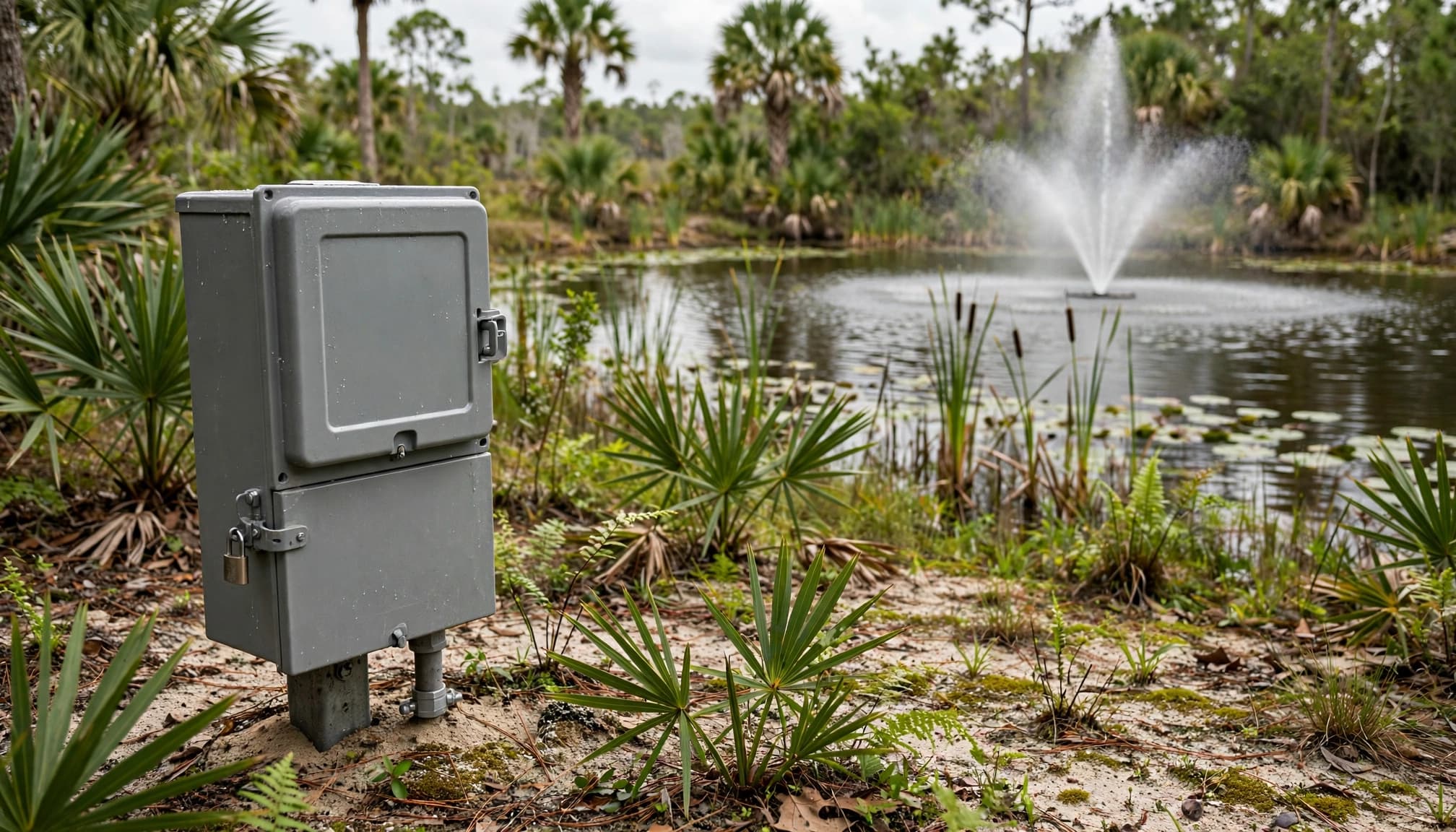
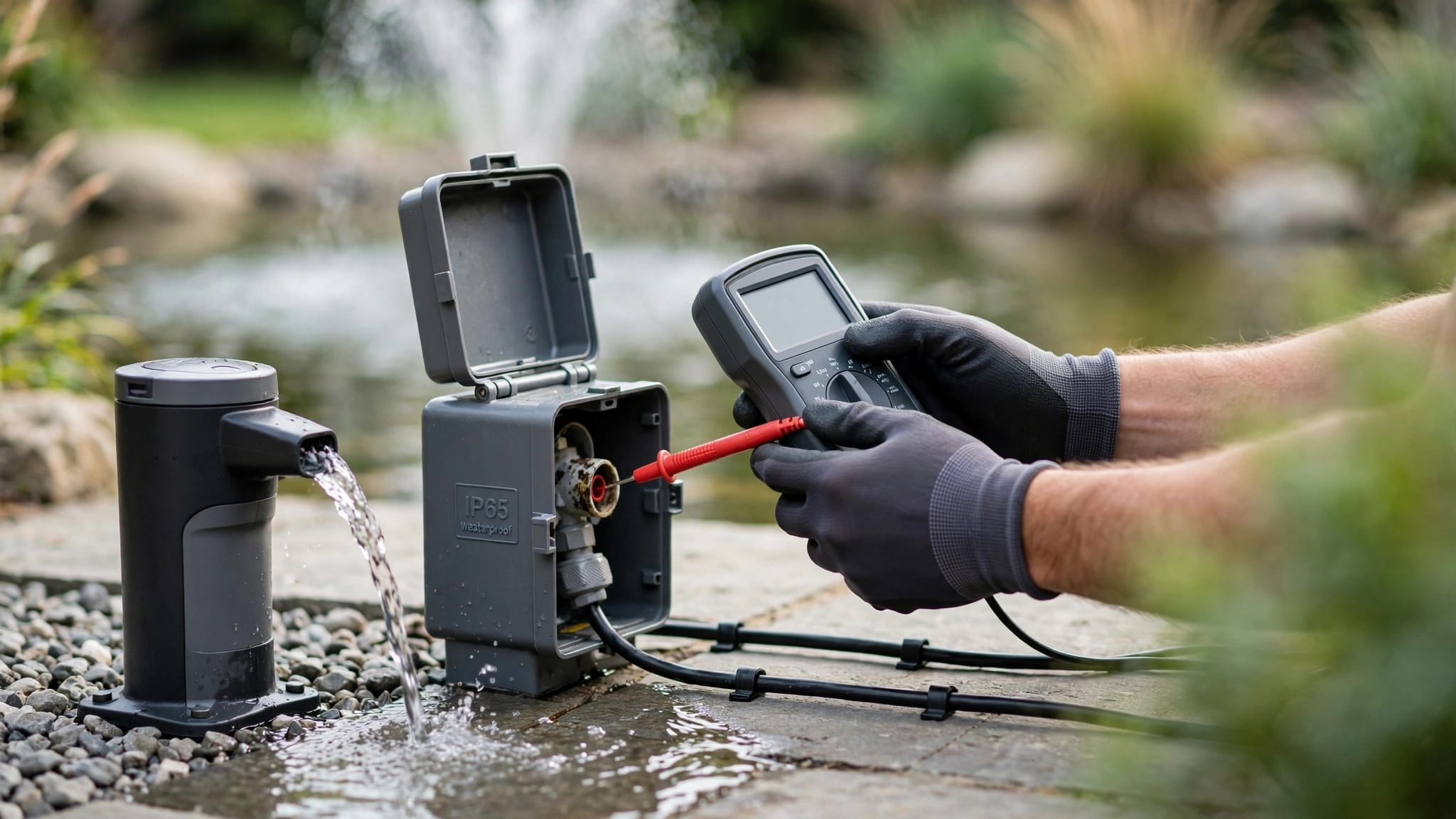
Outdoor controls need weather-rated protection and safe electrical installation near water. If a pump repeatedly trips a breaker, don't treat the issue as a scheduling problem. Review the warning signs in this guide to fountain pump breaker problems.
Florida Conditions That Add to Ownership Costs
Electricity is only one part of running a pond fountain. Florida's climate can change cleaning frequency, water levels, and the risk of weather-related equipment damage.
Heat, sunlight, and algae buildup
Warm water and abundant sunlight support algae growth in Florida ponds. Rain can also carry nutrients into the water, increasing bloom potential after runoff events.
Algae and floating debris can clog screens and interfere with a clean spray pattern. Inspect the intake and nozzle regularly, especially after heavy rain or periods of rapid plant growth. A fountain that looks weak may need cleaning or repair rather than more operating hours.
A practical Florida lake fountain maintenance checklist can help property managers track spray quality, water level, cable condition, and recurring service needs.
Evaporation and falling water levels
High temperatures, wind, low humidity, and solar exposure affect evaporation. Fountain spray can add more water exposure to air, yet there is no single evaporation rate that fits every pond.
Check water level before the pump runs dry or begins drawing air. A low water level can affect performance and may damage equipment. Record water added during dry periods, then treat that water use as a separate cost from the fountain's electrical use.
Tropical storms and electrical safety
Florida storms bring high winds, heavy rain, flooding, and lightning risk. Inspect anchors, mooring lines, cords, shore connections, and controls well before tropical weather arrives.
After a storm, look for shifted equipment, frayed cable, submerged controls, unusual vibration, or a changed spray pattern. A qualified technician should inspect compromised electrical components before restarting the fountain.
Add Maintenance and Access to Your Budget
A low monthly power estimate doesn't guarantee low long-term ownership costs. Service access, fountain placement, cleaning requirements, and replacement parts all affect the total.
Maintenance protects performance
Regular cleaning helps water flow through the intake and nozzle as intended. It can also reveal early problems, such as worn hardware, damaged cables, or a pump that has lost output.
Grinding sounds, persistent vibration, repeated breaker trips, and uneven spray need prompt attention. Delaying repair can turn a small service visit into a pump or electrical replacement.
Property owners who need installation, seasonal inspection, or repair support can review lake fountain installation services for Southwest Florida systems.
Floating and fixed systems have different service needs
A floating fountain may be harder to retrieve if it sits far from shore. A fixed fountain can be easier to access when the pump and controls are close to the bank, though the initial site work may require more planning.
Neither design automatically costs less to own. Compare power draw, installation requirements, access for cleaning, and expected service needs before choosing equipment. This comparison of floating versus fixed pond fountains helps clarify the tradeoffs.
Frequently Asked Questions
How do I find my fountain's wattage?
Look for a label on the pump, motor housing, controller, or product documentation. Use the listed watts in the calculation. If the label is missing or unreadable, contact the manufacturer or a fountain service professional rather than guessing.
Should a Florida pond fountain run all day?
The right schedule depends on the pond's size, water quality, appearance goals, and equipment plan. Continuous operation costs more, while a timer lowers use. Choose a schedule after considering circulation, algae conditions, and the property's needs.
Does a larger pond always cost more to aerate?
Not automatically. Pond shape, depth, fountain design, pump rating, and required spray pattern all affect equipment selection. A pond's surface acreage alone can't determine electric cost.
A Clear Estimate Starts With Real Numbers
Accurate pond fountain operating costs come from three details: the pump's rated watts, its actual daily runtime, and the electricity price on your bill. Use those numbers to compare schedules before assuming a fountain must run continuously.
Florida heat, runoff, evaporation, and storms can change maintenance needs, so keep electricity estimates separate from total ownership costs. A well-maintained fountain is easier to budget because its performance is easier to monitor.
Latest posts
Read Our Blog
Tips, guides, industry best practices, and news.

Contact us
Get in touch
Our friendly team is ready to chat.