
Floating Fountain Anchoring Methods for Retention Ponds
Floating fountain anchoring affects more than the fountain's appearance. A unit that drifts, rotates, or pulls against its cable can lose its spray pattern, damage equipment, and become harder to service.
Retention ponds vary widely in depth, sediment, shape, exposure, and water-level movement. The right anchoring method depends on those conditions, along with the fountain's size, pump force, maintenance plan, and manufacturer requirements. A careful site assessment should come before installation.
Why anchoring matters in a retention pond
A floating fountain needs to stay within its intended operating area. Its position affects the spray display, circulation pattern, electrical cable route, and access for future service.
Position affects performance and safety
A fountain that shifts toward a bank, dock, seawall, or drainage structure may face debris strikes or restricted water flow. Movement can also place stress on the float assembly, mooring lines, shackles, and underwater cable.
The fountain's location should support the owner's goal. A central unit may improve visual coverage and circulation across an open pond, while a smaller fountain near a visible shoreline may serve a primarily decorative purpose. Pond acreage alone cannot determine the correct layout. Depth, shape, sediment, and the amount of water that needs circulation also matter.
The lake fountain anchoring guidelines recommend matching mooring lines to the fountain manufacturer's design. That requirement matters because line length, attachment points, and tension all affect how the fountain responds to wind and changing water levels.
Exposure changes the load on the system
A pond with a long open fetch can develop more wave action than a sheltered basin. Wind pushes against the fountain, mooring lines, and spray. Storms can add floating branches, leaves, and other debris.
Water levels create another concern. Heavy rain, drainage changes, evaporation, and seasonal conditions can alter the distance between the fountain and the pond bottom. A system that works at one water level may develop excessive tension or too much slack after a major change.
Before selecting an anchor, document:
- Normal and low operating depth
- Expected water-level changes
- Wind direction and open-water exposure
- Pond shape and shoreline structures
- Sediment depth and firmness
- Fountain size and expected thrust
- Equipment retrieval and service access
Floating fountain anchoring methods for different sites
No single method suits every retention pond. The main choices include submerged deadweight anchors, embedded anchors, engineered shoreline connections, and manufacturer-designed multi-point mooring systems.
Submerged deadweight anchors
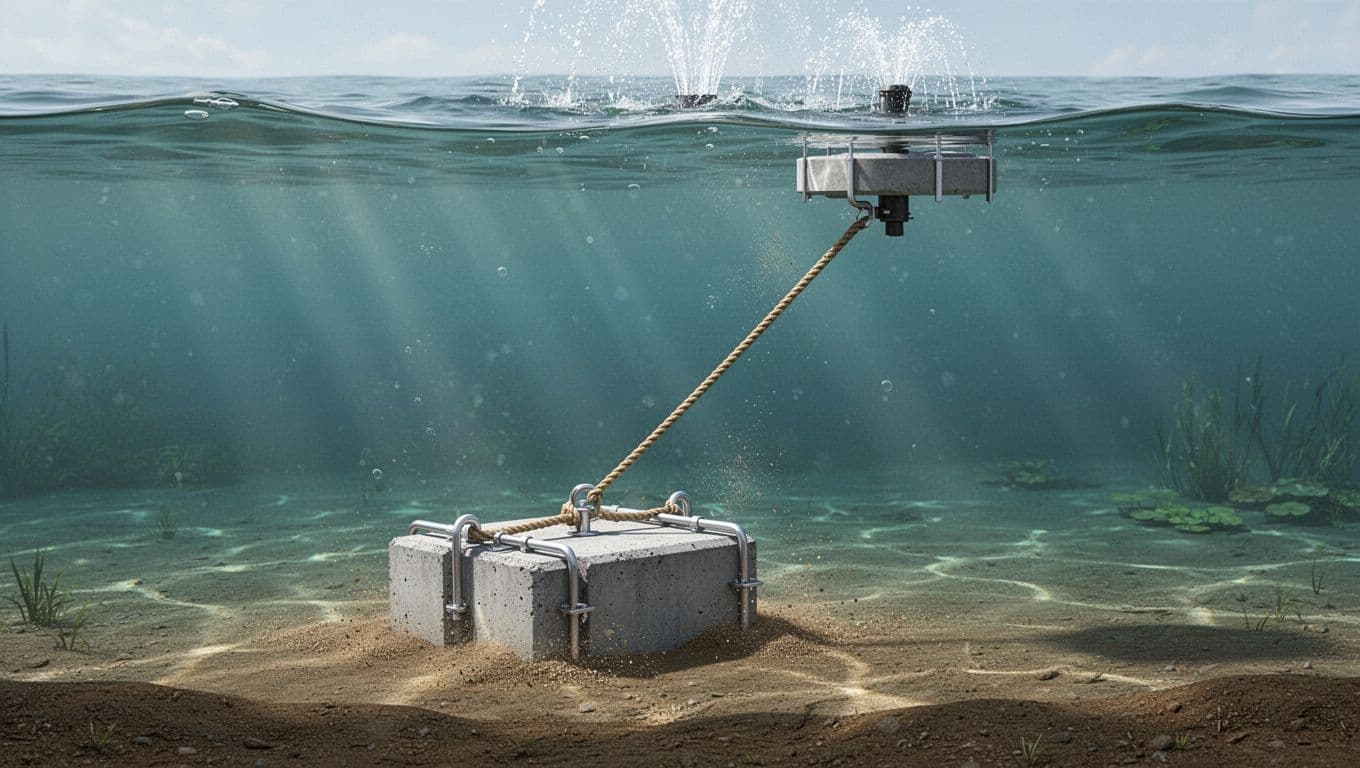
A deadweight anchor rests on the pond bottom and resists movement through its mass and contact with the sediment. This approach can be considered where driven or embedded anchors are impractical, but it still requires careful design.
Soft sediment may allow a weight to settle, tilt, or shift. Dense vegetation, accumulated muck, or a sloped bottom can also reduce stability. The anchor must be sized and shaped for the fountain, water conditions, and expected forces. The manufacturer's specifications or a qualified contractor should determine the acceptable configuration.
A deadweight system may simplify removal compared with a permanent underwater base. However, it still needs a retrieval plan, suitable connection hardware, and enough clearance to prevent contact with the fountain, intake, or cable.
Embedded and engineered anchor points
Screw, helical, or other embedded anchors can work where the pond bottom has suitable bearing material. These systems transfer pulling forces into the surrounding substrate rather than relying only on weight.
Loose muck, deep organic sediment, rock, or an unknown bottom profile can make installation difficult. Underwater installation may also require specialized equipment and a method for confirming that the anchor reached competent material.
Shoreline connections are another option in some designs, but the tie point must be structurally sound and positioned according to the manufacturer's layout. A tree, fence, dock rail, or lightweight landscape feature can move or fail before the fountain does. Those objects should never substitute for a designed anchor.
A multi-point layout can resist rotation and keep a fountain centered, but line count and attachment angles must follow the equipment design. Adding lines without checking the geometry can create uneven loading.
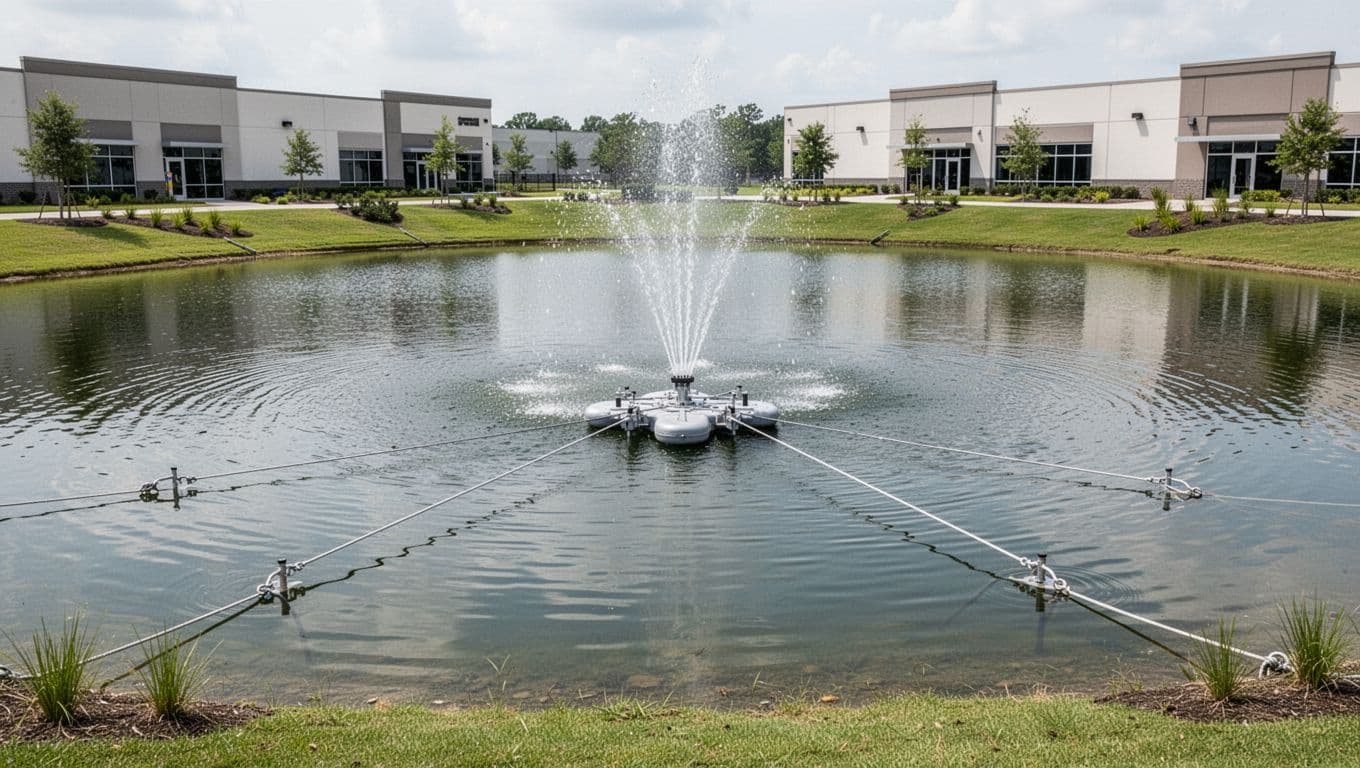
Match the method to pond conditions
The best anchoring decision starts with the pond, not the fountain catalog. Two retention ponds with the same surface area may need different systems because their bottoms, shorelines, and exposure differ.
Depth and changing water levels
Measure the depth at the proposed fountain location during normal operation. Check whether the site becomes shallow during dry weather or after planned drawdown. Shallow water can limit boat access, restrict anchor placement, and make it harder to remove the fountain safely.
Water-level changes also affect line geometry. A fixed-length line may become tight when the water drops or too loose when the pond rises. Adjustable systems may help, but the range of movement, line length, and tension still need to match the manufacturer's design.
A fountain should never be positioned where the intake could reach sediment during normal changes. Mud and debris can restrict the intake, reduce flow, and increase pump strain.
Sediment, wind, and fountain size
Sediment conditions determine whether the bottom can hold an embedded anchor or support a deadweight system. A contractor may need to inspect the substrate when the pond contains deep muck, construction fill, or uneven deposits.
Wind and wave exposure increase lateral forces. A broad pond with little shoreline protection may need a more robust mooring arrangement than a small basin surrounded by buildings or mature vegetation.
Fountain size also matters. A larger pump and spray pattern can produce greater thrust and wind resistance. The visual display should not be selected separately from the pond's circulation goals. If the fountain is too small for the basin, it may leave large areas untouched. If the equipment is oversized for the location, the anchoring system may face loads that the pond bottom cannot support.
For communities comparing installation types, the guidance on floating versus fixed pond fountains also highlights an important tradeoff: floating units can avoid the construction of a permanent underwater base, but they need water-based service access.
Anchoring components and installation best practices
Anchoring is a system, not a single weight or rope. Each component must work with the others under normal operation and during changing site conditions.
Select compatible hardware
A typical system may include:
- A submerged deadweight or embedded anchor
- Mooring lines sized for the fountain design
- Shackles, thimbles, swivels, and connection points
- Chafe protection where lines or cables could rub
- Float assemblies and lifting points
- Underwater electrical cable with appropriate strain relief
- A protected route from the fountain toward shore
Hardware should resist the pond's water chemistry and exposure. Corrosion around shackles, cable fittings, or connection points can weaken the system before damage becomes visible from shore.
Lines should remain clear of the intake, pump housing, float structure, and electrical cable. Repeated cable abrasion at one shoreline location may point to an anchor problem or an unsafe cable route, rather than a cable defect alone.
Set the system in a controlled sequence
Start with a site survey and mark the intended fountain location, anchor points, cable route, access path, and nearby structures. Confirm local requirements before work begins. Retention ponds may fall under property, drainage, electrical, environmental, or community rules that vary by location.
Installers should place or embed anchors according to the approved design. Lines need balanced tension, with enough movement for expected water-level changes but no unnecessary slack that allows the unit to drift.
After connecting the fountain, verify that it floats level and remains in position without pulling sharply in one direction. Check the spray pattern, intake clearance, cable movement, and line contact points. The system should also have a practical way to retrieve the fountain for cleaning or repair.
A qualified service provider can manage these details through professional lake fountain installation, especially when the pond has uncertain sediment, limited access, or significant storm exposure.
Inspect and maintain the complete system
A floating fountain needs inspection beyond the visible spray. Maintenance should cover the equipment, mooring system, cable route, and surrounding pond conditions.
Watch for movement and material damage
During calm weather, compare the fountain's position with its normal location. Changes in spray direction, uneven output, unusual vibration, or a unit that sits at an angle can indicate a mooring, float, intake, or pump problem.
Inspect accessible areas for:
- Frayed or stretched mooring lines
- Worn shackles or missing retaining hardware
- Cracked or waterlogged floats
- Corrosion around metal connections
- Cable cuts, abrasion, or loose connections
- Debris around the intake and nozzle
- Algae or mineral buildup affecting flow
The lake fountain cable and anchor inspection guidance recommends checking exposed cables, anchors, floats, lines, and hardware. Keep records of inspection dates, storm impacts, repairs, and any change in the fountain's normal position.
Plan for water-based service
A floating fountain may require a boat, waders, or another safe retrieval method. Offshore maintenance can take longer than service on a bank-mounted system, particularly when algae, leaves, or other debris collect around the intake.
Property managers should identify who can access the fountain, how power will be disconnected, and where the unit can be brought for cleaning. Electrical work and underwater cable inspection should follow safe procedures. A fountain that trips a breaker, shows damaged wiring, or continues to operate abnormally needs professional attention.
Common failure points and contractor warning signs
Anchoring problems often develop gradually. A line may chafe against a hard edge, a shackle may corrode, or sediment may allow an anchor to move. Storm conditions can expose weaknesses that were not obvious during calm weather.
A long fetch, changing water levels, exposed shorelines, docks, seawalls, and heavy debris all deserve extra attention. Review hurricane-safe fountain anchoring before tropical weather threatens the property. Storm preparation may involve securing, removing, or servicing the fountain according to the manufacturer's instructions. No anchoring system should be described as storm-proof without site-specific engineering.
Call a qualified contractor when:
- The fountain has shifted from its normal position
- Anchors appear to have dragged, settled, or buried
- Mooring lines are frayed, stretched, or rubbing
- Hardware has significant corrosion
- The spray remains weak after safe cleaning
- The pump trips electrical protection
- The pond bottom or water depth is uncertain
- Underwater access presents a safety risk
- The installation may require approval or structural work
Key takeaways
- Choose an anchor based on sediment, depth, water-level movement, wind, waves, and fountain size.
- Use the manufacturer's mooring layout rather than improvising line lengths or tie points.
- Keep lines and underwater cables separated, protected, and easy to inspect.
- Treat movement, uneven spray, corrosion, and cable abrasion as early warning signs.
- Plan retrieval and storm response before installation.
- Use a qualified contractor when the bottom is unstable, access is difficult, or electrical and underwater work are involved.
Floating fountain anchoring FAQ
Is a deadweight anchor suitable for every retention pond?
No. A deadweight may suit some sites, but soft or uneven sediment can allow it to settle or move. Wind exposure, fountain size, water depth, and expected forces must also be considered. The manufacturer or a qualified contractor should approve the design.
How many mooring lines does a floating fountain need?
The required number depends on the fountain model, layout, exposure, and manufacturer's specifications. A multi-point system can help control rotation, but adding lines without checking the attachment angles may create uneven tension.
Can I tie the fountain to a tree, fence, or dock rail?
No. Those structures may shift, flex, or fail before the fountain. Use an engineered anchor point or a designed submerged system that matches the fountain's installation requirements.
How often should the anchors and lines be inspected?
The schedule should reflect exposure, algae, leaf fall, water chemistry, storm activity, and the amount of public use around the pond. Inspect after severe weather and whenever the spray, position, vibration, or electrical behavior changes.
When should a property manager call for help?
Schedule professional service when the fountain moves, lines or cables show damage, hardware corrodes, the pump trips protection, or the pond bottom is difficult to assess. Underwater retrieval and electrical inspection should not be improvised.
Conclusion
Reliable floating fountain anchoring begins with the retention pond itself. Depth, sediment, wind, waves, water-level changes, fountain size, and maintenance access all influence the correct method.
A properly designed system keeps the fountain positioned, protects its cable and pump, and makes future service safer. When site conditions are uncertain, manufacturer specifications and qualified installation support provide a better foundation than a one-size-fits-all anchor.
Latest posts
Read Our Blog
Tips, guides, industry best practices, and news.

Contact us
Get in touch
Our friendly team is ready to chat.